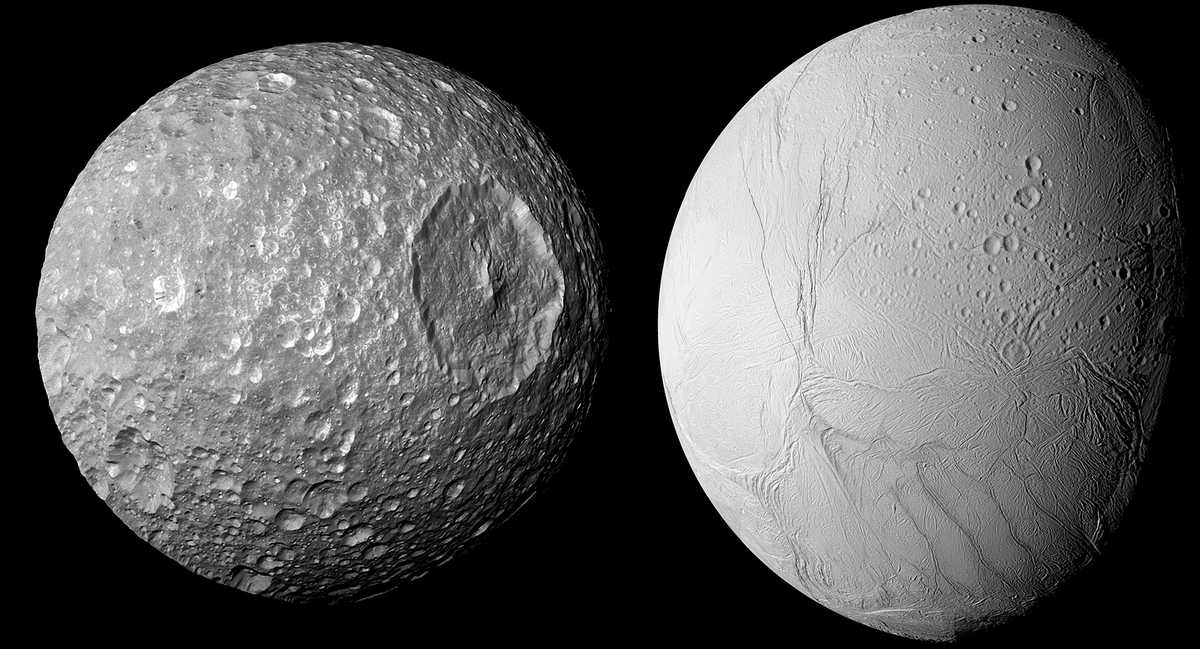
NASA / JPL-Caltech / Space Science Institute An SwRI scientist has discovered that Saturn’s small moon Mimas (left) likely has something in common with its larger neighbor Enceladus: an internal ocean beneath a thick icy surface. Thought to be a frozen inert satellite, Mimas is now considered a “stealth” ocean world with a surface that does not betray what lies beneath. This discovery could greatly expand the number of potentially habitable worlds thought to exist.
Discovery could point to a new class of ‘stealth’ ocean worlds. A Southwest Research Institute scientist set out to prove that the tiny, innermost moon of Saturn was a frozen inert satellite and instead discovered compelling evidence that Mimas has a liquid internal ocean...
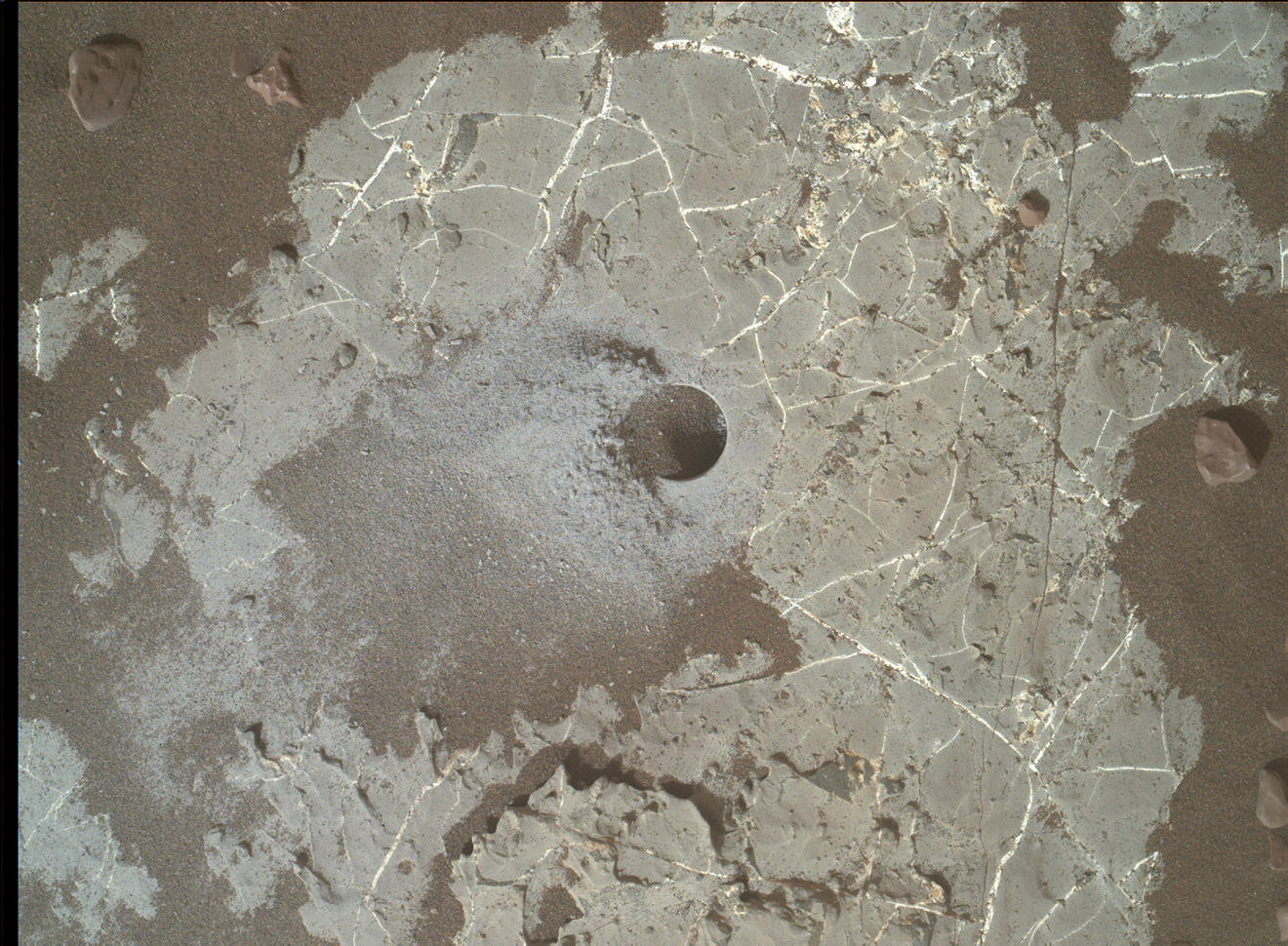
This image shows the Highfield drill hole made by NASA’s Mars Curiosity rover as it was collecting a sample on “Vera Rubin Ridge” in Gale Crater.
Credit: NASA/JPL-Caltech/MSSS
The type of carbon is associated with biological processes on Earth. Curiosity scientists offer several explanations for the unusual carbon signals. After analyzing powdered rock samples collected from the surface of Mars by NASA’s Curiosity rover, scientists have announced that several of the samples are rich in a type of carbon that on Earth is associated with biological processes.
While the finding is intriguing, it doesn’t necessarily point to ancient life on Mars, as scientists have not yet found conclusive supporting evidence of ancient or current biology there, such as sedimentary rock formations ...
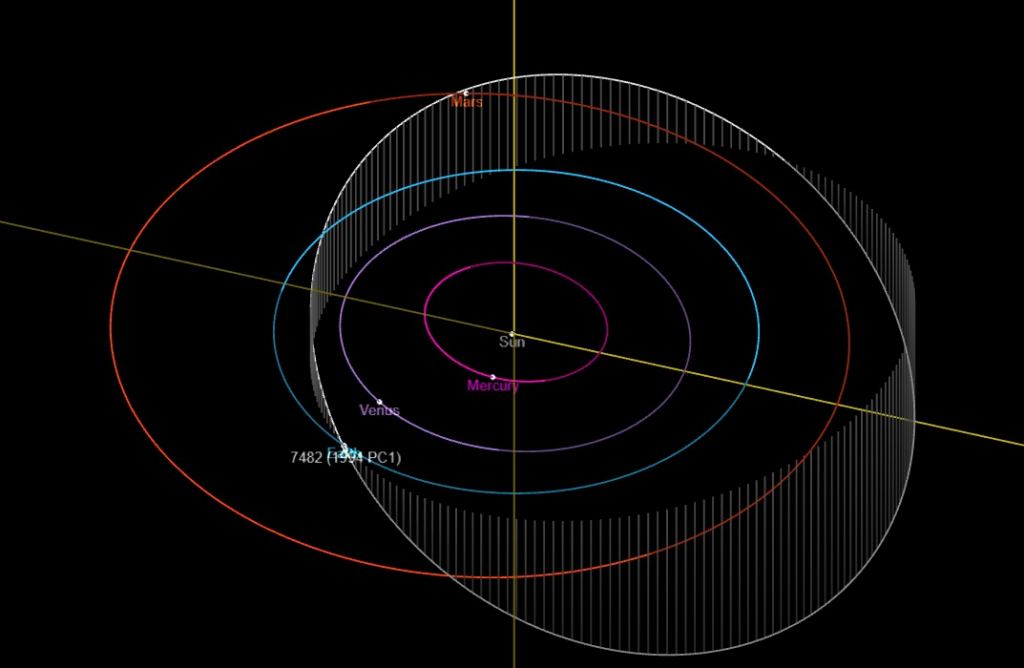
In a slow moving universe, asteroids give us a rare chance to see things moving in real time. On the evening of Tuesday, January 18, 1.1-kilometer asteroid (7482) 1994 PC1 passed 1.23 million miles (1.98 million kilometers) from the Earth. This is about five times the distance from the Earth to the moon, and just a shade over the distance to the anti-sunward Earth-sun Lagrange 2 point, soon to be the home of the James Webb Space Telescope.
Fortunately, both the Earth and said space telescope are safe from the asteroid on this pass, and will remain so for centuries in to the foreseeable future. The asteroid was discovered on the night of August 9, 1994 by astronomer Robert McNaught observing from the Siding Spring Observatory...
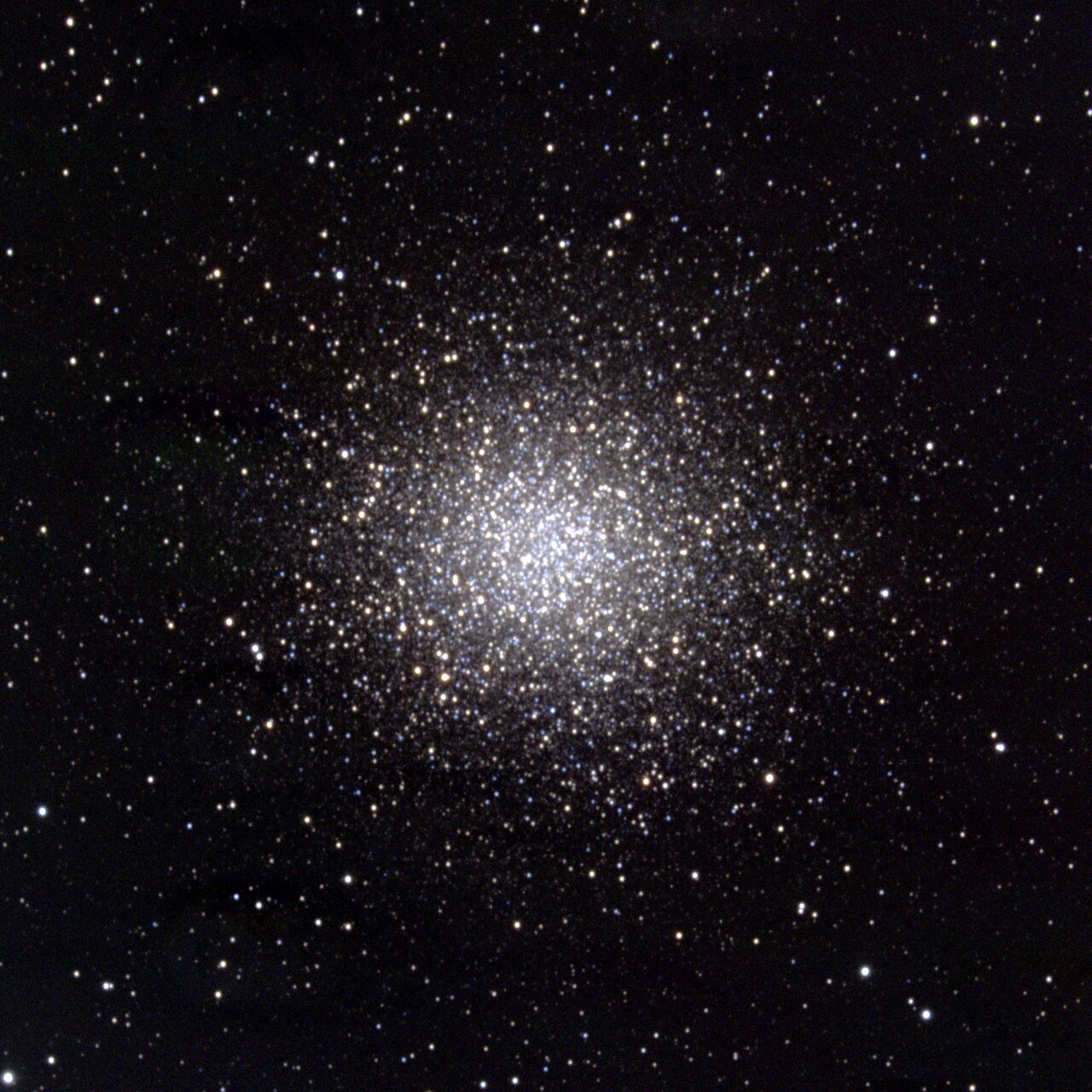
Messier 14 globular cluster. Credit: NOIRLAB/NSF/AURA.
Using the Hubble Space Telescope (HST), astronomers have observed the globular cluster Messier 14 and its peculiar multiple stellar populations. Results of the observational campaign, published January 7 on arXiv.org, deliver important insight into the nature of this cluster.
Globular clusters (GCs) are collections of tightly bound stars orbiting galaxies. Astronomers perceive them as natural laboratories enabling studies on the evolution of stars and galaxies. In particular, globular clusters could help researchers better understand the formation history and evolution of early type galaxies, as the origin of GCs seems to be closely linked to periods of intense star formation.
At a distance of about 30,300 light years away fr...





Recent Comments