Category Astronomy/Space

Saturn makes Waves in its own Rings

Saturn Makes Waves in its Own Rings
An illustration of Saturn and its “fuzzy” core. Credit: Caltech/R. Hurt (IPAC)

In the same way that earthquakes cause our planet to rumble, oscillations in the interior of Saturn make the gas giant jiggle around ever so slightly. Those motions, in turn, cause ripples in Saturn’s rings.

In a new study accepted in the journal Nature Astronomy, two Caltech astronomers have analyzed those rippling rings to reveal new information about the core of Saturn. For their study, they used older data captured by NASA’s Cassini, a spacecraft that orbited the ringed giant for 13 years before it dove into the planet’s atmosphere and disintegrated in 2017.

The findings suggest that the planet’s core is not a hard ball of rock, as some previous theories had proposed, but a diffuse soup of ice, roc...

Read More

Nearby Star-forming Region yields Clues to the Formation of our Solar System

figure-1-450.jpg
Multi-wavelength observations of the Ophiuchus star-forming region reveal interactions between clouds of star-forming gas and radionuclides produced in a nearby cluster of young stars. The top image (a) shows the distribution of aluminum-26 in red, traced by gamma-ray emissions. The central box represents the area covered in the bottom left image (b), which shows the distribution of protostars in the Ophiuchus clouds as red dots. The area in the box is shown in the bottom right image (c), a deep near-infrared color composite image of the L1688 cloud, containing many well known prestellar dense-gas cores with disks and protostars (see larger image below). (Credit: Forbes et al., Nature Astronomy 2021)

The Ophiuchus star-forming complex offers an analog for the formation of the solar sys...

Read More

Traces of Ceres’ Icy Crust found at Occator Crater

The study focused on Occator crater (left), which contains Ceres’ most prominent bright spots. The newly reported map (right) reveals higher concentrations of hydrogen than expected if the near sub-surface within Occator crater and its ejecta blanket was ice free. Results indicate that the crustal materials excavated by the crater-forming impact were rich in water ice. Image credits: NASA/JPL-CalTech/UCLA/MPS/DLR/IDA and Prettyman et al. (2021).

Anomalies in the distribution of hydrogen at Occator crater on the dwarf planet Ceres reveal an icy crust, says a new paper led by Tom Prettyman, a Senior Scientist at the Planetary Science Institute.

The evidence comes from data acquired by the Gamma Ray and Neutron Detector (GRaND) aboard NASA’s Dawn spacecraft...

Read More

Magnetic Patterns Hidden in Meteorites reveal early Solar System Dynamics

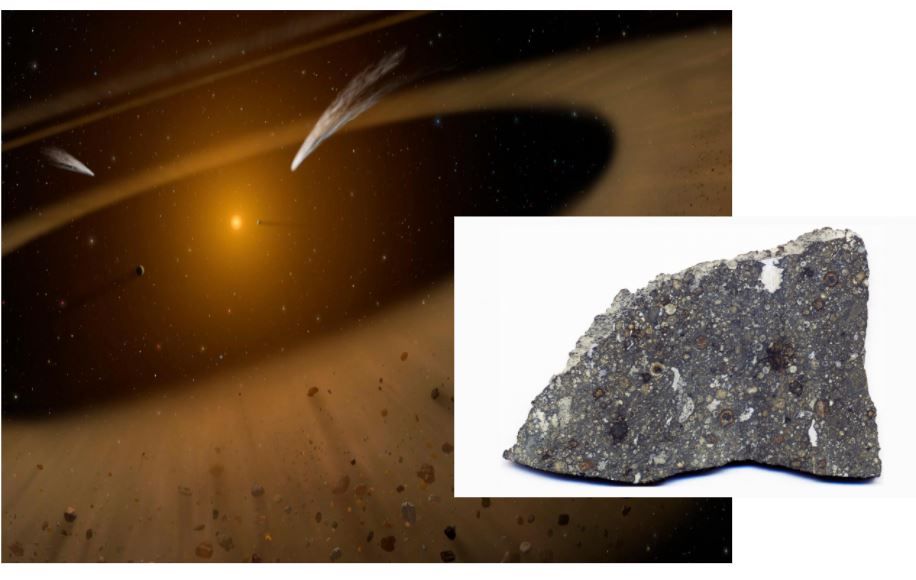
Jupiter and a comet formed in a cold outer region of the early solar system.(Illustration provided by Yuki Kimura).

Researchers have developed a novel technique to investigate the dynamics of the early Solar System by analyzing magnetites in meteorites utilizing the wave nature of electrons.

Within meteorites, the magnetic fields associated with the particles that make up the object can act as a historical record. By analyzing such magnetic fields, scientists can deduce the probable events that affected the object and reconstruct a time-lapse of what events occurred on the meteorite and when.

“Primitive meteorites are time capsules of primordial materials formed at the beginning of our Solar System,” said Yuki Kimura, an associate professor at the Institute of Low Temperature Sci...

Read More