

Using the European Southern Observatory’s Very Large Telescope (ESO’s VLT), astronomers have discovered a small black hole outside the Milky Way by looking at how it influences the motion of a star in its close vicinity...
Read More

November 12, 2021,
 Astronomy/Space
Using the European Southern Observatory’s Very Large Telescope (ESO’s VLT), astronomers have discovered a small black hole outside the Milky Way by looking at how it influences the motion of a star in its close vicinity...
Read More
November 11, 2021,
Astronomy/Space

Strange ‘eggshell planets’ are among the rich variety of exoplanets possible, according to a study from Washington University in St. Louis. These rocky worlds have an ultra-thin outer brittle layer and little to no topography. Such worlds are unlikely to have plate tectonics, raising questions as to their habitability.
Only a small subset of extrasolar planets are likely eggshell...
Read More
November 10, 2021,
Astronomy/Space

These cosmic ribbons of gas have been left behind by a titanic stellar explosion called a supernova. DEM L249 is thought to be the remnant of a Type 1a supernova, the death of a white dwarf star. White dwarf stars are usually stable, but in a binary system—two stars orbiting each other—a white dwarf can gravitationally pull so much matter from its companion that it reaches critical mass and explodes.
DEM L249, located in the Large Magellanic Cloud, is an unusual supernova remnant...
Read More
November 10, 2021,
Astronomy/Space
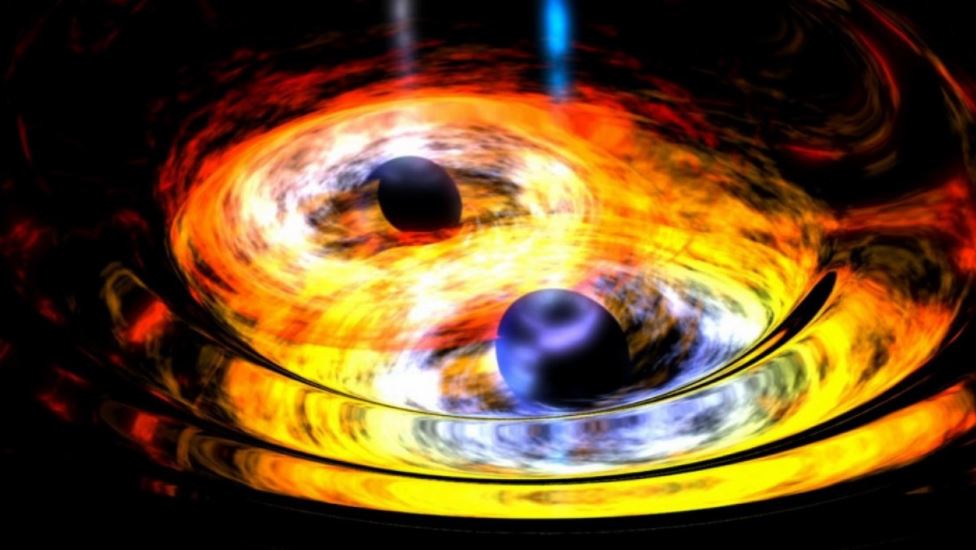
A team of international scientists, including researchers from The Australian National University (ANU), have unveiled the largest number of gravitational waves ever detected.
The discoveries will help solve some of the most complex mysteries of the Universe, including the building blocks of matter and the workings of space and time.
The global team’s study, published on ArXiv, made 35 new detections of gravitational waves caused by pairs of black holes merging or neutron stars and black holes smashing together, using the LIGO and Virgo observatories between November 2019 and March 2020.
This brings the total number of detections to 90 after three observing runs between 2015 and 2020.
The new detections are from massive cosmic ...
Read More
Recent Comments