Category Astronomy/Space

New Research adds a Wrinkle to our Understanding of the Origins of Matter in the Milky Way

This image combines data from four space telescopes to reconstruct all that remains of the oldest documented example of a supernova, which was witnessed in 185 A.D. by Chinese astronomers. Supernovae are understood to be important sources of cosmic rays arriving at Earth. Image credit: NASA

New findings published this week in Physical Review Letters suggest that carbon, oxygen, and hydrogen cosmic rays travel through the galaxy toward Earth in a similar way, but, surprisingly, that iron arrives at Earth differently. Learning more about how cosmic rays move through the galaxy helps address a fundamental, lingering question in astrophysics: How is matter generated and distributed across the universe?

“So what does this finding mean?” asks John Krizmanic, a senior scientist with UMBC’s...

Read More

Researchers trace Dust Grain’s journey through Newborn Solar System

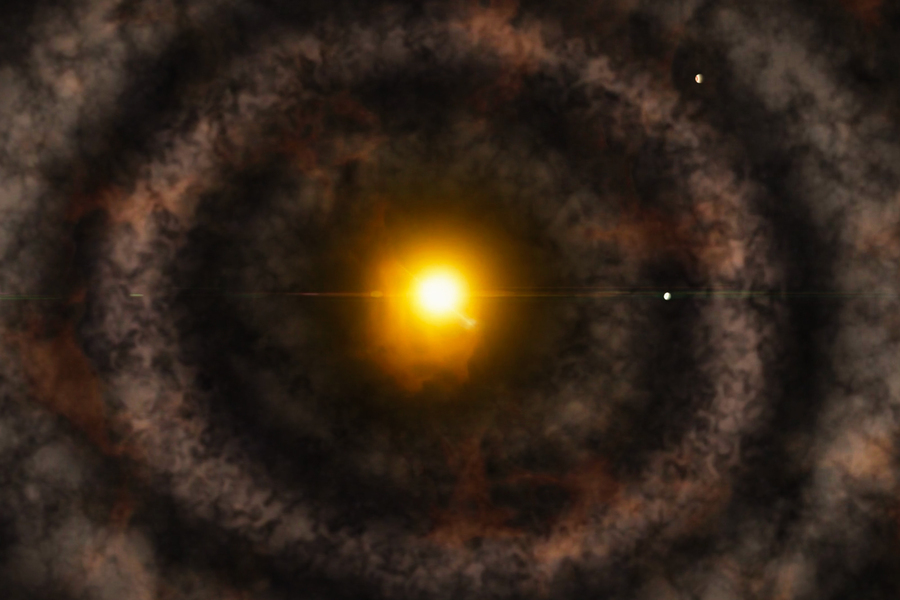
Artist’s illustration of the early solar system, at a time when no planets had formed yet. A swirling cloud of gas and dust surrounded the young sun. The cutaway through this so-called protoplanetary disk shows its three-dimensional structure.Heather Roper

Combining atomic-scale sample analysis and models simulating likely conditions in the nascent solar system, the study revealed clues about the origin of crystals that formed more than 4.5 billion years ago. The findings provide insights into the fundamental processes underlying the formation of planetary systems, many of which are still shrouded in mystery.

For the study, the team developed a new type of framework, which combines quantum mechanics and thermodynamics, to simulate the conditions to which the grain was exposed duri...

Read More

‘Pack Ice’ Tectonics reveal Venus’ Geological Secrets

Venus
An oblique radar view of the largest block in the Venus lowlands identified by Byrne et al. Complex belts of tectonic structures bound the block, but the interior is much less deformed, hosting lava flows and a handful of impact craters. Image: Paul Byrne, based on original NASA/JPL imagery.

A new analysis of Venus’ surface shows evidence of tectonic motion in the form of crustal blocks that have jostled against each other like broken chunks of pack ice. The movement of these blocks could indicate that Venus is still geologically active and give scientists insight into both exoplanet tectonics and the earliest tectonic activity on Earth.

“We’ve identified a previously unrecognized pattern of tectonic deformation on Venus, one that is driven by interior motion just like on Earth,” sa...

Read More

Study of Young Chaotic Star System reveals Planet Formation secrets

Using gas velocity data, scientists observing Elias 2-27 were able to directly measure the mass of the young star’s protoplanetary disk and also trace dynamical perturbations in the star system. Visible in this paneled composite are the dust continuum 0.87mm emission data (blue), along with emissions from gases C18O (yellow) and 13CO (red).
Credit: ALMA (ESO/NAOJ/NRAO)/T. Paneque-Carreño (Universidad de Chile), B. Saxton (NRAO)

A team of scientists using the Atacama Large Millimeter/submillimeter Array (ALMA) to study the young star Elias 2-27 have confirmed that gravitational instabilities play a key role in planet formation, and have for the first time directly measured the mass of protoplanetary disks using gas velocity data, potentially unlocking one of the mysteries of planet fo...

Read More