Category Astronomy/Space

Student astronomer finds Missing Galactic Matter

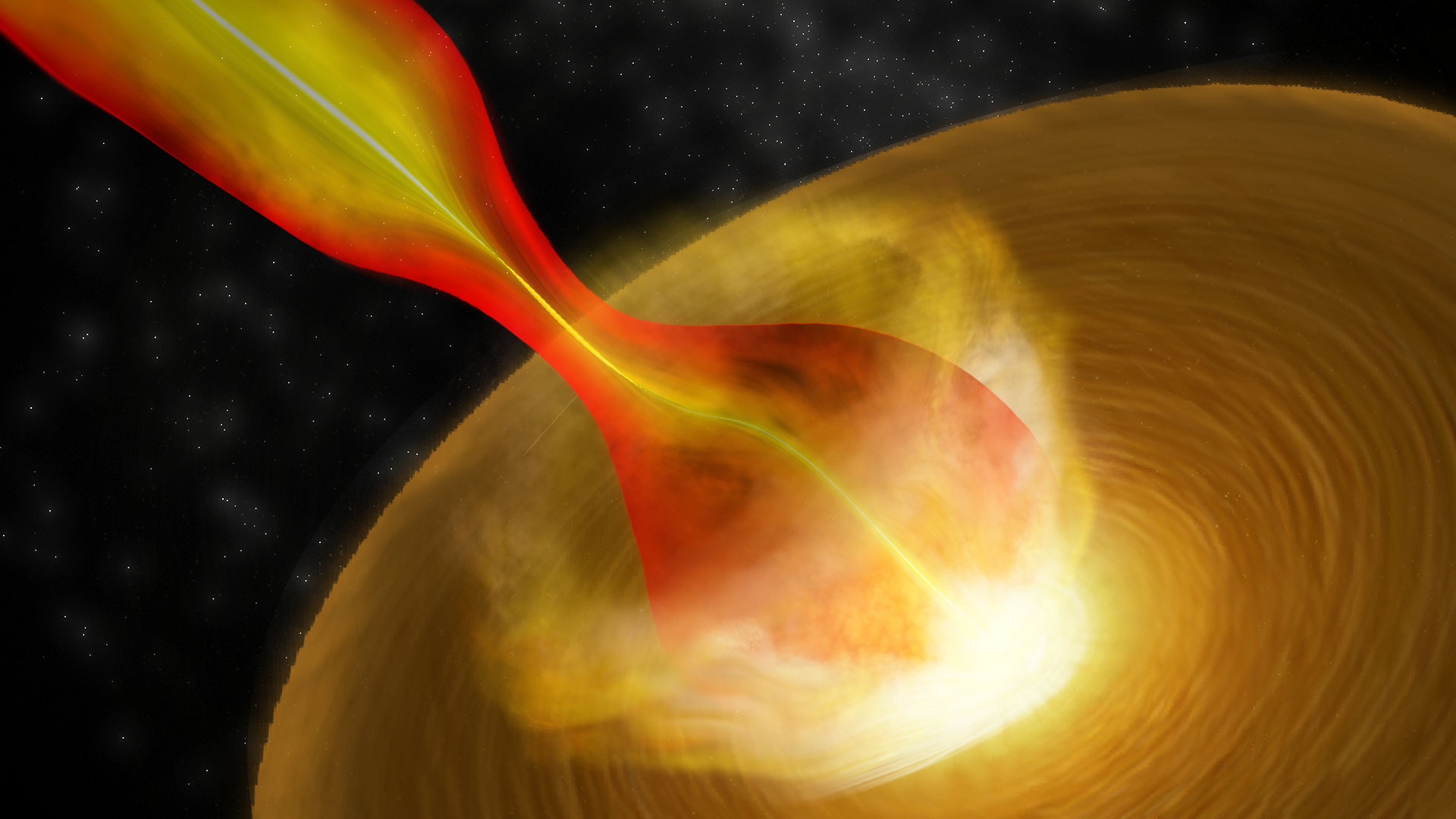
Artist’s impression of a thin gas cloud formed by tidal disruption from a passing star. Scientists think this is one of the possible ways the cold clump of gas detected in the study could have been formed.
CREDIT
Mark Myers/OzGrav

Astronomers have for the first time used distant galaxies as ‘scintillating pins’ to locate and identify a piece of the Milky Way’s missing matter.

For decades, scientists have been puzzled as to why they couldn’t account for all the matter in the universe as predicted by theory. While most of the universe’s mass is thought to be mysterious dark matter and dark energy, 5 percent is ‘normal matter’ that makes up stars, planets, asteroids, peanut butter and butterflies. This is known as baryonic matter.

However, direct measurement has only accounted for abo...

Read More

Possible Detection of Hydrazine on Saturn’s moon Rhea

Possible detection of hydrazine on Saturn’s moon Rhea
Cassini grand finale. Credit: The European Space Agency

In a new report on Science Advances, Mark Elowitz, and a team of scientists in physical sciences, optical physics, planetary science and radiation research in the U.S., U.K., India, and Taiwan, presented the first analysis of far-ultraviolet reflectance spectra of regions on Rhea’s leading and trailing hemispheres—as collected by the Cassini ultraviolet imaging spectrograph during targeted flybys. In this work, they specifically aimed to explain the unidentified broad absorption feature centered near 184 nanometers of the resulting spectra. Using laboratory measurements of the UV spectroscopy of a set of molecules, Elowitz et al...

Read More

True Identity of Mysterious Gamma-Ray Source revealed

Artist’s impression of PSR J2039−5617 and its companion. The binary system consists of a rapidly rotating neutron star

An international research team including members from The University of Manchester has shown that a rapidly rotating neutron star is at the core of a celestial object now known as PSR J2039-5617

The international collaboration used novel data analysis methods and the enormous computing power of the citizen science project Einstein@Home to track down the neutron star’s faint gamma-ray pulsations in data from NASA’s Fermi Space Telescope. Their results show that the pulsar is in orbit with a stellar companion about a sixth of the mass of our Sun. The pulsar is slowly but surely evaporating this star...

Read More

The Secrets of 3000 Galaxies laid Bare

A/Prof Julia Bryant from the University of Sydney inside the SAMI instrument at the top end of the Anglo Australian Telescope
CreditScott Croom/University of Sydney

Shedding light on the evolution of the Universe. The complex mechanics determining how galaxies spin, grow, cluster and die have been revealed following the release of all the data gathered during a massive seven-year Australian-led astronomy research project.

The scientists observed 13 galaxies at a time, building to a total of 3068, using a custom-built instrument called the Sydney-AAO Multi-Object Integral-Field Spectrograph (SAMI), connected to the 4-metre Anglo-Australian Telescope (AAT) at Siding Spring Observatory in New South Wales. The telescope is operated by the Australian National University.

Overseen by ...

Read More