Category Astronomy/Space

An ‘Old Faithful’ Active Galaxy: Black Hole Rips Away at Star

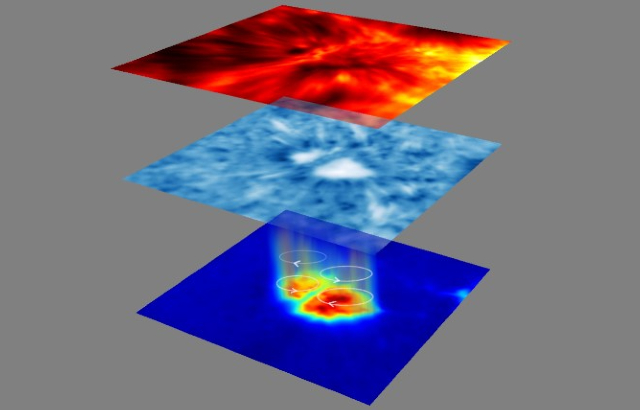
This image of active galaxy ESO 253-3 was captured by the European Space Observatory’s Multi Unit Spectroscopic Explorer as part of the All-weather MUse Supernova Integral-field of Nearby Galaxies (AMUSING) survey. ESO 253-3 displays the most predictable and frequent flares scientists have yet identified in an active galaxy.
Credits: Michael Tucker (University of Hawai’i) and the AMUSING survey

During a typical year, over a million people visit Yellowstone National Park, where the Old Faithful geyser regularly blasts a jet of boiling water high in the air. Now, an international team of astronomers has discovered a cosmic equivalent, a distant galaxy that erupts roughly every 114 days.

Using data from facilities including NASA’s Neil Gehrels Swift Observatory and Transiting Exopla...

Read More

Measurements of Pulsar Accceleration reveal Milky Way’s dark side

PulsarMeasurements

The ripples in the Milky Way disk are shown, along with the tidal debris from the Sagittarius dwarf galaxy. The pulsars analyzed by Chakrabarti and collaborators to calculate galactic accelerations are shown in the inset. IAS; Dana Berry

It is well known that the expansion of the universe is accelerating due to a mysterious dark energy. Within galaxies, stars also experience an acceleration, though this is due to some combination of dark matter and the stellar density. In a new study to be published in Astrophysical Journal Letters, researchers have now obtained the first direct measurement of the average acceleration taking place within our home galaxy, the Milky Way.

Led by Sukanya Chakrabarti at the Institute for Advanced Study with collaborators from Rochester Institute of Techn...

Read More

‘Galaxy-sized’ Observatory sees potential hints of Gravitational Waves

Graphic showing pulsar light traveling to Earth amid a sea of gravitational waves. (Credit: NANOGrav/T. Klein)

Scientists have used a “galaxy-sized” space observatory to find possible hints of a unique signal from gravitational waves, or the powerful ripples that course through the universe and warp the fabric of space and time itself.

The new findings, which appeared recently in The Astrophysical Journal Letters, hail from a U.S. and Canadian project called the North American Nanohertz Observatory for Gravitational Waves (NANOGrav).

For over 13 years, NANOGrav researchers have pored over the light streaming from dozens of pulsars spread throughout the Milky Way Galaxy to try to detect a “gravitational wave background...

Read More

Chandra Studies Extraordinary Magnetar

This image contains an exceptional magnetar, a type of neutron star with very powerful magnetic fields.

In 2020, astronomers added a new member to an exclusive family of exotic objects with the discovery of a magnetar. New observations from NASA’s Chandra X-ray Observatory help support the idea that it is also a pulsar, meaning it emits regular pulses of light.

Magnetars are a type of neutron star, an incredibly dense object mainly made up of tightly packed neutron, which forms from the collapsed core of a massive star during a supernova.

What sets magnetars apart from other neutron stars is that they also have the most powerful known magnetic fields in the universe. For context, the strength of our planet’s magnetic field has a value of about one Gauss, while a refrigerator magnet measures about 100 Gauss...

Read More