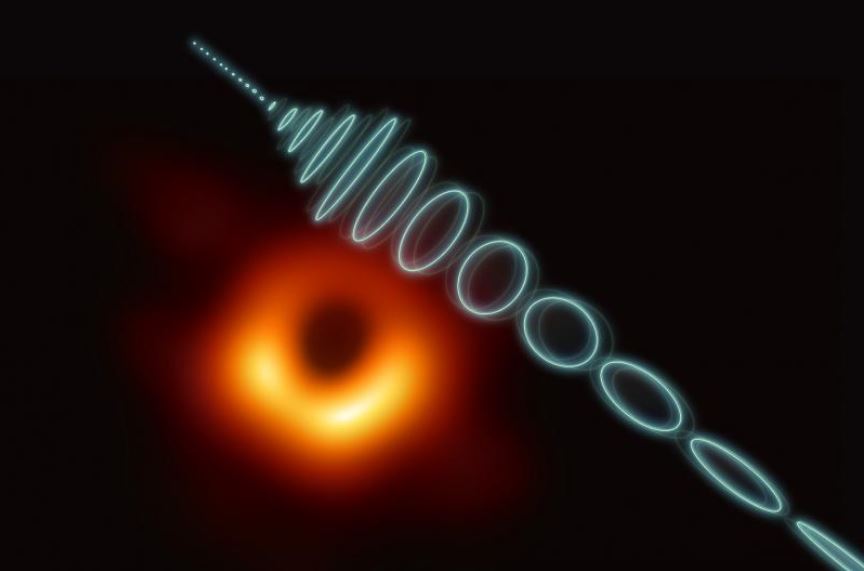
An artist’s impression of a “string” passing near a black hole. As the string approaches the black hole, it is gradually stretched. Then, as it moves past the black hole, it begins to vibrate. The image to the left, which was captured by the Event Horizon Telescope, represents the shadow of the supermassive black hole at the center of the galaxy M87, including the ring of light around it. (Credit: EHT Collaboration; Kavli IPMU (Kavli IPMU modified EHT’s original image)).
A paper by the Kavli Institute for the Physics and Mathematics of the Universe (Kavli IPMU) Director Ooguri Hirosi and Project Researcher Matthew Dodelson on the string theoretical effects outside the black hole photon sphere has been selected for the “Editors’ Suggestion” of the journal Physical Review D...
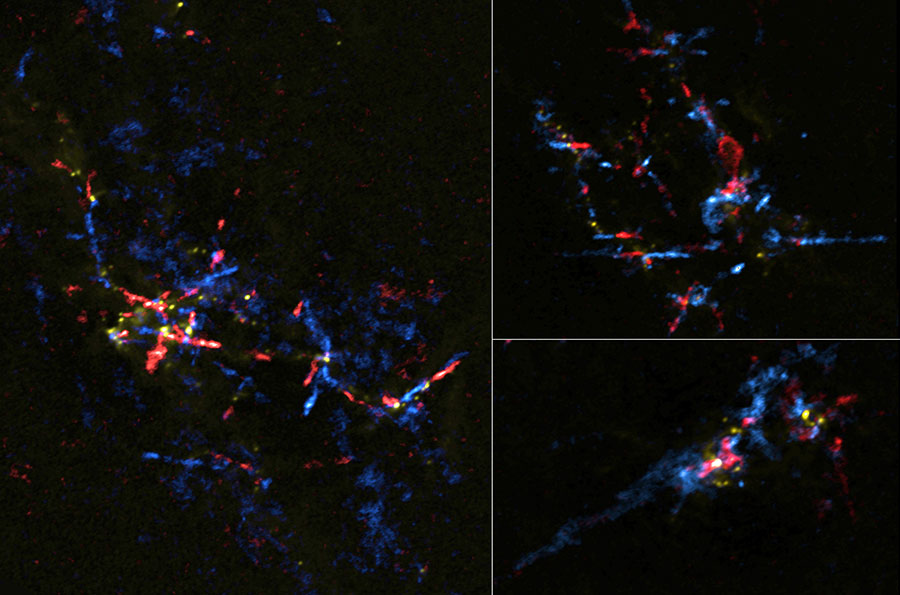
ALMA pseudo-color composite image of the gas outflows from stellar eggs in the Galactic Center region. Gas moving toward us is shown in blue and gas moving away from us is shown in red. Credit: ALMA (ESO/NAOJ/NRAO), Lu et al
Astronomers found a number of stellar eggs containing baby stars around the center of the Milky Way using the Atacama Large Millimeter/submillimeter Array (ALMA). Previous studies had suggested that the environment there is too harsh to form stars. These findings indicate that star formation is more resilient than researchers thought.
Stars form in stellar eggs, cosmic clouds of gas and dust which collapse due to gravity. If something interferes with the gravity driven contraction, star formation will be suppressed...
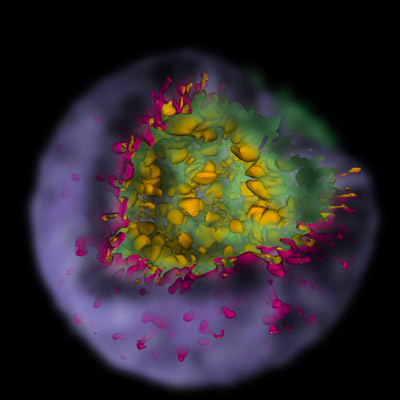
A supernova creates a cloud of debris that bears an imprint of the explosion. In this visualization of the simulation data, one quarter of the remnant’s outer shell has been removed to reveal the clumps of matter within (colors denote different materials). Credit: Reproduced from Ref. 1 by permission of the AAS.
Astronomers are now in a better position to interpret observations of supernova remnants thanks to computer simulations of these cataclysmic events by RIKEN astrophysicists.
When certain types of stars die, they go out in a blaze of glory—an incredibly powerful explosion known as a supernova. One of the most common forms of supernova, typeIa, starts with a dense white dwarf star that has burned up its hydrogen fuel...
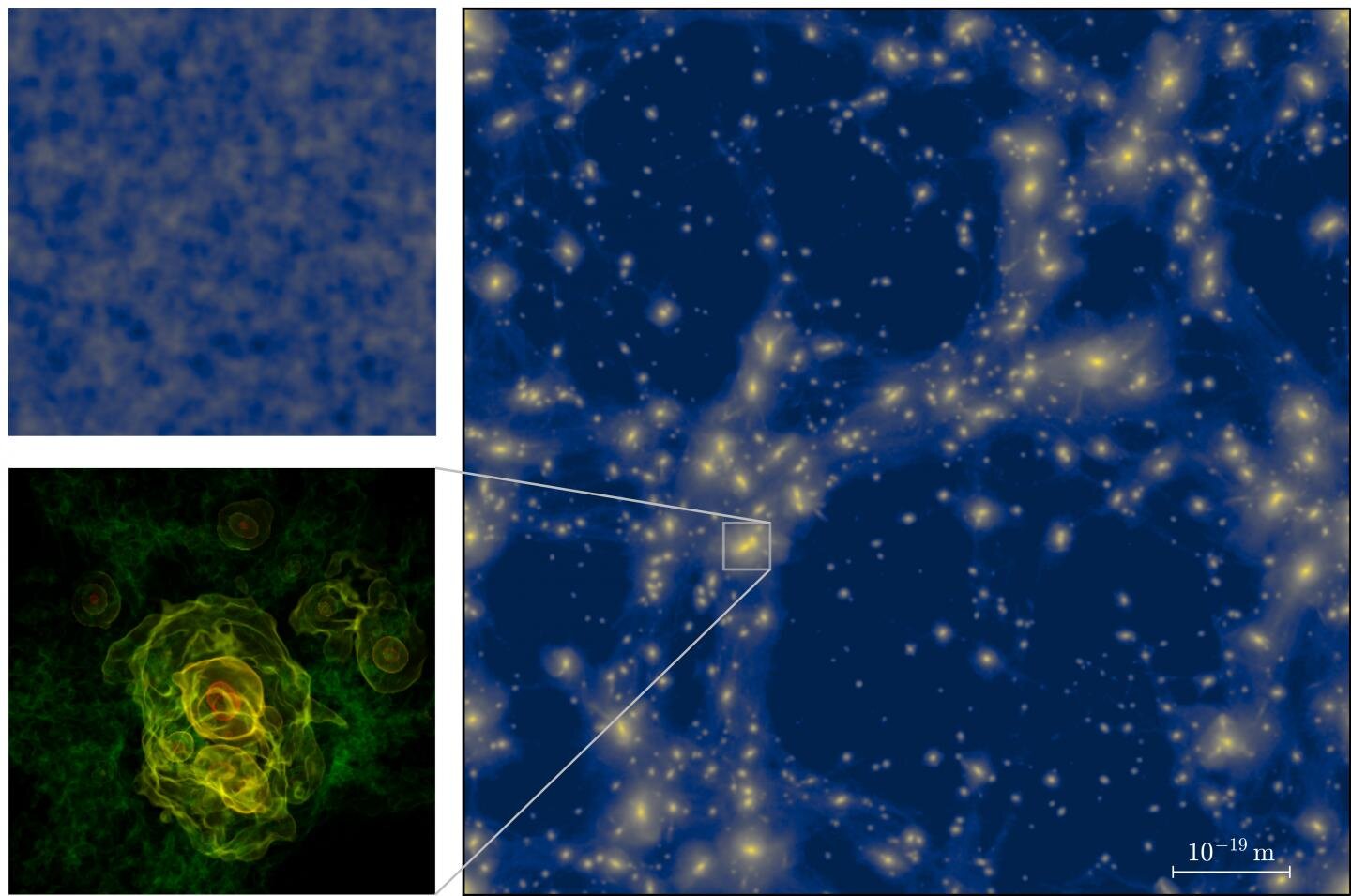
The results of the simulation show the growth of tiny, extremely dense structures very soon after the inflation phase of the very early universe. Between the initial and final states in the simulation (top left and right respectively), the area shown has expanded to ten million times its initial volume, but is still many times smaller than the interior of a proton. The enlarged clump at the bottom left would have a mass of about 20kg. Credit: Jens Niemeyer, University of Göttingen
The very first moments of the Universe can be reconstructed mathematically even though they cannot be observed directly. Physicists from the Universities of Göttingen and Auckland (New Zealand) have greatly improved the ability of complex computer simulations to describe this early epoch...





Recent Comments