Category Astronomy/Space

Space Travel can Adversely Impact Energy Production in a cell

Studies of both mice and humans who have traveled into space reveal that critical parts of mitochondria can be made dysfunctional due to changes in gravity, radiation exposure and other factors, according to investigators at Georgetown Lombardi Comprehensive Cancer Center. These findings are part of an extensive research effort across many scientific disciplines to look at the health effects of travel into space. The research has implications for future space travel as well as how metabolic changes due to space travel could inform medical science on earth.

The findings appeared November 25, 2020, in Cell and are part of a larger compendium of research into health aspects of space travel that appears concurrently in Cell, Cell Reports, Cell Systems, Patterns, and iScience.

“My gr...

Read More

Blast from the Past

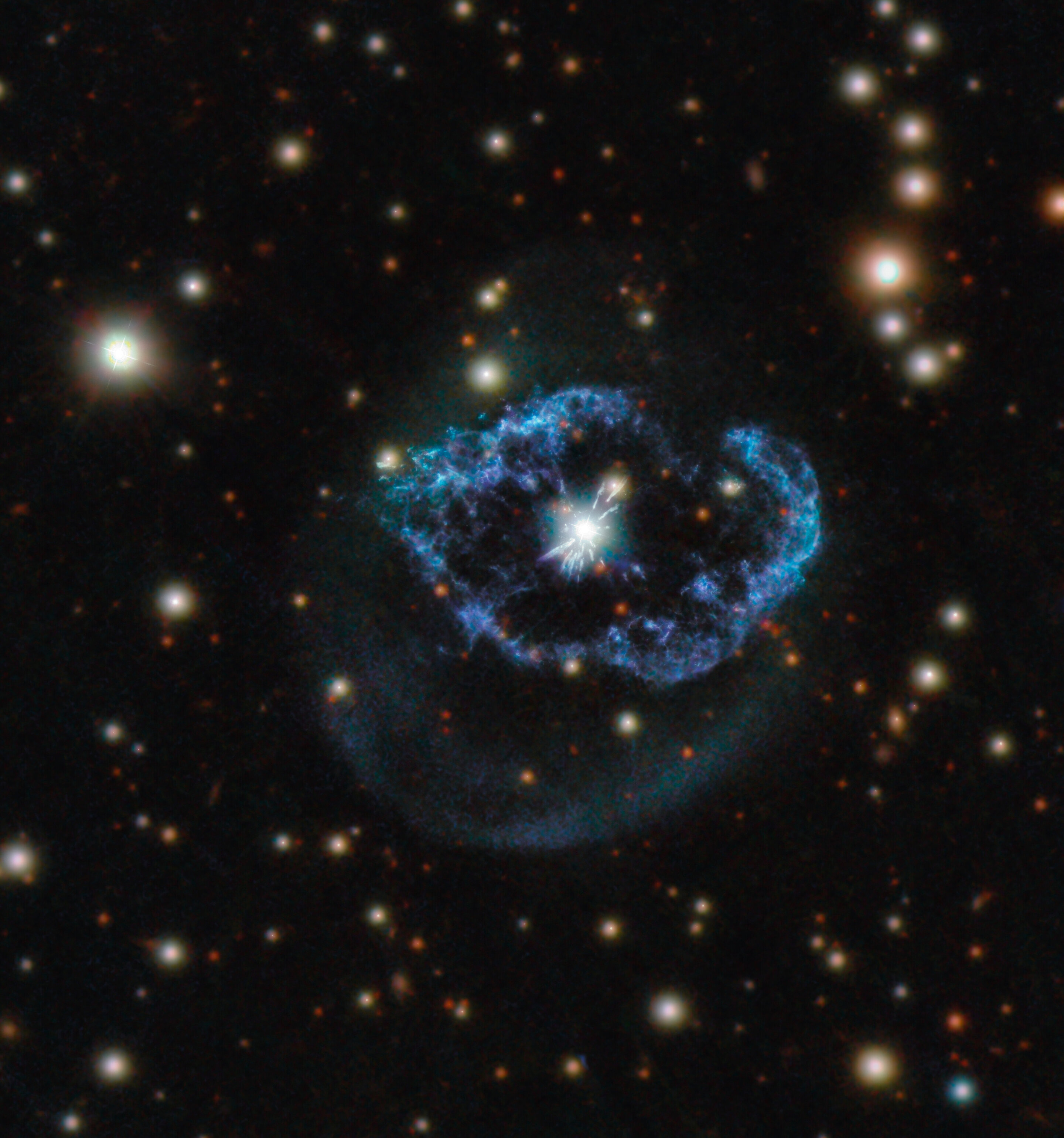
The enigmatic CK Vulpeculae nebula. The team of astronomers measured the speeds and changes in positions of the two small reddish arcs about 1/4 of the way up from the bottom and 1/4 of the way down from the top to help determine that the nebula is expanding five times faster than previously thought.

Credit:International Gemini Observatory/NOIRLab/NSF/AURA
Image processing: Travis Rector (University of Alaska Anchorage), Jen Miller (Gemini Observatory/NSF’s NOIRLab), Mahdi Zamani & Davide de Martin

Gemini North observations enable breakthrough in centuries-old effort to unravel astronomical mystery...

Read More

Milky Way Family Tree

Family tree of the Milky Way. The main progenitor of the Milky Way is denoted by the trunk of the tree, coloured by stellar mass. Black lines indicate the five identified galaxies. Grey dotted lines depict other mergers that the Milky Way experienced that could not be connected to a specific progenitor. From left to right, the six images along the top of the figure indicate the identified progenitor galaxies: Sagittarius, Sequoia, Kraken, the Milky Way’s Main progenitor, the progenitor of the Helmi streams, and Gaia-Enceladus-Sausage. | © D. Kruijssen

Astrophysicists reconstruct the galaxy merger history of our home galaxy. Galaxies like the Milky Way formed by the merging of smaller progenitor galaxies...

Read More

Astronomers discover New ‘Fossil Galaxy’ Buried Deep within the Milky Way

An all-sky image of the stars in the Milky Way as seen from Earth. The coloured rings show the approximate extent of the stars that came from the fossil galaxy known as Heracles. Credit: Danny Horta-Darrington (LJMU), ESA/Gaia, SDSS

Scientists working with data from the Sloan Digital Sky Surveys’ Apache Point Observatory Galactic Evolution Experiment (APOGEE) have discovered a “fossil galaxy” hidden in the depths of our own Milky Way. This result, published in Monthly Notices of the Royal Astronomical Society, may shake up our understanding of how the Milky Way grew into the galaxy we see today.

The proposed fossil galaxy may have collided with the Milky Way ten billion years ago, when our galaxy was still in its infancy...

Read More