A near-infrared Hubble image of the luminous, barred spiral galaxy ESO320-G030. Infrared observations and modeling of over a dozen molecular species at its center reveal massive inflows of gas to a nuclear region undergoing a burst of star formation and dominated by three-components, a small warm core, a disk, and an outer envelope. NASA/HST; Alonso-Herrero et al.
A galactic bar is the approximately linear structure of stars and gas that stretches across the inner regions of some galaxies. The bar stretches from one inner spiral arm, across the nuclear region, to an arm on the other side...
Scientists from Cornell and Spain’s Centro de AstrobiologÃa have found that Earth’s most arid desert – Chile’s Atacama Desert, shown above – may hold a key to finding microbial life on Mars.
Earth’s most arid desert may hold a key to finding life on Mars. Diverse microbes discovered in the clay-rich, shallow soil layers in Chile’s dry Atacama Desert suggest that similar deposits below the Martian surface may contain microorganisms, which could be easily found by future rover missions or landing craft.
Led by Cornell University and Spain’s Centro de AstrobiologÃa, scientists now offer a planetary primer to identifying microbial markers on shallow rover digs in Martian clay, in their work published Nov. 5 in Nature Scientific Reports.
Image by Julie Roussy, McGill Graphic Design and Getty Images.
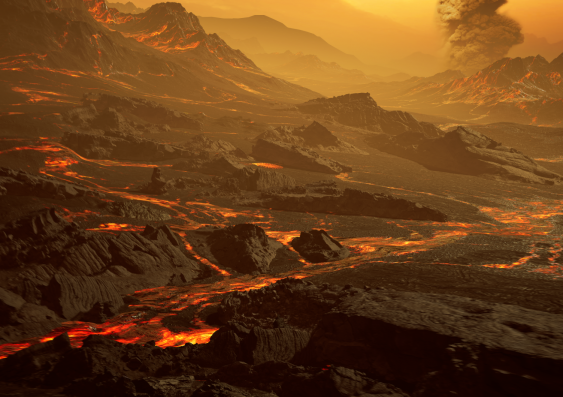
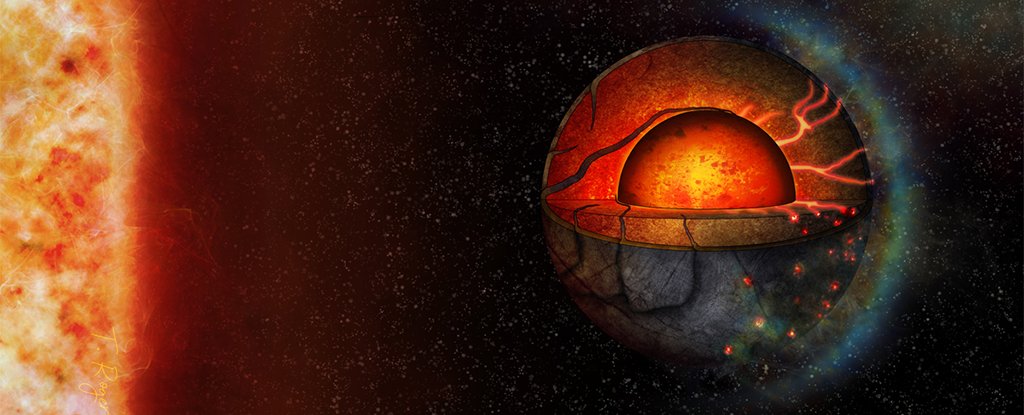
Among the most extreme planets discovered beyond the edges of our solar system are lava planets: fiery hot worlds that circle so close to their host star that some regions are likely oceans of molten lava. According to scientists from McGill University, York University, and the Indian Institute of Science Education, the atmosphere and weather cycle of at least one such exoplanet is even stranger, featuring the evaporation and precipitation of rocks, supersonic winds that rage over 5000 km/hr, and a magma ocean 100 km deep.
In a study published in Monthly Notices of the Royal Astronomical Society, the scientists use computer simulations to predict the conditions on K2-141b, an Earth-size exoplanet with a surface, ocean, a...
The high-pressure mineral Donwilhelmsite, recently discovered in the lunar meteorite Oued Awlitis 001 from Apollo missions, is important for understanding the inner structure of Earth. A team of European researchers discovered a new high-pressure mineral in the lunar meteorite Oued Awlitis 001, named donwilhelmsite [CaAl4Si2O11]...
Recent Comments