



The German eROSITA consortium (eROSITA-DE), which includes the University of Bonn and is led by the Max Planck Institute for Extraterrestrial Physics (MPE), has released its second major public data set, the “eROSITA Data Release 2” (DR2).
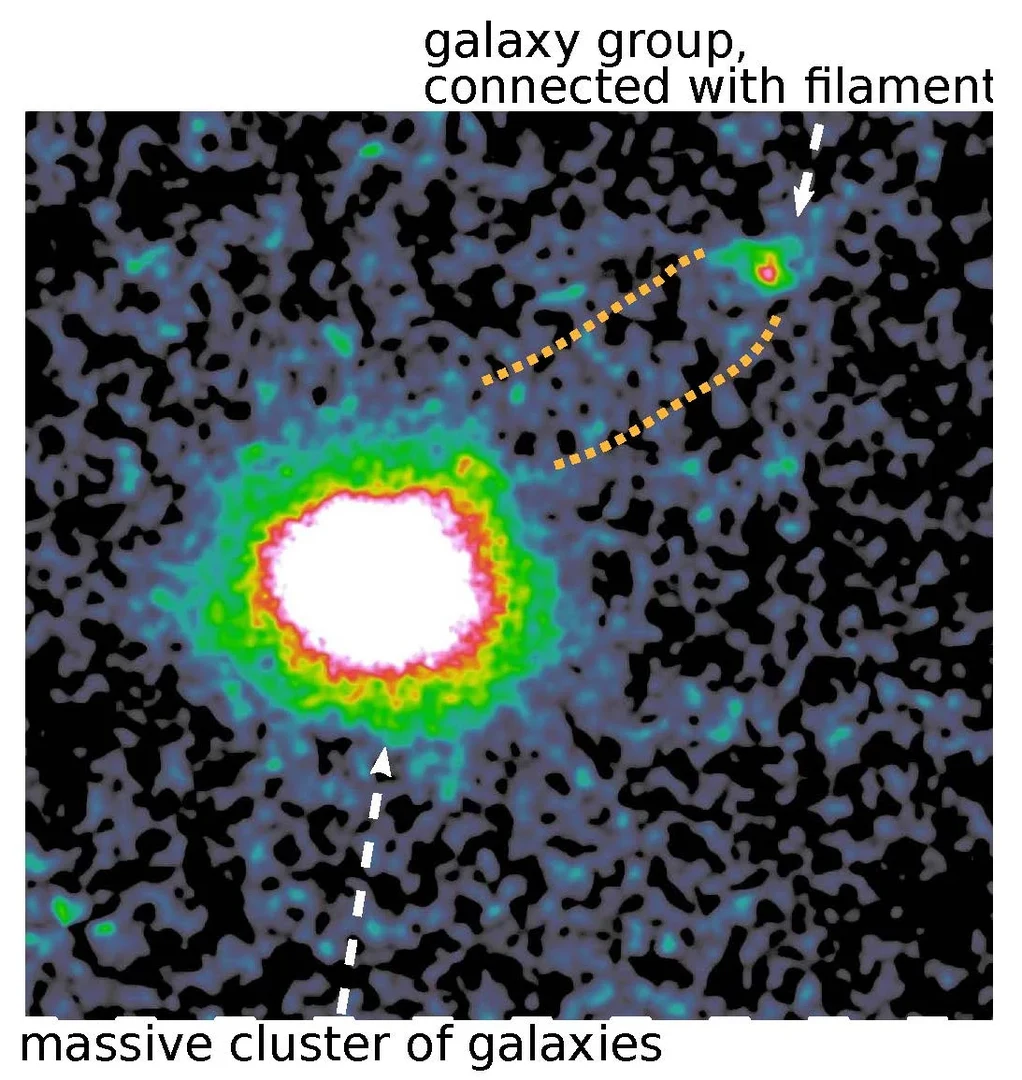
Built from the first three all-sky surveys conducted by the eROSITA telescope aboard the Spectrum-Roentgen-Gamma (SRG) mission, DR2 provides the most sensitive and comprehensive catalog of the X-ray sky currently available to the public. Spearheaded by the University of Bonn, an analysis of a massive galaxy cluster has shown that theoretical models for how the universe formed largely match observations, albeit with some interesting discrepancies in the finer details.
“By combining three all-sky surveys, DR2 provides a much more complete inventory of the X-ray sky and a robust foundation for statistical studies,” says Miriam E. Ramos-Ceja, ground segment manager of the eROSITA instrument and lead author of the DR2 publication.
Nearly 2 million sources
The main DR2 catalog contains close to 2 million X-ray sources detected in the 0.2–2.3 kiloelectronvolt (keV) band across the western half of the sky. This includes more than 1.9 million point-like sources, primarily stars and actively accreting supermassive black holes, as well as around 64,000 extended sources such as galaxy clusters, nearby galaxies and supernova remnants. The number of detected sources has roughly doubled compared with the first data release.
Together, these two catalogs capture the diversity of the X-ray universe, from nearby stars to distant active galactic nuclei (AGNs) and massive galaxy clusters. Many sources have been newly identified in X-rays, while others can now be characterized much more precisely.
Observations confirm models—except for the finer details
For its contribution, the research group led by Professor Thomas Reiprich and Jakob Dietl from the Argelander Institute for Astronomy at the University of Bonn is assessing and analyzing one specific object in the sky: galaxy cluster A3266. Their study is set to appear in Astronomy & Astrophysics.
“We’re observing a supermassive galaxy cluster and the process by which matter accretes along cosmic filaments,” Dietl reveals. “Our working group in Bonn led the analysis of—and was the first to measure—the faint X-ray emission in the outer reaches of this galaxy cluster.”
The overarching questions the researchers are attempting to answer are what the large-scale distribution of matter looks like in the present universe, how it came to be so and whether it tallies with theoretical models. In terms of cosmological timescales, large objects like galaxy clusters emerged only very recently. “Studying them can tell you a great deal about the whole formation process that went on in the past,” Dietl explains.
This is why the researchers are investigating the thread-like connections (“filaments”) between structures like these, such as those close to the massive galaxy cluster A3266, and comparing them with what theory predicts.
“One interesting thing we’ve found is that the gas we’re observing in the outer reaches of the galaxy cluster and in the filaments is a bit hotter and denser than expected and contains relatively little by way of heavy elements,” Dietl reports. In his view, these differences demonstrate that, although theoretical models for how the universe formed essentially agree with observations, drilling down into the details reveals inconsistencies with the models’ predictions, which may help refine them further.
Reiprich says, “The spectacular images that taken of A3266 and our interpretation of the physics going on inside it are bringing us closer to our goal: a detailed understanding of the process that produces galaxies and galaxy clusters in the universe.”
http://uni-bonn.de/en/news/homing-in-on-the-x-ray-sky



Recent Comments