Category Astronomy/Space

Some Planets may be Better for Life than Earth

Artist’s depiction of the first validated Earth-size planet to orbit a distant star in the habitable zone identified by NASA’s Kepler Space Telescope. Researchers are proposing that future telescopes look for planets that are better for life than Earth. Image Credit: NASA Ames/SETI Institute/JPL-Caltech

Earth is not necessarily the best planet in the universe. Researchers have identified two dozen planets outside our solar system that may have conditions more suitable for life than our own. Some of these orbit stars that may be better than even our sun.

A study led by Washington State University scientist Dirk Schulze-Makuch recently published in the journal Astrobiology details characteristics of potential “superhabitable” planets, that include those that are older, a little la...

Read More

Astronomers reveal first Direct Image of Beta Pictoris c using New Astronomy Instrument

The vast majority of planets near foreign stars are discovered by astronomers with the help of sophisticated methods. The exoplanet does not appear in the image, but reveals itself indirectly in the spectrum. A team of scientists from the Max Planck Institutes for Astronomy and Extraterrestrial Physics has now succeeded in obtaining the first direct confirmation of a previously discovered exoplanet using the method of radial velocity measurement. Using the the GRAVITY instrument at the VLT telescopes in Chile, the astronomers observed the faint glint of the planet Beta Pictoris c, some 63 light-years away from Earth, next to the bright rays of its mother star...

Read More

Geoscience: Cosmic Diamonds formed during Gigantic Planetary Collisions

Artist’s impression of the collision of two protoplanets.Credits: NASA/SOFIA/Lynette Cook https://www.nasa.gov/image-feature/what-happens-when-planets-collide

Geoscientists have found the largest extraterrestrial diamonds ever discovered – a few tenths of a millimeter in size nevertheless – inside meteorites. Together with an international team of researchers, they have now been able to prove that these diamonds formed in the early period of our solar system when minor planets collided together or with large asteroids. These new data disprove the theory that they originated deep inside planets – similar to diamonds formed on Earth – at least the size of Mercury.

It is estimated that over 10 million asteroids are circling the Earth in the asteroid belt...

Read More

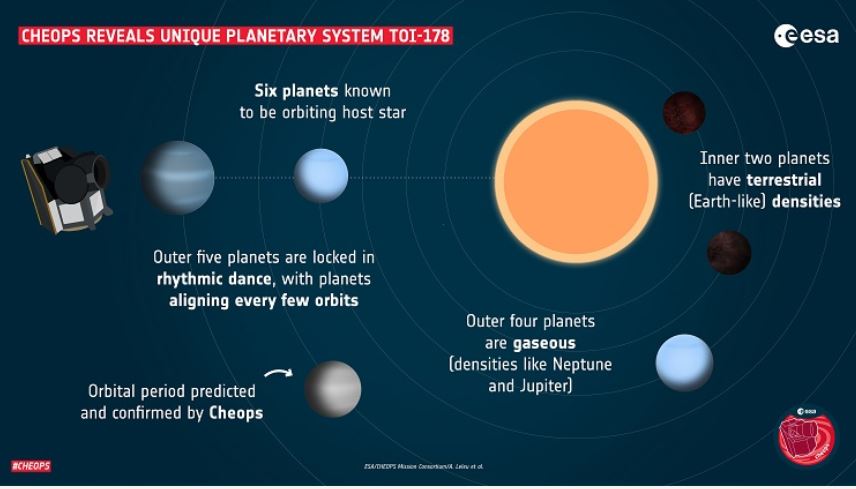
First study with CHEOPS Data describes one of the most Extreme Planets in the Universe

https://www.unibe.ch/news/media_news/media_relations_e/media_releases/2020/media_releases_2020/first_study_with_cheops_data_describes_one_of_the_most_extreme_planets_in_the_universe/index_eng.html?fbclid=IwAR2VtVi0lleu0dXaVp2_jT1jOf3dB3H86GCW0sare7tOVhMOwJSX3RSZVsI

Observations with the space telescope reveal details of the exoplanet WASP-189b – one of the most extreme planets known. Eight months after the space telescope CHEOPS started its journey into space, the first scientific publication using data from CHEOPS has been issued. CHEOPS is the first ESA mission dedicated to characterising known exoplanets. Exoplanets, i.e...

Read More