Category Astronomy/Space

New observations of Black Hole devouring a Star Reveal Rapid Disk Formation

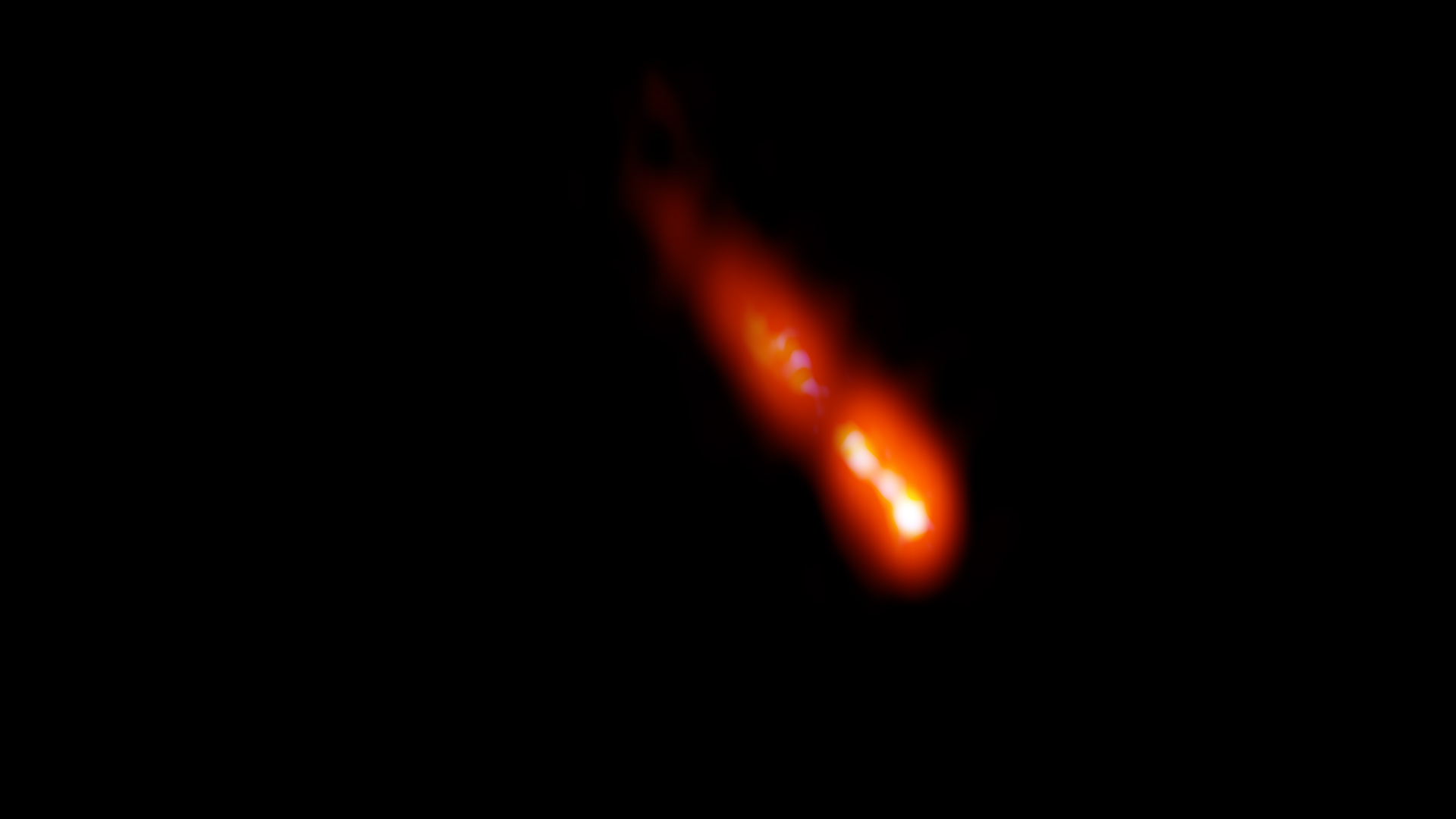
tde-simulation-450.jpg
This image from a computer simulation shows the rapid formation of an accretion disk during the disruption of a star by a supermassive black hole. (Image credit: Jamie Law-Smith and Enrico Ramirez-Ruiz)

When a star passes too close to a supermassive black hole, tidal forces tear it apart, producing a bright flare of radiation as material from the star falls into the black hole. Astronomers study the light from these “tidal disruption events” (TDEs) for clues to the feeding behavior of the supermassive black holes lurking at the centers of galaxies.

New TDE observations led by astronomers at UC Santa Cruz now provide clear evidence that debris from the star forms a rotating disk, ie an accretion disk, around the black hole...

Read More

Galactic Bar Paradox Resolved in Cosmic Dance

Snapshots from a Milky Way galaxy simulation. The bar in the centre and the spiral arms are thought to rotate at different speeds. If they are disconnected the bar shows its true and smaller structure (left). Every time they meet, the bar appears longer and its rotation slower (right).
Credit T. Hilmi / University of Surrey
Licence type Attribution (CC BY 4.0)

New light has been shed on a mysterious and long-standing conundrum at the very heart of our galaxy. The new work offers a potential solution to the so-called ‘Galactic bar paradox’, whereby different observations produce contradictory estimates of the motion of the central regions of the Milky Way. The results are published in Monthly Notices of the Royal Astronomical Society.

The majority of spiral galaxies, like our home the ...

Read More

Ancient Star explosions revealed in Deep-sea Sediments

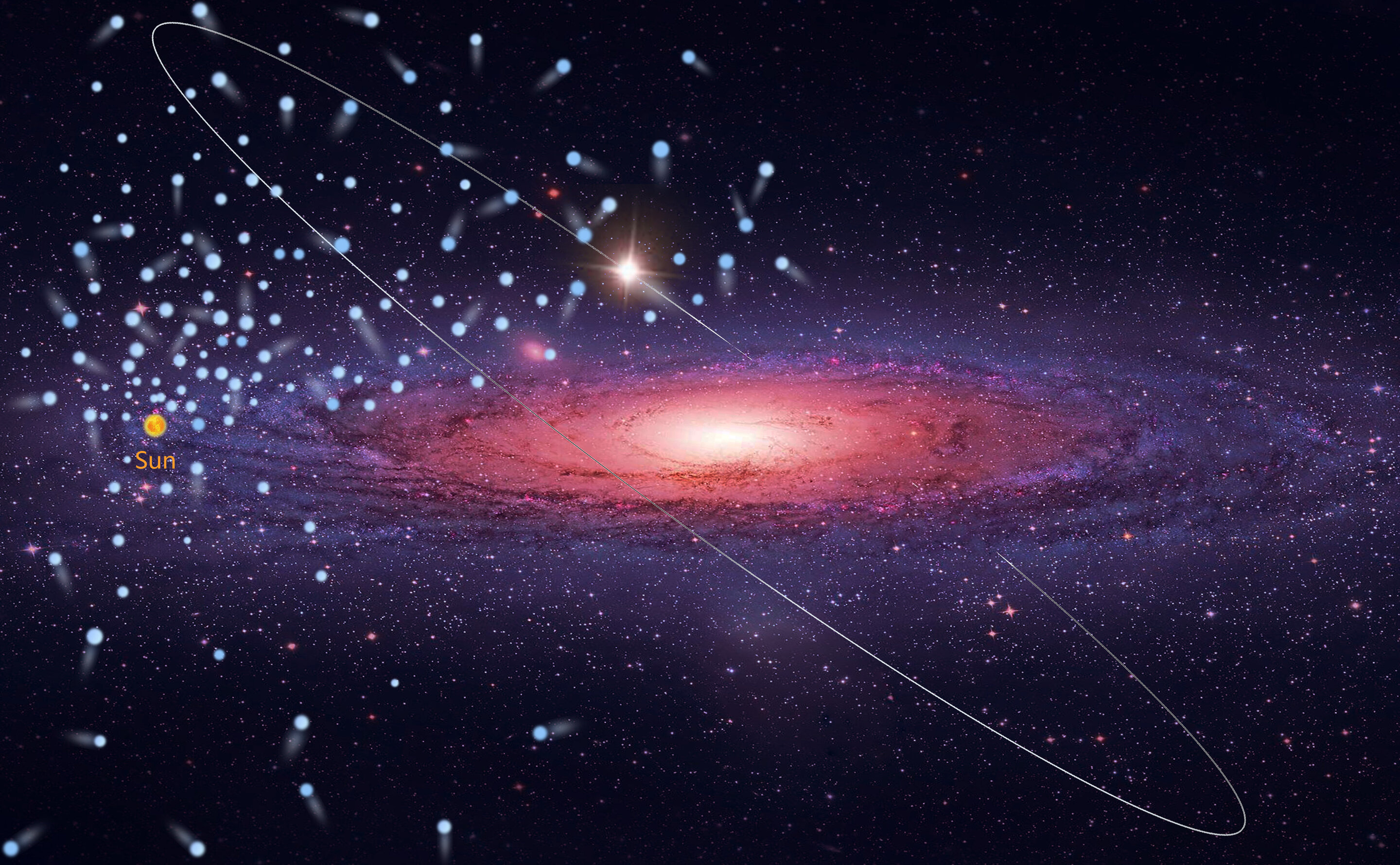
A mystery surrounding the space around our solar system is unfolding thanks to evidence of supernovae found in deep-sea sediments.

Professor Anton Wallner, a nuclear physicist at ANU, led the study which shows Earth has been travelling for the last 33,000 years through a cloud of faintly radioactive dust.

“These clouds could be remnants of previous supernova explosions, a powerful and super bright explosion of a star,” Professor Wallner said.

Professor Wallner conducted the research at the ANU Heavy Ion Accelerator Facility (HIAF). He also holds joint positions at the Helmholtz-Zentrum Dresden-Rossendorf (HZDR) and Technical University Dresden (TUD) in Germany.

The researchers searched through several deep-sea sediments from two different locations that date back 33,000 years using the...

Read More

Asteroid 2018 VP₁ may be heading for Earth. But there’s no need to worry

The orbit of asteroid 2018 VP₁ intersects Earth’s orbit once every two years. NASA / JPL

Social media around the world lit up over the weekend, discussing the possibility that an asteroid (known as 2018 VP₁) could crash into Earth on November 2. But you can rest easy. The asteroid does not pose a threat to life on Earth. Most likely, it will sail harmlessly past our planet. At worst, it will burn up harmlessly in our atmosphere and create a firework show for some lucky Earthlings.

So, what’s the story?

Our story begins a couple of years ago, on November 3, 2018. That night, the Zwicky Transient Facility at Palomar Observatory in Southern California discovered a faint new “near-Earth asteroid”—an object whose orbit can approach, or cross, that of our planet.

At the time...

Read More