Category Astronomy/Space

Image: Hubble captures Supernova Host Galaxy

This image from the NASA/ESA Hubble Space Telescope features the spectacular galaxy NGC 2442, nicknamed the Meathook galaxy owing to its extremely asymmetrical and irregular shape.

This image from the NASA/ESA Hubble Space Telescope features the spectacular galaxy NGC2442, nicknamed the Meathook galaxy owing to its extremely asymmetrical and irregular shape.

This galaxy was host to a supernova explosion spotted in March 2015, known as SN2015F, that was created by a white dwarf star. The white dwarf was part of a binary star system and siphoned mass from its companion, eventually becoming too greedy and taking on more than it could handle.

This unbalanced the star and triggered runaway nuclear fusion that eventually led to an intensely violent supernova explosion.

The supernova...

Read More

Hubble snaps close-up of Celebrity Comet NEOWISE

This ground-based image of comet C/2020 F3 (NEOWISE) was taken from the Northern Hemisphere on July 16, 2020. The inset image, taken by the Hubble Space Telescope on Aug. 8, 2020, reveals a close-up of the comet after its pass by the Sun. Hubble’s image zeroes in on the comet’s nucleus, which is too small to be seen. It’s estimated to measure no more than 3 miles (4.8 kilometers) across. Instead, the image shows a portion of the comet’s coma, the fuzzy glow, which measures about 11,000 miles (18,000 kilometers) across in this image. Comet NEOWISE won’t pass through the inner solar system for another nearly 7,000 years.
Credits: NASA, ESA, STScI, Q. Zhang (Caltech); ground-based image copyright © 2020 by Zoltan G. Levay, used with permission

NASA Hubble Space Telescope images ...

Read More

Mystery Gas discovered near Center of Milky Way

Credit: ESO/B. Tafreshi/ TWAN

An international team of researchers have discovered a dense, cold gas that’s been shot out from the centre of the Milky Way “like bullets.”

Exactly how the gas has been ejected is still a mystery, but the research team, including Professor Naomi McClure-Griffiths from The Australian National University (ANU), say their findings could have important implications for the future of our galaxy.

“Galaxies can be really good at shooting themselves in the foot,” Professor McClure-Griffiths said.

“When you drive out a lot of mass, you’re losing some of the material that could be used to form stars, and if you lose enough of it, the galaxy can’t form stars at all anymore.

“So, to be able to see hints of the Milky Way losing this star forming gas is kin...

Read More

Exploding Stars may have caused Mass Extinction on Earth, study shows

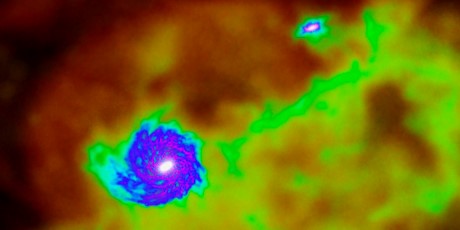
A team of researchers led by professor Brian Fields hypothesizes that a supernova about 65 light-years away may have contributed to the ozone depletion and subsequent mass extinction of the late Devonian Period, 359 million years ago. Pictured is a simulation of a nearby supernova colliding with and compressing the solar wind. Earth’s orbit, the blue dashed circle, and the Sun, red dot, are shown for scale.
Graphic courtesy Jesse Miller

Imagine reading by the light of an exploded star, brighter than a full moon – it might be fun to think about, but this scene is the prelude to a disaster when the radiation devastates life as we know it...

Read More