Category Astronomy/Space

Researchers track slowly splitting ‘Dent’ in Earth’s Magnetic Field

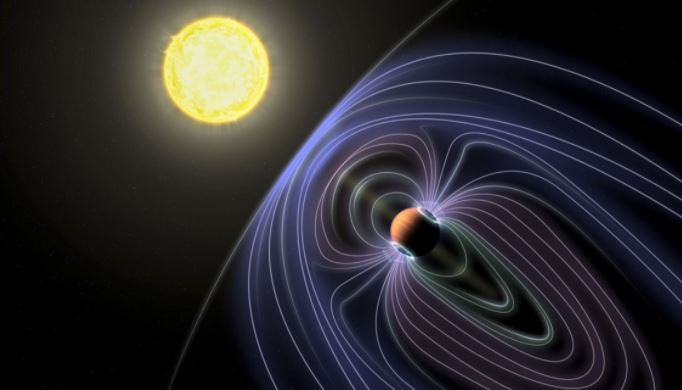
Earth’s magnetic field acts like a protective shield around the planet, repelling and trapping charged particles from the Sun. But over South America and the southern Atlantic Ocean, an unusually weak spot in the field – called the South Atlantic Anomaly, or SAA – allows these particles to dip closer to the surface than normal. Currently, the SAA creates no visible impacts on daily life on the surface. However, recent observations and forecasts show that the region is expanding westward and continuing to weaken in intensity. The South Atlantic Anomaly is also of interest to NASA’s Earth scientists who monitor the changes in magnetic strength there, both for how such changes affect Earth’s atmosphere and as an indicator of what’s happening to Earth’s magnetic fields, deep inside the globe...
Read More

Experiments Replicate High Densities in ‘White Dwarf’ Stars

To study the pressures created by white dwarf stars, researchers fired nanometer laser light into a hohlraum—a tiny gold cylinder—bathing a 1 mm sample of a carbon-based compound in radiation heated to nearly 3.5 million degrees, at pressures ranging from 100 to 450 million atmospheres. (Illustration courtesy of Lawrence Livermore National Laboratory)

Findings could shed light on creating new materials on Earth. For the first time, researchers have found a way to describe conditions deep in the convection zone of “white dwarf” stars, which are home to some of the densest collections of matter in the Universe.

In a project conducted at the National Ignition Facility at Lawrence Livermore National Laboratory, the research team, including University of Rochester engineering profess...

Read More

Aurora mysteries unlocked with NASA’s THEMIS mission

The photograph was taken east of Saskatoon on winter solstice in 2015 with a 81% illuminated waxing gibbous Moon. It was processed with PixInsight to remove streaks caused due to an accidentally nudged tripod during exposure while attempting to retain realistic star shapes and colors. The exposure time was 2.5 seconds. Credit: Alan Duffy

A special type of aurora, draped east-west across the night sky like a glowing pearl necklace, is helping scientists better understand the science of auroras and their powerful drivers out in space. Known as auroral beads, these lights often show up just before large auroral displays, which are caused by electrical storms in space called substorms...

Read More

How Stars form in the Smallest Galaxies

Image: ESO
Image: ESO

The question of how small, dwarf galaxies have sustained the formation of new stars over the course of the Universe has long confounded the world’s astronomers. An international research team led by Lund University in Sweden has found that dormant small galaxies can slowly accumulate gas over many billions of years. When this gas suddenly collapses under its own weight, new stars are able to arise.

There are around 2,000 billion galaxies in our Universe and, while our own Milky-Way encompasses between 200 and 400 billion stars, small dwarf galaxies contain only a thousand times less. How stars are formed in these tiny galaxies has long been shrouded in mystery.

However, in a new study published in the research journal Monthly Notices of the Royal Astronomical Society, a resea...

Read More