Category Astronomy/Space

Possibly Active Tectonic System on the Moon

Infrared (upper left) and other images from NASA’s Lunar Reconnaissance Orbiter revealed strange bare spots where the Moon’s ubiquitous dust is missing. The spots suggest an active tectonic process. 

Researchers have discovered a system of ridges spread across the nearside of the Moon topped with freshly exposed boulders. The ridges could be evidence of active lunar tectonic processes, the researchers say, possibly the echo of a long-ago impact that nearly tore the Moon apart.

“There’s this assumption that the Moon is long dead, but we keep finding that that’s not the case,” said Peter Schultz, a professor in Brown University’s Department of Earth, Environmental and Planetary Sciences and co-author of the research, which is published in the journal Geology...

Read More

Astronomers capture Rare Images Planet-forming Disks around Stars

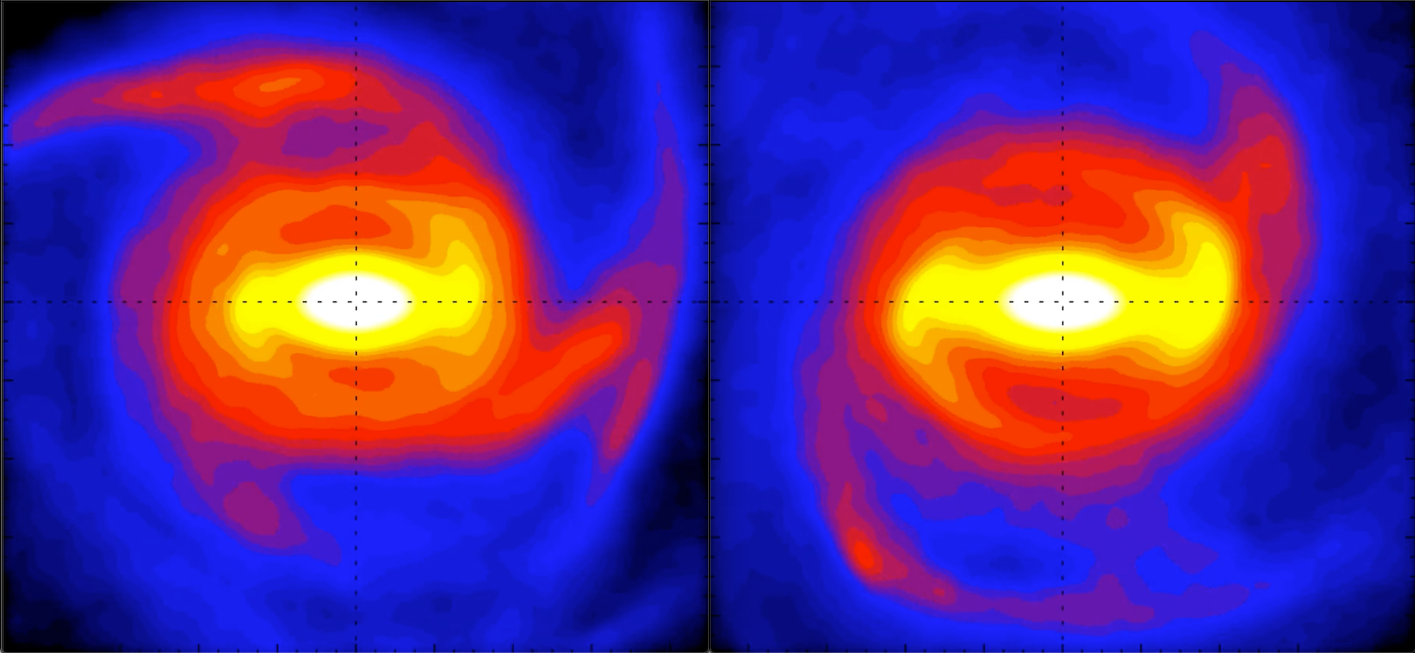
The protoplanetary disks around the R CrA (left) and HD45677 (right) stars, captured with ESO’s Very Large Telescope Interferometer. The orbits are added for reference. The star serves the same purpose, since its light was filtered out to get a more detailed image of the disk. Credit: Jacques Kluska et al.

An international team of astronomers has captured fifteen images of the inner rims of planet-forming disks located hundreds of light years away. These disks of dust and gas, similar in shape to a music record, form around young stars. The images shed new light on how planetary systems are formed. They were published in the journal Astronomy & Astrophysics.

To understand how planetary systems, including our own, take shape, you have to study their origins...

Read More

Newly discovered Exoplanet Dethrones former king of Kepler-88 planetary system

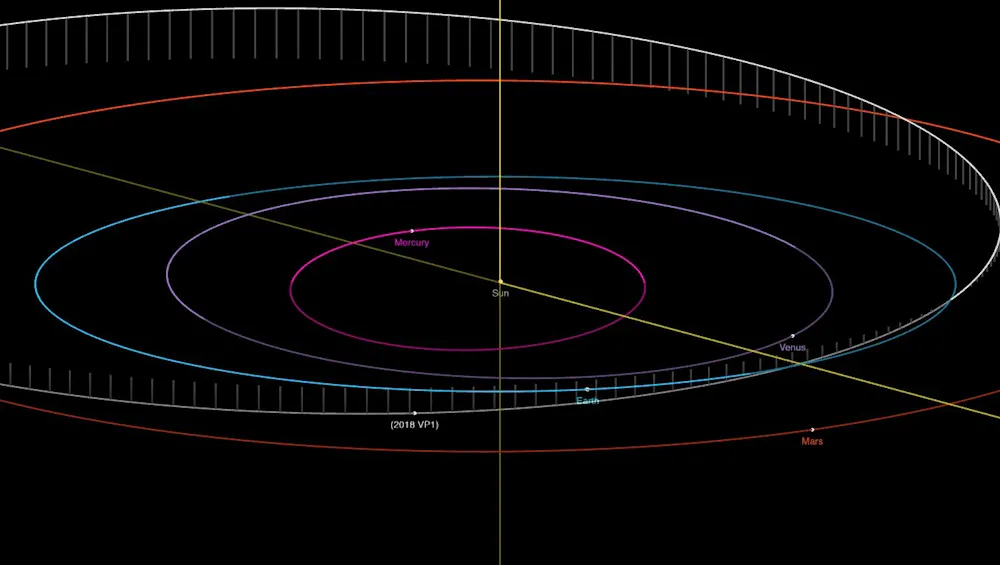
An artist’s illustration of the Kepler-88 planetary system. CREDIT: W. M. KECK OBSERVATORY/ADAM MAKARENKO

Our solar system has a king. The planet Jupiter, named for the most powerful god in the Greek pantheon, has bossed around the other planets through its gravitational influence. With twice the mass of Saturn, and 300 times that of Earth, Jupiter’s slightest movement is felt by all the other planets. Jupiter is thought to be responsible for the small size of Mars, the presence of the asteroid belt, and a cascade of comets that delivered water to young Earth.

Do other planetary systems have gravitational gods like Jupiter?

A team of astronomers led by the University of Hawaii Institute for Astronomy (UH IfA) has discovered a planet three times the mass of Jupiter in a distant ...

Read More

Spitzer Telescope reveals the Precise Timing of a Black Hole Dance

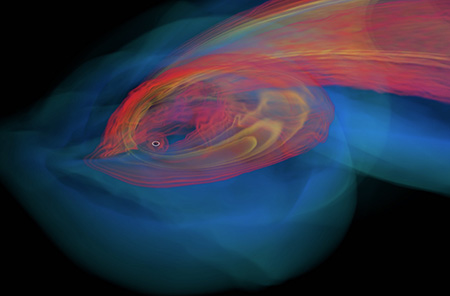
This image shows two massive black holes in the OJ 287 galaxy. The smaller black hole orbits the larger one, which is also surrounded by a disk of gas. When the smaller black hole crashes through the disk, it produces a flare brighter than 1 trillion stars. Credit: NASA/JPL-Caltech

Scientists have finally figured out the precise timing of a complicated dance between two enormous black holes, revealing hidden details about the physical characteristics of these mysterious cosmic objects.

Black holes aren’t stationary in space; in fact, they can be quite active in their movements. But because they are completely dark and can’t be observed directly, they’re not easy to study.

The OJ 287 galaxy hosts one of the largest black holes ever found, with over 18 billion times the mass of our...

Read More