Category Astronomy/Space

Hubble captures Breakup of Comet ATLAS

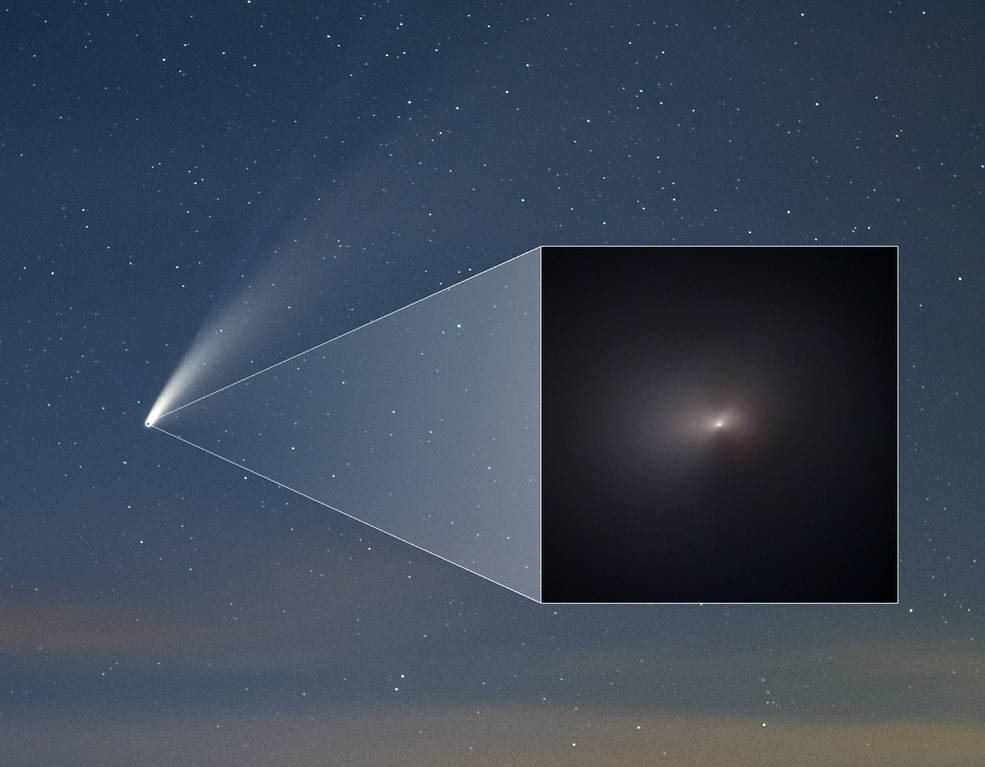
The NASA/ESA Hubble Space Telescope has provided astronomers with the sharpest view yet of the breakup of Comet C/2019 Y4 (ATLAS). The telescope resolved roughly 30 fragments of the fragile comet on 20 April and 25 pieces on 23 April.

The NASA/ESA Hubble Space Telescope has provided astronomers with the sharpest view yet of the breakup of Comet C/2019 Y4 (ATLAS). The telescope resolved roughly 30 fragments of the fragile comet on 20 April and 25 pieces on 23 April.

The comet was first discovered in December 2019 by the ATLAS (Asteroid Terrestrial-impact Last Alert System) robotic astronomical survey system in Hawaiʻi, USA...

Read More

‘Elegant’ Solution reveals how the universe got its structure

Why is the distribution of structure in the cosmos not uniform? The universe’s first structure originated when some of the material flung outward by the Big Bang overcame its trajectory and collapsed on itself, forming clumps. A team of Carnegie researchers showed that denser clumps of matter grew faster, and less-dense clumps grew more slowly. The group’s data revealed the distribution of density in the universe over the last 9 billion years. (On the illustration, violet represents low-density regions and red represents high-density regions.) Working backward in time, their findings reveal the density fluctuations (far right, in purple and blue) that created the universe’s earliest structure...
Read More

World’s first 3D Simulations of Superluminous Supernovae


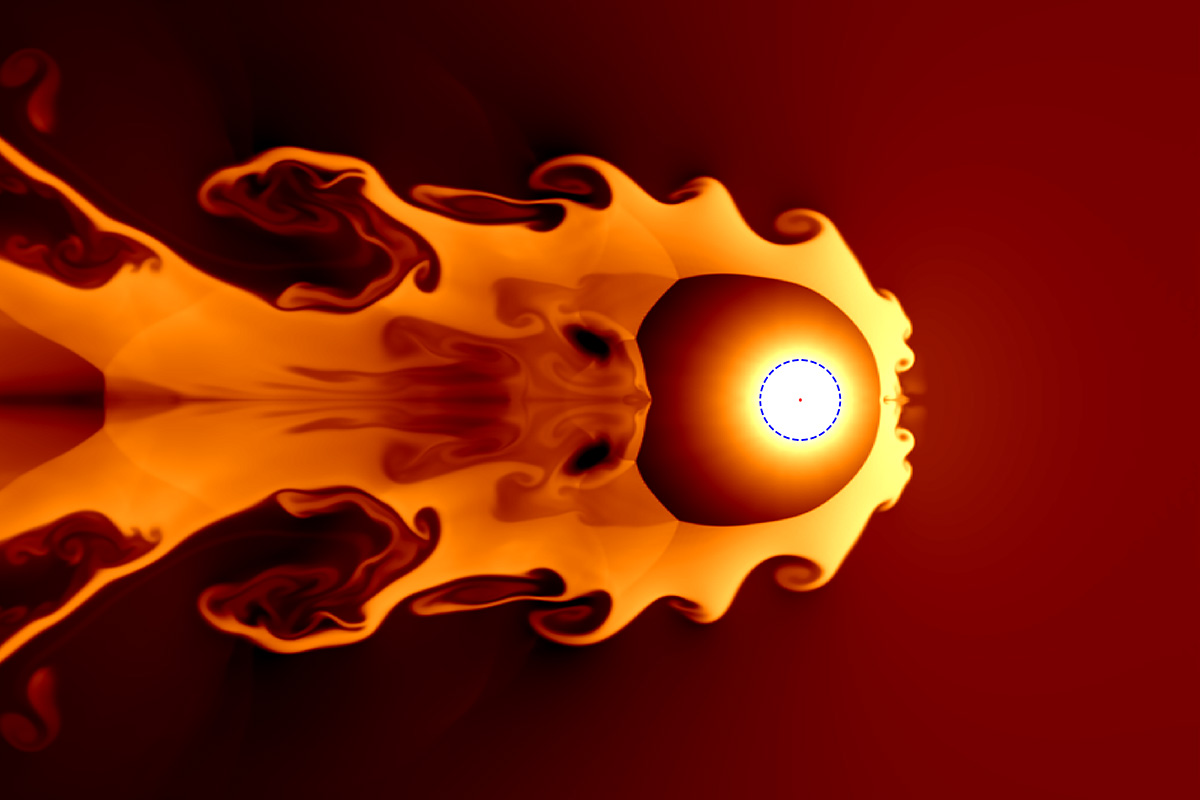
The nebula phase of the magnetar-powered super-luminous supernova from our 3D simulation. At the moment, the supernova ejecta has expanded to a size similar to the solar system. Large scale mixing appears at the outer and inner region of ejecta. The resulting light curves and spectra are sensitive to the mixing that depends on stellar structure and the physical properties of magnetar. Credit: Ken Chen

For most of the 20th century, astronomers have scoured the skies for supernovae—the explosive deaths of massive stars—and their remnants in search of clues about the progenitor, the mechanisms that caused it to explode, and the heavy elements created in the process. In fact, these events create most of the cosmic elements that go on to form new stars, galaxies, and life.

Because no...

Read More

Researchers use ‘Hot Jupiter’ data to Mine Exoplanet Chemistry

Atmospheric gases recede from a “hot Jupiter,” which is a Jupiter-size, egg-shaped planet that orbits close to its own sun, in this artistic rendering. Cornell astronomers have developed a new mathematical model for determining temperatures on different parts of exoplanets, rather than averaging a planet’s temperature. Matthew Fondeur/Cornell University

After spotting a curious pattern in scientific papers – they described exoplanets as being cooler than expected – Cornell University astronomers have improved a mathematical model to accurately gauge the temperatures of planets from solar systems hundreds of light-years away.

This new model allows scientists to gather data on an exoplanet’s molecular chemistry and gain insight on the cosmos’ planetary beginnings, according to research...

Read More