Category Astronomy/Space

On the Origin of Massive Stars

This scene of stellar creation, captured by the NASA/ESA Hubble Space Telescope, sits near the outskirts of the famous Tarantula Nebula. This cloud of gas and dust, as well as the many young and massive stars surrounding it, is the perfect laboratory to study the origin of massive stars.

A scene of stellar creation, captured by the NASA/ESA Hubble Space Telescope, sits near the outskirts of the famous Tarantula Nebula. This cloud of gas and dust, as well as the many young and massive stars surrounding it, is the perfect laboratory to study the origin of massive stars.

The bright pink cloud and the young stars surrounding it in this image taken with the NASA/ESA Hubble Space Telescope have the uninspiring name LHA 120-N 150...

Read More

New Telescope design could Capture Distant Celestial objects with Unprecedented Detail

A new multi-field hypertelescope design could image multiple stars at once with high resolution. Hypertelescopes use large arrays of mirrors with space between them. The multi-field design could be incorporated into the hypertelescope prototype being tested in the Alps (pictured).
Credit: Antoine Labeyrie, Collège de France and Observatoire de la Cote d’Azur

Researchers have designed a new camera that could allow hypertelescopes to image multiple stars at once. The enhanced telescope design holds the potential to obtain extremely high-resolution images of objects outside our solar system, such as planets, pulsars, globular clusters and distant galaxies.

“A multi-field hypertelescope could, in principle, capture a highly detailed image of a star, possibly also showing its planets and e...

Read More

Black Hole team discovers path to Razor-sharp Black Hole Images

George Wong (UIUC) and Michael Johnson (CfA)The image of a black hole has a bright ring of emission surrounding a “shadow” cast by the black hole. This ring is composed of a stack of increasingly sharp subrings that correspond to the number of orbits that photons took around the black hole before reaching the observer.

A team of researchers have published new calculations that predict a striking and intricate substructure within black hole images from extreme gravitational light bending. Last April, the Event Horizon Telescope (EHT) sparked international excitement when it unveiled the first image of a black hole...

Read More

Turbulent Convection at the Heart of Stellar Activity

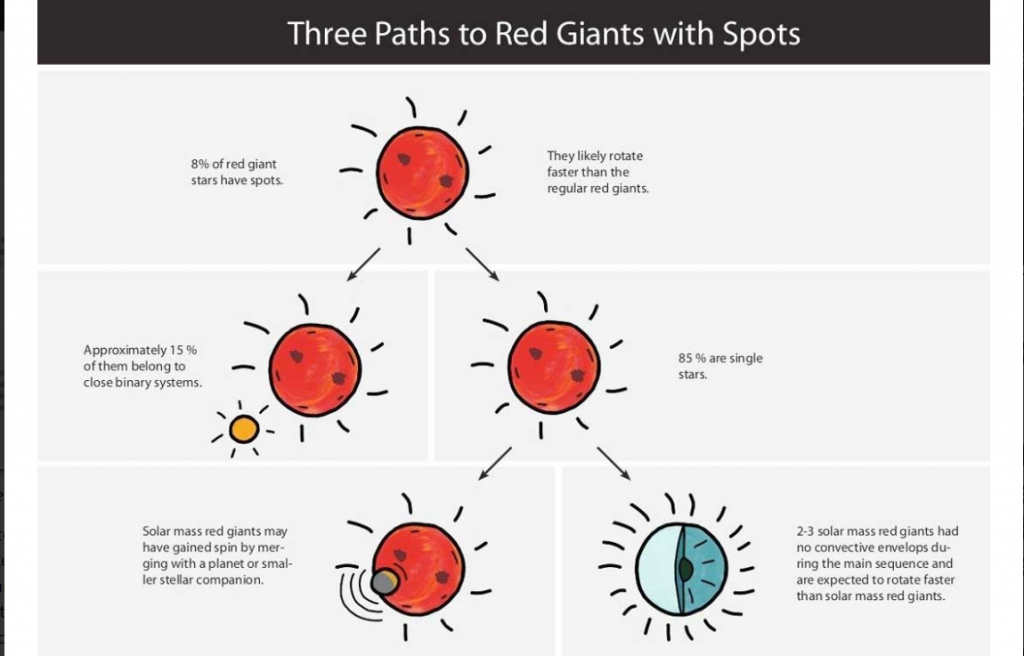
A look into the interior of the Sun and a more evolved giant star.
© MPS / Aalto University / hormesdesign.de

Different stars can exhibit different levels of activity. The Sun’s signs of solar activity are rather feeble on an astronomical scale. Other stars are up to ten times more active. While researchers have identified the magnetic fields generated in the interior of stars in a dynamo process as drivers of activity, the exact workings of this dynamo are unclear. Scientists now find that a common, turbulence-dependent dynamo mechanism plays a crucial role for stellar activity in all stages of stellar evolution.

In their interiors, stars are structured in a layered, onion-like fashion. In those with solar-like temperatures, the core is followed by the radiation zone...

Read More