
Category Biology/Biotechnology

New Research Backs Belief that Tomatoes can be a Gout Trigger

Gout is a painful and debilitating form of arthritis that affects approximately 3X more men than women. 4 to 5% of European men in NZ suffer from gout. Amongst Māori and Pacific Island men this figure rises to 10-15% due to a greater genetic risk in these people.

The researchers surveyed 2051 New Zealanders with clinically verified gout. Of these people 71% reported having one or more food triggers. Tomatoes were listed as a trigger in 20% of these cases. Genetics PhD student Tanya Flynn, says that tomatoes were found to be the 4th most commonly mentioned trigger, after seafood, alcohol and red meat.

“We thought it important to find a biological reason for this to add weight to what gout patients are already saying,” Miss Flynn says...

Read More
Hot Chilli may Unlock a new Rx for

A high-fat diet may impair important receptors located in the stomach that signal fullness, researchers have discovered. They investigated the association between hot chilli pepper receptors (TRPV1) in the stomach and the feeling of fullness, in lab studies, suggesting that their work will inform further studies and the development of new therapies.

“The stomach stretches when it is full, which activates nerves in the stomach to tell the body that it has had enough food. We found that this activation is regulated through hot chilli pepper or TRPV1 receptors,” says Associate Professor Amanda Page. “It is known from previous studies that capsaicin, found in hot chillies, reduces food intake in humans...

Read More

Building Computers from DNA?

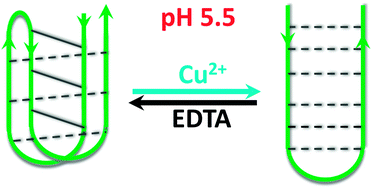
Graphical abstract: Reversible DNA i-motif to hairpin switching induced by copper(ii) cations

i-Motif DNA structures have previously been utilised for many different nanotechnological applications, but all have used changes in pH to fold the DNA. Herein we describe how copper(II) cations can alter the conformation of i-motif DNA into an alternative hairpin structure which is reversible by chelation with EDTA

Scientists can now ‘switch’ the structure of DNA using copper salts and EDTA. Ethylenediaminetetraacetic acid is an agent commonly found in shampoo and other household products. The applications for this discovery include nanotechnology – where DNA is used to make tiny machines, and in DNA-based computing – where computers are built from DNA rather than silicon...

Read More

Comet Impacts may have led to Life on Earth – and perhaps elsewhere

C/2006 P1 Comet McNaught, the 'Great Comet of 2007', as seen from Swift's Creek, Victoria, Australia on 23 January 2007. Image credit: Fir0002 / Flagstaffotos / Wikimedia Commons CC BY-SA 3.0.

C/2006 P1 Comet McNaught, the ‘Great Comet of 2007′, as seen from Swift’s Creek, Victoria, Australia on 23 January 2007. Image credit: Fir0002 / Flagstaffotos / Wikimedia Commons CC BY-SA 3.0.

Substantial synthesis of peptides – the first building blocks of life may have been driven by comet impacts. Dr Sugahara from JAMSTEC in Yokahama, and Dr Koichi Mimura, from Nagoya University performed a series of experiments to mimic the conditions of comet impacts on the Early Earth at the time when life first appeared, around 4 billion years ago.

They took frozen mixtures of amino acid, water ice and silicate (forsterite) at cryogenic condition (77 K), and used a propellant gun to simulate the shock of a comet impact...

Read More