Category Biology/Biotechnology

Daily Multivitamin may Improve Cognition and Possibly Protect Against Decline, study suggests

Three-year change in the episodic memory composite (A) and executive function composite (B) for the active and placebo multivitamin-mineral groups (plotted values: mean standardized (z) scores and 95% confidence intervals).

In the study, researchers estimated that three years of multivitamin supplementation roughly translated to a 60-percent slowing of cognitive decline (about 1.8 years).

Could taking a daily multivitamin help maintain cognitive health with aging and possibly prevent cognitive decline? According to new research from Wake Forest University School of Medicine, conducted in collaboration with Brigham and Women’s Hospital in Boston, taking a daily supplement may improve cognition in older adults, but additional studies are needed to confirm these findings before any hea...

Read More

Risk Factor for developing Alzheimer’s Disease Increases by 50-80% in Older Adults who caught COVID-19

Risk factor for developing Alzheimer's disease increases by 50-80% in older  adults who caught Covid | Mirage News

Older people who were infected with COVID-19 show a substantially higher risk — as much as 50% to 80% higher than a control group — of developing Alzheimer’s disease within a year, according to a study of more than 6 million patients 65 and older.

In a study published today in the Journal of Alzheimer’s Disease, researchers report that people 65 and older who contracted COVID-19 were more prone to developing Alzheimer’s disease in the year following their COVID diagnosis. And the highest risk was observed in women at least 85 years old.

The findings showed that the risk for developing Alzheimer’s disease in older people nearly doubled (0.35% to 0.68%) over a one-year period following infection with COVID...

Read More

Scientists discover how Cells Repair Longevity-promoting ‘Recycling System’

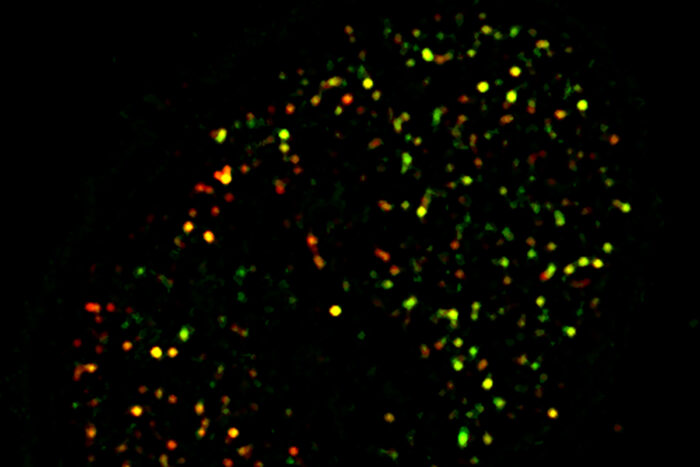
University of Pittsburgh researchers describe for the first time a pathway by which cells repair damaged lysosomes, structures that contribute to longevity by recycling cellular trash. The findings are an important step towards understanding and treating age-related diseases driven by leaky lysosomes.

“Lysosome damage is a hallmark of aging and many diseases, particularly neurodegenerative disorders such as Alzheimer’s,” said lead author Jay Xiaojun Tan, Ph.D., assistant professor of cell biology at Pitt’s School of Medicine and member of the Aging Institute, a partnership between Pitt and UPMC. “Our study identifies a series of steps that we believe is a universal mechanism for lysosomal repair, which we named the PITT pathway as a nod to the University of Pittsburgh.”

As the c...

Read More

Family ties: Inherited Genetic Variants Increase Risk of Hodgkin Lymphoma

(L to R) Ninad Oak Ph.D., Jamie Flerlage M.D., Jason Myers, and Evadnie Rampersaud, Ph.D. Not pictured: Jun J. Yang Ph.D. and Jamie Maciaszek Ph.D.

Why did my child get cancer? Clinicians have longed for a way to help answer this question. Doctors knew Hodgkin lymphoma sometimes occurs in families, but why this happens has been a mystery. Scientists at St. Jude Children’s Research Hospital have now helped solve it. The researchers studied multiple families affected by Hodgkin lymphoma and identified genetic variants linked to an increased risk of developing the disease. The findings appeared as a first edition in Blood.

Hodgkin lymphoma is a cancer of the lymphatic system (part of the immune system) that affects lymph nodes but can spread to the spleen, liver, bone marrow and lungs...

Read More