The mTOR protein plays a central role in cell growth, proliferation and survival. Its activity varies according to the availability of nutrients and some growth factors, including hormones. This protein is implicated in several diseases, including cancer, where its activity frequently increases...
Magnetic bacteria (grey) can squeeze through narrow intercellular spaces to cross the blood vessel wall and infiltrate tumours. (Visualisations: Yimo Yan / ETH Zurich)
Researchers at ETH Zurich are planning to use magnetic bacteria to fight cancerous tumours. They have now found a way for these microorganisms to effectively cross blood vessel walls and subsequently colonise a tumour.
Scientists around the world are researching how anti-cancer drugs can most efficiently reach the tumours they target. One possibility is to use modified bacteria as “ferries” to carry the drugs through the bloodstream to the tumours. Researchers at ETH Zurich have now succeeded in controlling certain bacteria so that they can effectively cross the blood vessel wall and infiltrate tumour tissue.
Researchers at the University of Illinois Chicago have found a small molecule capable of manipulating an immune process that plays an important role in cancers and autoimmune diseases.
Their discovery is reported in an Angewandte Chemie paper titled “Discovery of the First Selective Nanomolar Inhibitors of ERAP2 by Kinetic Target-Guided Synthesis.”
They discovered the molecule — and enzyme inhibitor — after first studying how the immune system works and why some diseases can be resistant to treatments.
“Tumors have the ability to present cell-surface markers in the form of non-self peptide antigens, or neoantigens, which renders them exquisitely sensitive to recognition and elimination by T-cells, a form of immune cells that kill tumor cells upon recognition of neoantigens,” ...
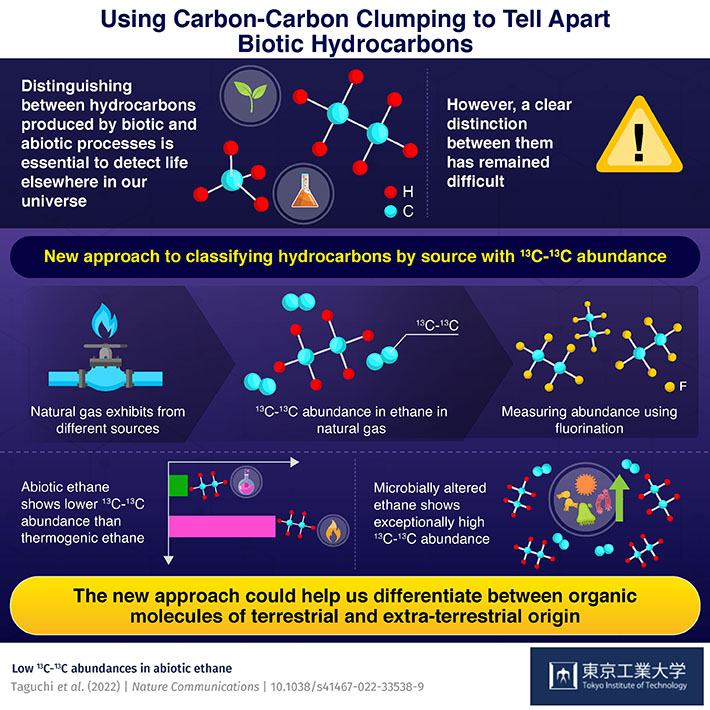
The mystery of the origin of hydrocarbons found in extraterrestrial environment may finally be resolved, thanks to a technique based on a 13C-13C abundance analysis. By measuring the abundance of clumped 13C-13C isotope in the hydrocarbons, it can be inferred if a hydrocarbon was produced via biological processes. This could open doors to distinguishing such hydrocarbons from abiotic ones, aiding our search for extraterrestrial life.
An important signature of life is the existence of organic molecules that have originated from biological processes. The most common organic molecule found in all life forms are hydrocarbons. However, they need not be of biotic origin, i.e., produced from thermal decomposition of sedimentary organic matter or microbes...





Recent Comments