Category Biology/Biotechnology

Increased Consumption of Whole Grains could significantly Reduce the Economic Impact of Type 2 Diabetes

Increased consumption of whole grain foods could significantly reduce the incidence of type 2 diabetes and the costs associated with its treatment in Finland, according to a recent study by the University of Eastern Finland and the Finnish Institute for Health and Welfare. The findings were published in Nutrients.

“Our study shows that already one serving of full grains as part of the daily diet reduces the incidence of type 2 diabetes at the population level and, consequently, the direct diabetes-related costs, when compared to people who do not eat whole grain foods on a daily basis. Over the next ten years, society’s potential to achieve cost savings would be from 300 million (-3.3%) to almost one billion (-12...

Read More

Chip-Based Optical Tweezers Levitate Nanoparticles in a Vacuum

Schematic of optically levitating a nanoparticle with a metalens in a vacuum. The metalens focuses a laser beam to create chip-based optical tweezers.
Credit: Kunhong Shen, Purdue University

Metalens-based design shrinks footprint, making optical traps practical for precision sensing and measurements.

Researchers have created tiny chip-based optical tweezers that can be used to optically levitate nanoparticles in a vacuum. Optical tweezers — which employ a tightly focused laser beam to hold living cells, nanoparticles and other objects — can be used for a variety of precision measurements and sensing applications. However, these optical traps are usually produced with bulky optical components.

“By using an ultrathin metalens, we reduced the diameter of the focusing lens from about...

Read More

Scientists Design Nanoparticles that Communicate with Cancer Cells

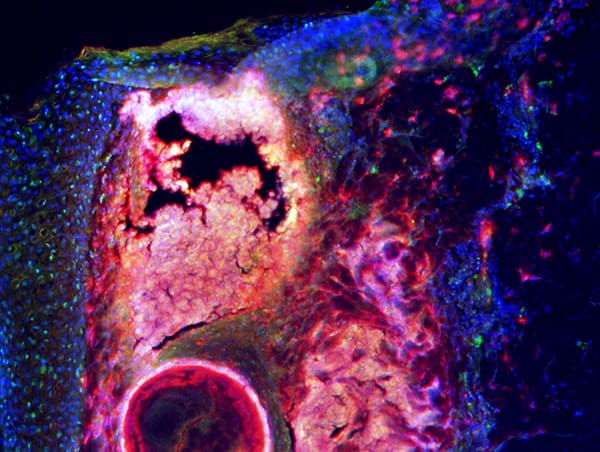
micriscopic image of nanoparticles (see caption)
Gold nanoparticle aggregates (red) are observed inside triple negative breast cancer cells after an enzyme-activated assembly and internalization process. (photo credit: Richard Huang and Ye He)

The breakthrough advance could lead to a novel, drug-free therapeutic that can slow, possibly stop, the growth of cancer cells. A multi-institutional research team has designed nanoparticles that can communicate with and slow the development of cancer cells. The work — detailed in a newly published paper in Advanced Materials — has uncovered a novel framework for the potential development of drug-free cancer therapies.

Led by scientists at the Advanced Science Research Center at the Graduate Center, CUNY (CUNY ASRC), the research team was able to design nanoparticles that are activated to se...

Read More

Americans Vaccinated Against Coronavirus Have Lower Mortality Rates — Even From Non-Covid Causes

Maryland County Vaccinates Minority Communities
Nurses draw Covid-19 vaccine doses from a vial on March 25, 2021 in Bowie, Maryland.
 
GETTY IMAGES

People who are vaccinated against Covid-19 are less likely to die for any reason — including from non-coronavirus causes — than the unvaccinated, according to a Centers for Disease Control and Prevention study released Friday, which researchers framed as more proof of the vaccines’ safety despite stubborn levels of vaccine hesitancy.

KEY FACTS
Partially and fully vaccinated people died from non-coronavirus causes at a lower rate than their unvaccinated peers, according to the study, which looked at millions of patients at seven U.S. health organizations from December to July.

All three vaccines approved by U.S...

Read More