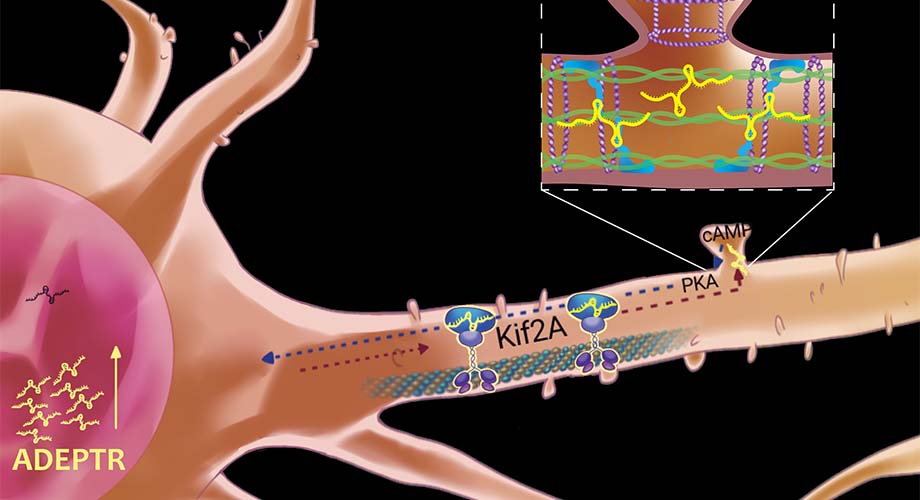
Treatment reverses paralysis in mice; offers a general delivery platform for neurologic drugs. Currently there’s no treatment for botulism once the toxin gets into neurons...
Read More

Treatment reverses paralysis in mice; offers a general delivery platform for neurologic drugs. Currently there’s no treatment for botulism once the toxin gets into neurons...
Read More
Engineers demonstrate a new shape-changing nozzle that could revolutionize ‘4D printing’ applications. Engineers at the University of Maryland (UMD) have created a new shape-changing or “morphing” 3D printing nozzle that was featured as a Frontispiece in the January 5th issue of the journal Advanced Materials Technologies.
The team’s morphing nozzle offers researchers new means for 3D printing “fiber-filled composites” — materials made up of short fibers that boost special properties over traditional 3D-printed parts, such as enhancing part strength or electrical conductivity. The challenge is that these properties are based on the directions or “orientations” of the short fibers, which has been difficult to control during the 3D printing process, until now.
“When 3D printing wi...
Read More
In a study to examine a Mediterranean diet in relation to prostate cancer progression in men on active surveillance, researchers from The University of Texas MD Anderson Cancer Center found that men with localized prostate cancer who reported a baseline dietary pattern that more closely follows the key principles of a Mediterranean-style diet fared better over the course of their disease.
“Men with prostate cancer are motivated to find a way to impact the advancement of their disease and improve their quality of life,” said Justin Gregg, M.D., assistant professor of Urology and lead author of the study, published today in Cancer. “A Mediterranean diet is non-invasive, good for overall health and, as shown by this study, has the potential to effect the progression of their cancer.”
...Read More
An international team of researchers led by Swinburne University of Technology has demonstrated the world’s fastest and most powerful optical neuromorphic processor for artificial intelligence (AI), which operates faster than 10 trillion operations per second (TeraOPs/s) and is capable of processing ultra-large scale data.
Published in the journal Nature, this breakthrough represents an enormous leap forward for neural networks and neuromorphic processing in general.
Artificial neural networks, a key form of AI, can ‘learn’ and perform complex operations with wide applications to computer vision, natural language processing, facial recognition, speech...
Read More
Recent Comments