Category Biology/Biotechnology

Remote Control of Blood Sugar: Electromagnetic Fields treat Diabetes in Animal Models

Study suggests EMFs alter redox signaling to improve insulin sensitivity. Researchers from the University of Iowa may have discovered a safe new way to manage blood sugar non-invasively. Exposing diabetic mice to a combination of static electric and magnetic fields for a few hours per day normalizes two major hallmarks of type 2 diabetes, according to new findings published Oct. 6 in Cell Metabolism.

“We’ve built a remote control to manage diabetes,” says Calvin Carter, PhD, one of the study’s lead authors and a postdoc in the lab of senior author Val Sheffield, MD, PhD, professor of pediatrics, and of ophthalmology and visual sciences at the UI Carver College of Medicine...

Read More

Drink Coffee After Breakfast, not before, for better Metabolic Control

Strong black coffee being poured by laptop.
The new study reports a negative impact from coffee on our blood sugar control after a bad night’s sleep. Image Credit: AdobeStock.

A strong, black coffee to wake you up after a bad night’s sleep could impair control of blood sugar levels, according to a new study.

Research from the Centre for Nutrition, Exercise & Metabolism at the University of Bath (UK) looked at the effect of broken sleep and morning coffee across a range of different metabolic markers.

Writing in the British Journal of Nutrition the scientists show that whilst one night of poor sleep has limited impact on our metabolism, drinking coffee as a way to perk you up from a slumber can have a negative effect on blood glucose (sugar) control.

Given the importance of keeping our blood sugar levels within a safe ra...

Read More

A Cancer Shredder

Krebs bekämpfen, indem eine neu entwickelte Substanz Krebs erregende Aurora-Proteine schreddert: Das ist das Ziel einer neuen Studie von Wissenschaftlern der Unis in Würzburg und Frankfurt. (Image: Dr. Sandy Pernitzsch)

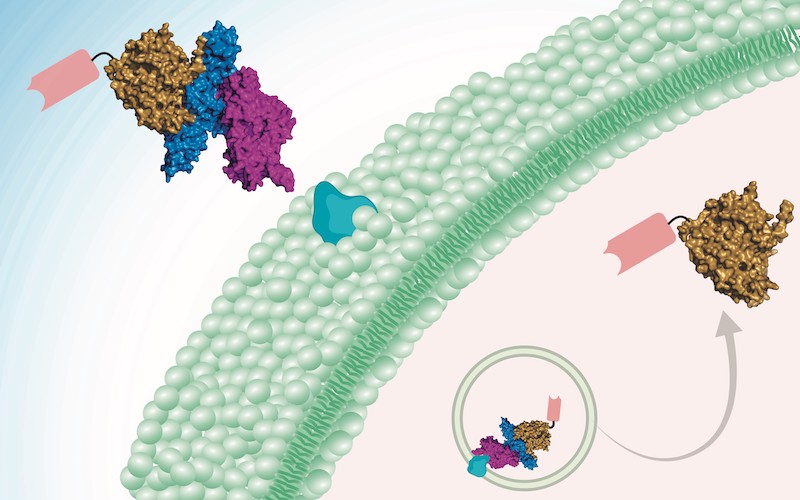
Substance with new mechanism of action found. Researchers have developed a new compound for treating cancer. It destroys a protein that triggers its development.

The villain in this drama has a pretty name: Aurora – Latin for dawn. In the world of biochemistry, however, Aurora (more precisely: Aurora-A kinase) stands for a protein that causes extensive damage. There, it has been known for a long time that Aurora often causes cancer. It triggers the development of leukemias and many pediatric cancers, such as neuroblastomas.

Researchers at the universities of Wür...

Read More

Neurons in Spinal-cord injuries are Reconnected in vivo via Carbon Nanotube Sponges

Neurons in spinal-cord injuries are reconnected in vivo via carbon nanotube sponges
From left to right: image of a healthy backbone (control); image of an injured backbone without an implant; image of an injured backbone in which the biocompatible nanomaterial has been implanted and where the neuronal reconnection can be observed. Credit: Author: Pedro Ramos / CIC biomaGUNE

Research conducted by two groups at the Center for Cooperative Research in Biomaterials CIC biomaGUNE and one at SISSA, Scuola Internazionale Superiore di Studi Avanzati (Italy), have shown that functional materials based on carbon nanotubes facilitate the reconnecting of neuronal networks damaged as a result of spinal cord injuries...

Read More