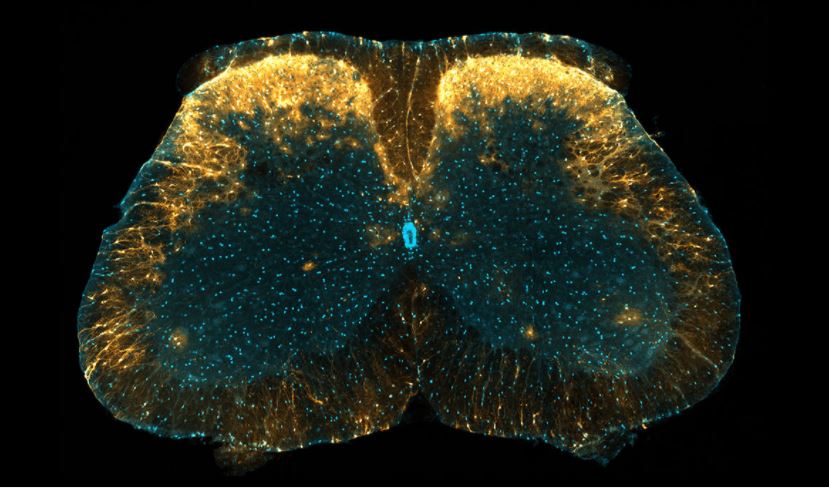
The image shows a series of suprachiasmatic nucleus slices expressing click beetle green in AVP neurons and click beetle red in non-AVP neurons. As time progresses (spiraling into the image), the AVP (green) and non-AVP (red) neurons luminesce together rhythmically, thanks to the intact genetic clocks of the AVP neurons and exchange of neuronal signals. Digital manipulation of bioluminescence images. Artwork by John Abel and Alta Lewis Millard. Credit: Neuron
A new mouse model helps researchers study the roles of cell types in keeping time inside the body. UT Southwestern scientists have developed a genetically engineered mouse and imaging system that lets them visualize fluctuations in the circadian clocks of cell types in mice...
: Dichotomous functions of HDAC3 orchestrate the inflammatory response to endotoxin in vivo.
Researchers from the Perelman School of Medicine at the University of Pennsylvania have now identified a protein called histone deacetylase 3 (HDAC3) as the orchestrator of the immune system’s inflammation response to infection. By using both specially cultured cells and small animal models, HDAC3 was found to be directly involved in the production of agents that help kill off harmful pathogens as well as the restoration of homeostasis, the body’s state of equilibrium. This work, published in Nature, shows that some of the methods being tested to fight cancer and harmful inflammation, such as sepsis, that target molecules like HDAC3 could actually have unintended and deadly consequences.
One 50-minute, 212 F cooking cycle in a dry electric multicooker decontaminates an N95 respirator without chemicals and without compromising the filtration or fit. Photo by Chamteut Oh
Owners of electric multicookers may be able to add another use to its list of functions, a new study suggests: sanitization of N95 respirator masks.
The University of Illinois, Urbana-Champaign study found that 50 minutes of dry heat in an electric cooker, such as a rice cooker or Instant Pot, decontaminated N95 respirators inside and out while maintaining their filtration and fit. This could enable wearers to safely reuse limited supplies of the respirators, originally intended to be one-time-use items.
Led by civil and environmental engineering professors Thanh “Helen” Nguyen and Vishal Verma, the...
A prototype patent-pending temporal pressure device developed by the NTU and A*STAR scientists, which can put pressure on the skin, thus creating micropores that allow the drugs to pass through the skin easier. Credit: Nanyang Technological University
Scientists from Nanyang Technological University, Singapore (NTU Singapore) and the Agency for Science, Technology and Research (A*STAR) have shown that applying ‘temporal pressure’ to the skin of mice can create a new way to deliver drugs.
In a paper published in Science Advances, the researchers showed that bringing together two magnets so that they pinch and apply pressure to a fold of skin, led to short term changes in the skin barrier and specifically the formation of “micropores” underneath its surface.
Recent Comments