
Category Biology/Biotechnology

Bonding to Bones Strongly

The DN gel and HAp/DN gel implanted in rabbit femurs. The Micro-CT image shows HAp/DN gel has the same contrast as the bone HAp (indicated with the red arrow); the cross-section shows that the boundaries of the bone and the HAp layer are fused. Credit: Nonoyama T., Wada S. et al., Advanced Materials, May 17, 2016

The DN gel and HAp/DN gel implanted in rabbit femurs. The Micro-CT image shows HAp/DN gel has the same contrast as the bone HAp (indicated with the red arrow); the cross-section shows that the boundaries of the bone and the HAp layer are fused. Credit: Nonoyama T., Wada S. et al., Advanced Materials, May 17, 2016

Researchers at Hokkaido University have developed a new kind of hydrogel that bonds spontaneously and strongly to defected bones, suggesting potential use in the treatments of joint injuries. When soft supporting human tissues – including cartilage and ligaments, which are joined firmly to bones – are damaged, they cannot spontaneously repair inside the body. The use of artificial supporting tissues has the potential to significantly ameliorate damage to soft tissues...

Read More
Shocking new role found for the Immune System: Controlling Social Interaction

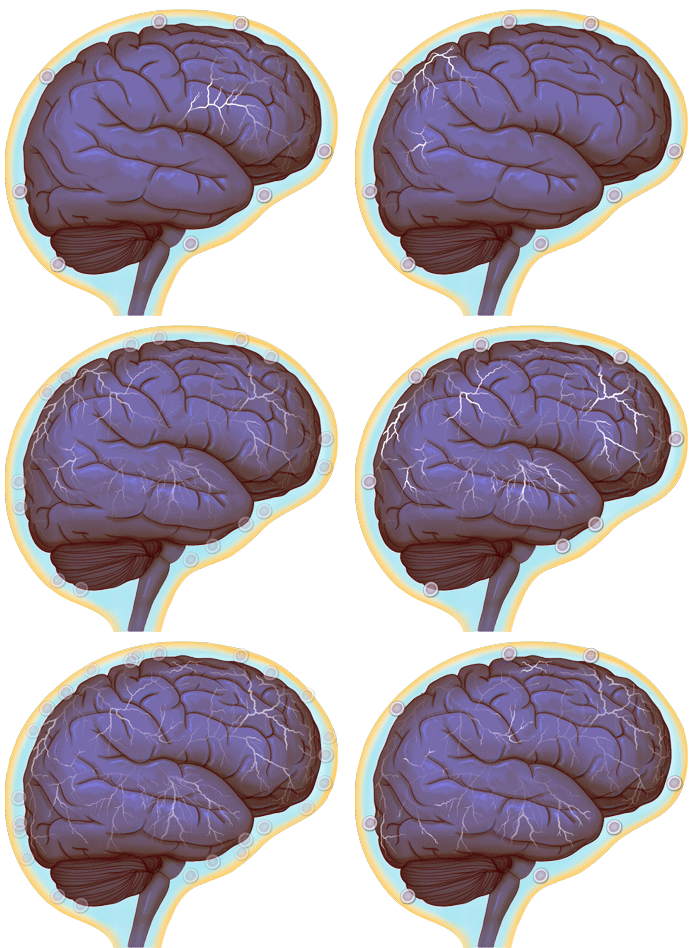
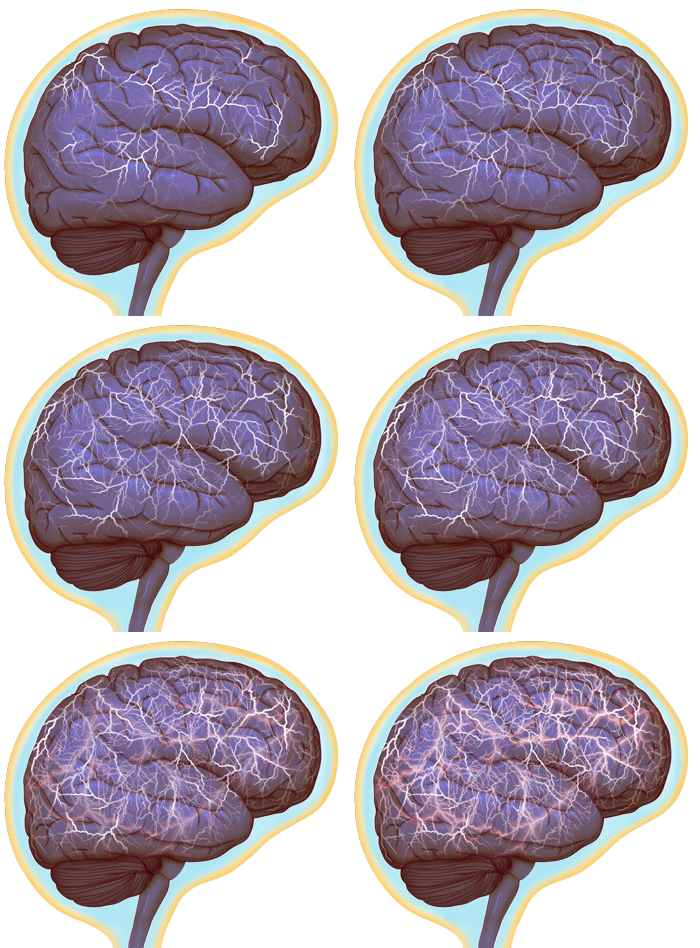
Normal brain activityA hyper-connected brainUniversity of Virginia School of Medicine researchers have determined that the immune system directly affects and even controls, creatures’ social behavior, such as their desire to interact with others. So could immune system problems contribute to an inability to have normal social interactions? The answer appears to be yes, and could have great implications for neurological conditions eg autism-spectrum disorders and schizophrenia.

“The brain and the adaptive immune system were thought to be isolated from each other, and any immune activity in the brain was perceived as sign of a pathology. And now, not only are we showing that they are closely interacting, but some of our behavior traits might have evolved because of our immune response to pathogens,” explained Jonathan Kipnis, PhD...

Read More

Mini-brain model of Idiopathic Autism reveals underlying Pathology of Neuronal Overgrowth

This image shows induced pluripotent stem cell-derived neural progenitor cells after neuronal differentiation. The neurons express a pan neuronal marker Map2 in green and a percentage of the cells express a marker for inhibitory neurons, GABA, in red. The cells' nuclei are stained blue. Credit: UC San Diego Health

This image shows induced pluripotent stem cell-derived neural progenitor cells after neuronal differentiation. The neurons express a pan neuronal marker Map2 in green and a percentage of the cells express a marker for inhibitory neurons, GABA, in red. The cells’ nuclei are stained blue. Credit: UC San Diego Health

The vast majority of cases of ASD are idiopathic (cause unknown). Researchers have created a “mini-brain” model, derived from persons with a particular form of idiopathic ASD characterized by over-sized brains, revealing a defective molecular pathway during brain development that results in early neuronal overgrowth and dysfunctional cortical networks...

Read More

DNA Origami lights up a Microscopic Glowing Van Gogh

This reproduction of The Starry Night contains 65,536 glowing pixels and is just the width of a dime across. Credit: Paul Rothemund and Ashwin Gopinath/Caltech

This reproduction of The Starry Night contains 65,536 glowing pixels and is just the width of a dime across. Credit: Paul Rothemund and Ashwin Gopinath/Caltech

A hurdle for large-scale integration of molecular devices on chips has been removed by a technique that allows humanmade DNA shapes to be placed wherever desired, to within a margin of error of just 20nm. Using folded DNA to precisely place glowing molecules within microscopic light resonators, researchers at Caltech have created one of the world’s smallest reproductions of Vincent van Gogh’s The Starry Night...

Read More