Category Chemistry/Nanotechnology

Engineers create Single-step, All-in-One 3D Printing method to make Robotic Materials

A 3D-printed ‘meta-bot’ developed by UCLA engineers.Rayne Research Group / UCLA

Advance shows promise for ”meta-bots’ designed to deliver drugs or aid rescue missions. A team of UCLA engineers and their colleagues have developed a new design strategy and 3D printing technique to build robots in one single step.

A study that outlined the advance, along with the construction and demonstration of an assortment of tiny robots that walk, maneuver and jump, was published in Science.

The breakthrough enabled the entire mechanical and electronic systems needed to operate a robot to be manufactured all at once by a new type of 3D printing process for engineered active materials with multiple functions (also known as metamaterials)...

Read More

Earth-Abundant Solar Pixels found to produce Hydrogen for Weeks

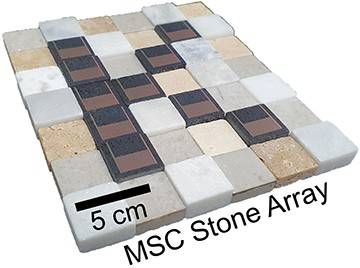
Multiple BiOI and BiOI-BiVO4 pixels on a device.
Multiple BiOI and BiOI-BiVO4 pixels on a device. Credit: Dr Virgil Andrei.

Devices made of readily available oxide and carbon-based materials can produce clean hydrogen from water over weeks — according to new research.

The findings, co-led by Dr Virgil Andrei, a Research Fellow at St John’s College, University of Cambridge, with academics at Imperial College London, could help overcome one of the key issues in solar fuel production, where current earth-abundant light-absorbing materials are limited through either their performance or stability.

Underexplored materials for light harvesting

Hydrogen fuel will play a critical role in the transition to full decarbonisation and reaching the UK’s goal of net-zero emissions by 2050...

Read More

Researchers identify Alternative to Lithium-based Battery Technology

yao battery
Yan Yao and Ye Zhang work with all-solid-state sodium batteries.

Researchers have identified an alternative to lithium-based battery technology by developing sodium glassy electrodes capable of supporting long-duration, grid-scale energy storage. Lithium-ion batteries are currently the preferred technology to power electric vehicles, but they’re too expensive for long-duration grid-scale energy storage systems, and lithium itself is becoming more challenging to access.

While lithium does have many advantages — high energy density and capacity to be combined with renewable energy sources to support grid-level energy storage — lithium carbonate prices are at an all-time high...

Read More

Hydrogen Production Method opens up Clean Energy possibilities

Postdoctoral researcher Jamie Kee and Professor Su Ha and the novel reactor they developed to produce pure compressed hydrogen.

A new energy-efficient way to produce hydrogen gas from ethanol and water has the potential to make clean hydrogen fuel a more viable alternative for gasoline to power cars.

Washington State University researchers used the ethanol and water mixture and a small amount of electricity in a novel conversion system to produce pure compressed hydrogen. The innovation means that hydrogen could be made on-site at fueling stations, so only the ethanol solution would have to be transported. It is a major step in eliminating the need to transport high-pressure hydrogen gas, which has been a major stumbling block for its use as a clean energy fuel.

“This is a new wa...

Read More