Category Chemistry/Nanotechnology

Chloroplast-Fortified 3D-Printer Ink may Strengthen Products

Imagine that products could be strengthened with the same living materials that provide nutrients to strengthen trees. Professor Qiming Wang’s research lab is one of the first to infuse 3-D printer ink with living material. The material has potential for greater strength, to be flexible and self-heal. The work is documented in a paper published in The Proceedings of the National Academy of Sciences.

The idea for this bio-inspired ink came from trees that harness the power of photosynthesis to produce glucose that transform to cellulose and strengthen the plant’s cell structure. “When trees are young,” says Wang, “they are flexible, when they are mature, they are rigid.”

“The research idea is also inspired by Popeye the Sailor, the animated character who can strengthen his muscle...

Read More

Blue-light Stride in perovskite-based LEDs

Blue-LED-perovskite in close-up.
Blue light perovskite-basedLEDs are key to creating white light. Thor Balkhe

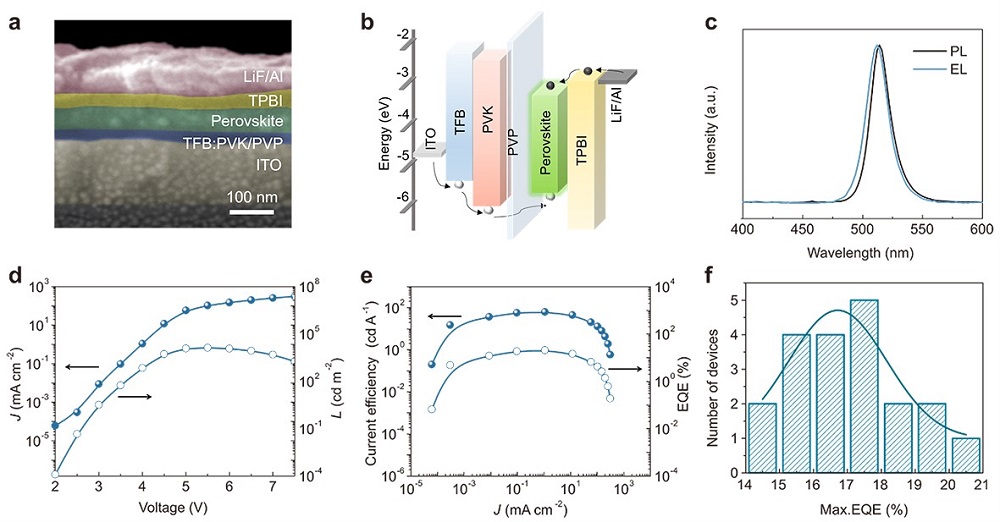
Mixed halide perovskites for spectrally stable and high-efficiency blue light-emitting diodes. Researchers at Linköping University, Sweden, have developed efficient blue light-emitting diodes based on halide perovskites. “We are very excited about this breakthrough,” says Feng Gao, professor at Linköping University. The new LEDs may open the way to cheap and energy-efficient illumination.

Illumination is responsible for approximately 20% of global electricity consumption, a figure that could be reduced to 5% if all light sources consisted of light-emitting diodes (LEDs)...

Read More

Eliminating Microplastics in Wastewater directly at the Source

A research team from INRS has developed a process for the electrolytic treatment of wastewater that degrades microplastics at the source. Wastewater can carry high concentrations of microplastics into the environment. These small particles of less than 5 mm can come from our clothes, usually as microfibers. Professor Patrick Drogui, who led the study, points out there are currently no established degradation methods to handle this contaminant during wastewater treatment. Some techniques already exist, but they often involve physical separation as a means of filtering pollutants. These technologies do not degrade them, which requires additional work to manage the separated particles.

Therefore, the research team decided to degrade the particles by electrolytic oxidation, a process n...

Read More

Researchers report Quantum-limit-approaching Chemical Sensing Chip

An illustration of the chip. A gloved hand holds a thin gold film which is struck by a beam of red light. An inset shows the chemical element abbreviations for gold and silver and the particles illuminated by the light.
The chip, which also may have uses in food safety monitoring, anti-counterfeiting and other fields where trace chemicals are analyzed. Credit: Huaxiu Chen, University at Buffalo.

Study shows improvements to chemical sensing chip that aims to quickly and accurately identify drugs and other trace chemicals. University at Buffalo researchers are reporting an advancement of a chemical sensing chip that could lead to handheld devices that detect trace chemicals — everything from illicit drugs to pollution — as quickly as a breathalyzer identifies alcohol.

The chip, which also may have uses in food safety monitoring, anti-counterfeiting and other fields where trace chemicals are analyzed, is described in a study that appears on the cover of the Dec...

Read More