



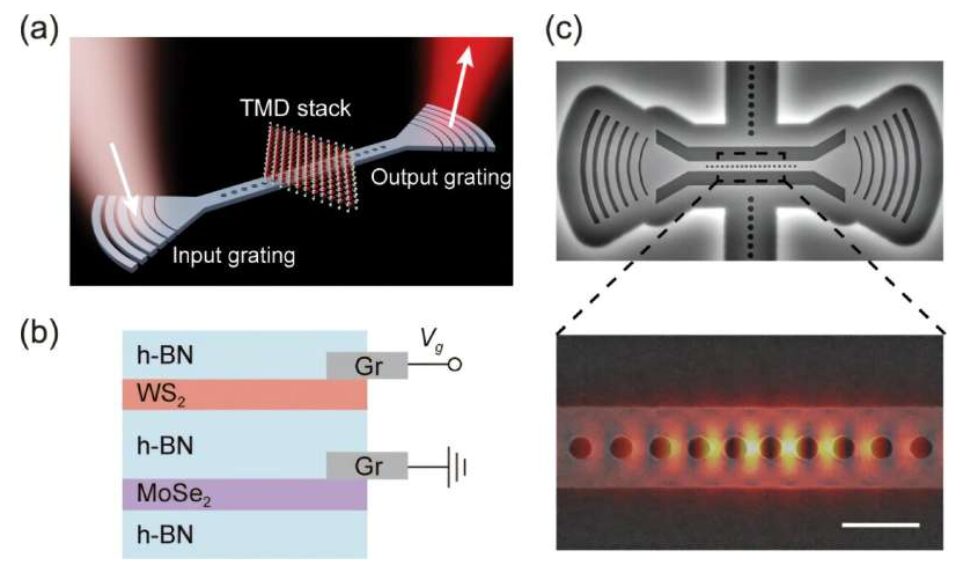
2D nanocavity exciton polaritons. (a) Schematic of the coupled TMD-PhC nanocavity. (b) Schematic of the gate-tunable TMD stack. (c) Scanning electron microscope image of the suspended Si3N4 nanobeam cavity, with the inset showing the simulated cavity mode profile. The dark area is suspended from the SiO2 substrate. Scale bar, 500 nm. Credit: Physical Review Letters (2026). DOI: 10.1103/gc15-qsvf
Photonic devices are hardware systems that can process information using light instead of electricity. These systems could potentially perform computations faster than electronic devices, while also consuming less energy.
A key challenge faced by engineers developing photonic systems is achieving strong optical nonlinearities, or in other words, developing approaches that enable the control of light signals using light, all while consuming little power. A proposed solution to attain these light-light interactions entails the use of exciton polaritons, hybrid particles that are formed when photons couple with excitons (i.e., bound pairs of electrons and holes inside semiconductors).
Researchers at University of Pennsylvania and Montana State University recently introduced a new photonic system that enables the reliable control of light signals using light.
Their proposed device, introduced in a paper published in Physical Review Letters, combines the 2D semiconducting material molybdenum diselenide (MoSe₂) with a photonic crystal nanocavity, a structure that tightly confines light.
“Our primary motivation was to advance the field of all-optical computing—a long-standing dream of building systems that process information using light instead of electricity,” Li He, Assistant Professor at Montana State University and senior author of the paper, told Tech Xplore.
“Because light travels faster and generates less heat than moving electrons, these systems could be significantly more powerful and energy-efficient than today’s electronic chips. However, to make this a reality, we faced a fundamental challenge: photons (i.e., light particles) typically do not interact with one another.”
To achieve all-optical switching in photonic devices, the researchers first had to identify a strategy to enable stronger interactions between photons. These interactions could then be leveraged to perform the same logic operations and computations executed by electronic devices.
Enabling ultralow-energy optical switching with 2D materials
The main goal of this recent study was to enable all-optical switching using a 2D material, specifically MoSe₂. The device they developed is based on a single MoSe₂ layer, a thin material with tunable electrical properties.
“By forcing light to couple strongly with the matter in atom-thin MoSe₂ layers, we can effectively have photons interact and change the system’s behavior using very little optical energy,” explained He.
“We achieved this by creating a hybrid state known as an exciton-polariton. These are ‘half-light, half-matter’ quasiparticles that inherit the best properties of both: because they are part photon, they can propagate at the speed of light, and because they are part matter (excitons), they exhibit interactions via their underlying excitons.”
To maximize nonlinear optical responses in their device, the researchers integrated MoSe₂ with a photonic crystal nanocavity. This is a structure engineered at the nanoscale that can confine light very tightly, boosting interactions between trapped photons and quasiparticles known as excitons that reside in the MoSe₂ layer.
“The nanocavity acts as an ultra-precise light trap that confines the polaritons to a subwavelength scale,” said He. “By squeezing them into such a tiny space, we significantly enhance the interaction strengths between the particles. This allowed us to reach a switching threshold at record-low power levels, using roughly 4 femtojoules of energy.”
Informing the development of quantum and neuromorphic technologies
By combining 2D materials with nanoengineered photonic structures, He and his colleagues were able to successfully realize ultrafast optical switching. Their proposed design could soon be refined further and adapted for specific applications.
“We demonstrated a path toward switching light at extremely low light intensities, moving toward the fundamental limits of how much energy is required for photons to interact,” said He.
“Crucially, our platform is designed for mass-producibility. By using materials and structures that can be patterned using standard manufacturing techniques, we have shown that these 2D-material devices can be integrated into large-scale integrated photonic circuits. This opens the door to chips containing thousands of interacting optical components.”
In the future, the researchers’ device could be integrated with other components to create various advanced technologies. For instance, it could prove useful for the development of high-speed and energy-efficient hardware to run artificial intelligence (AI) models, as well as scalable quantum computing architectures.
“While our current results demonstrate a nonlinear threshold at the femtojoule (fJ) level, this limit is by no means dictated by fundamental physics,” added He.
“We have clear paths to further lower this threshold by orders of magnitude. Currently, we are working on optimizing these nanostructures to potentially reach the quantum regime, where a single photon can control another. We are also exploring ‘on-chip integration’—connecting multiple nanocavities together to create complex circuits of light for functional optical processors.” https://techxplore.com/news/2026-05-based-chip-energy-future-ai.html



Recent Comments