Category Chemistry/Nanotechnology

Creating a Nanoscale On-Off Switch for Heat

Microscopic view of a highly-ordered crystalline structure
Source: College of Engineering
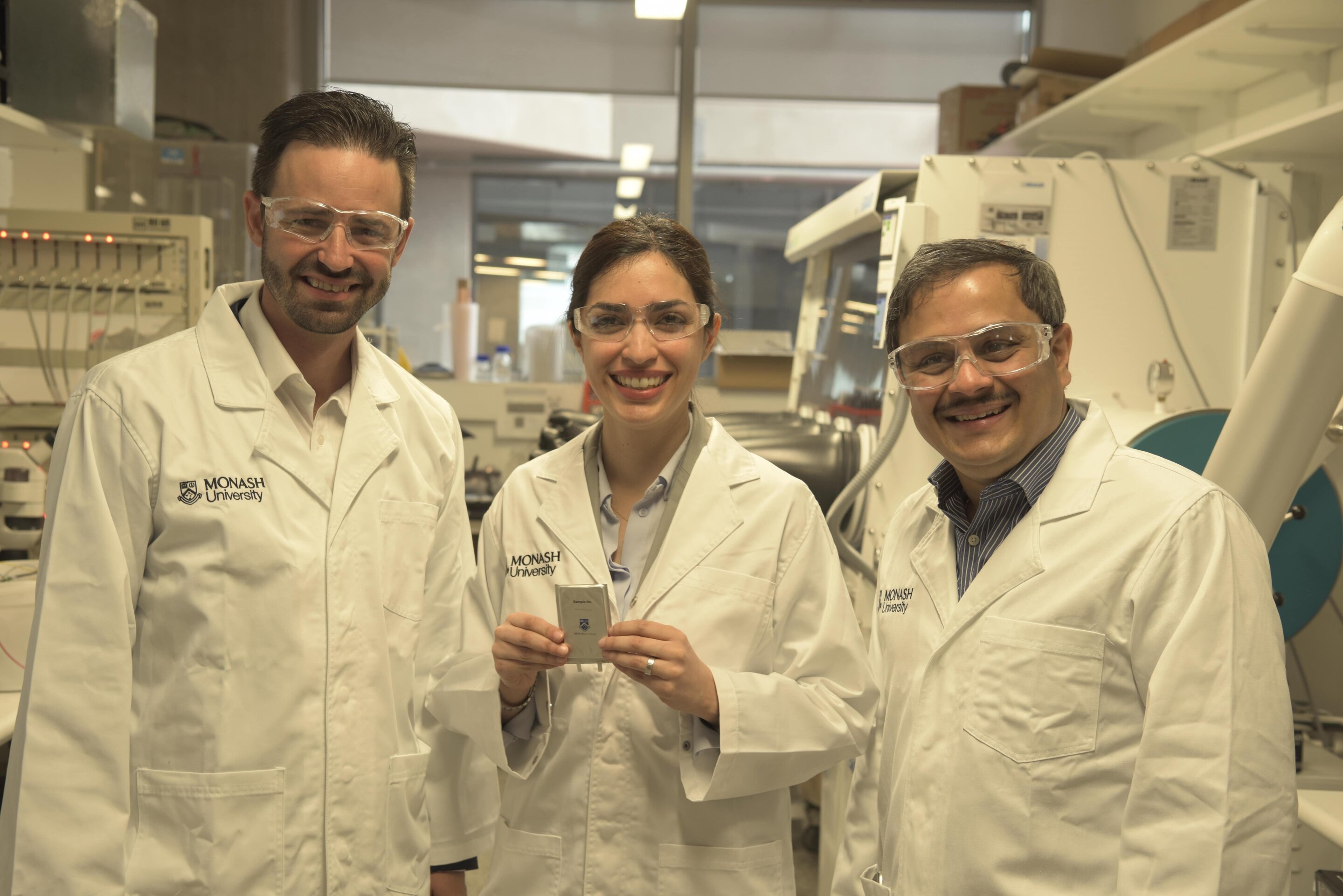
Research assistant Wei Gong, master’s student Xiao Luo, and Associate Professor Sheng Shen of the Department of Mechanical Engineering at Carnegie Mellon University.

Researchers create a polymer thermal regulator that can quickly transform from a conductor to an insulator, and back again. This control of heat flow at the nanoscale opens up new possibilities in developing switchable thermal devices, solid-state refrigeration, waste heat scavenging, thermal circuits, and computing. This is the first time that this work has been demonstrated experimentally.

Polymers are used to develop various materials, such as plastics, nylons, and rubbers...

Read More

Scientists convert Plastics into useful Chemicals using Sunlight

Webbanner SPMS Photocatalyst.jpg
Visible Light–Driven Cascade Carbon–Carbon Bond Scission for Organic Transformations and Plastics RecyclingAdvanced Science, 2019; 1902020 DOI: 10.1002/advs.201902020

Chemists at Nanyang Technological University, Singapore (NTU Singapore) have discovered a method that could turn plastic waste into valuable chemicals by using sunlight.

In lab experiments, the research team mixed plastics with their catalyst in a solvent, which allows the solution to harness light energy and convert the dissolved plastics into formic acid – a chemical used in fuel cells to produce electricity.

Reporting their work in Advanced Science, the team led by NTU Assistant Professor Soo Han Sen from the School of Physical and Mathematical Sciences made their catalyst from the affordable, biocomp...

Read More

A Tech Jewel: Converting Graphene into Diamond Film

Comparison between bilayer graphene and fluorinated monolayer diamond (F-diamane). Top: Optimized models of bilayer graphene and F-diamane. Orange and grey spheres represent fluorine and carbon atoms, respectively. Bottom: Cross-sectional transmission electron micrographs of as-grown bilayer graphene and F-diamane with the highlighted interlayer and interatomic distances.
Comparison between bilayer graphene and fluorinated monolayer diamond (F-diamane).
Top: Optimized models of bilayer graphene and F-diamane. Orange and grey spheres represent fluorine and carbon atoms, respectively. Bottom: Cross-sectional transmission electron micrographs of as-grown bilayer graphene and F-diamane with the highlighted interlayer and interatomic distances.

Synthesis of the thinnest possible diamond-like material starting from bilayer graphene and without high pressure. Can two layers of the “king of the wonder materials,” i.e...

Read More

Storing Data in Everyday Objects

3D-printed plastic rabbit
A 3D-​printed plastic rabbit. The plastic contains DNA molecules in which the printing instructions have been encoded. (Photograph: ETH Zurich / Julian Koch)

Researchers and an Israeli scientist have discovered a new method for turning nearly any object into a data storage unit. This makes it possible to save extensive data in, say, shirt buttons, water bottles or even the lenses of glasses, and then retrieve it years later. The technique also allows users to hide information and store it for later generations. It uses DNA as the storage medium.

Living beings contain their own assembly and operating instructions in the form of DNA. That’s not the case with inanimate objects: anyone wishing to 3D print an object also requires a set of instructions...

Read More