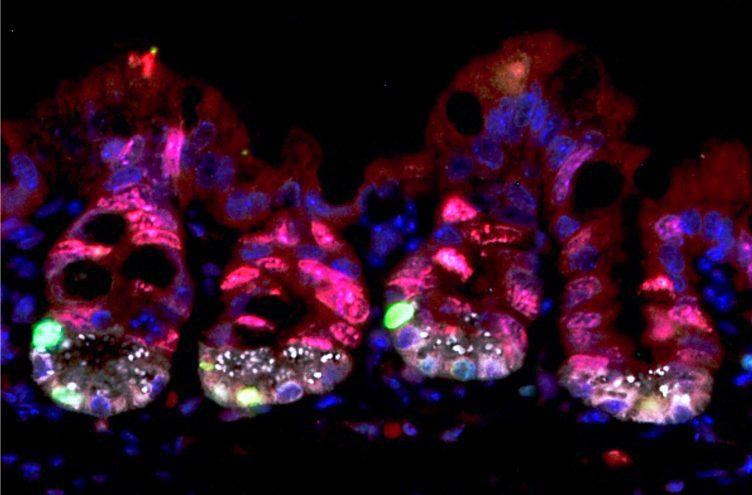
In red, highly proliferative cells of the intestinal crypts; they are targeted by irradiation and die during radiotherapy. They are considered to be radiosensitive. In green, dormant stem cells with high levels of URI; they survive irradiation, become proliferative after irradiation to regenerate the damaged intestine. /CNIO
Intensive radiotherapy can be toxic in 60% of patients with tumors located in the gastrointestinal cavity. Increases in levels of the protein URI protect mice against high-dose ionizing radiation-induced gastrointestinal syndrome and enhance mouse intestinal regeneration and survival in 100% of the cases...
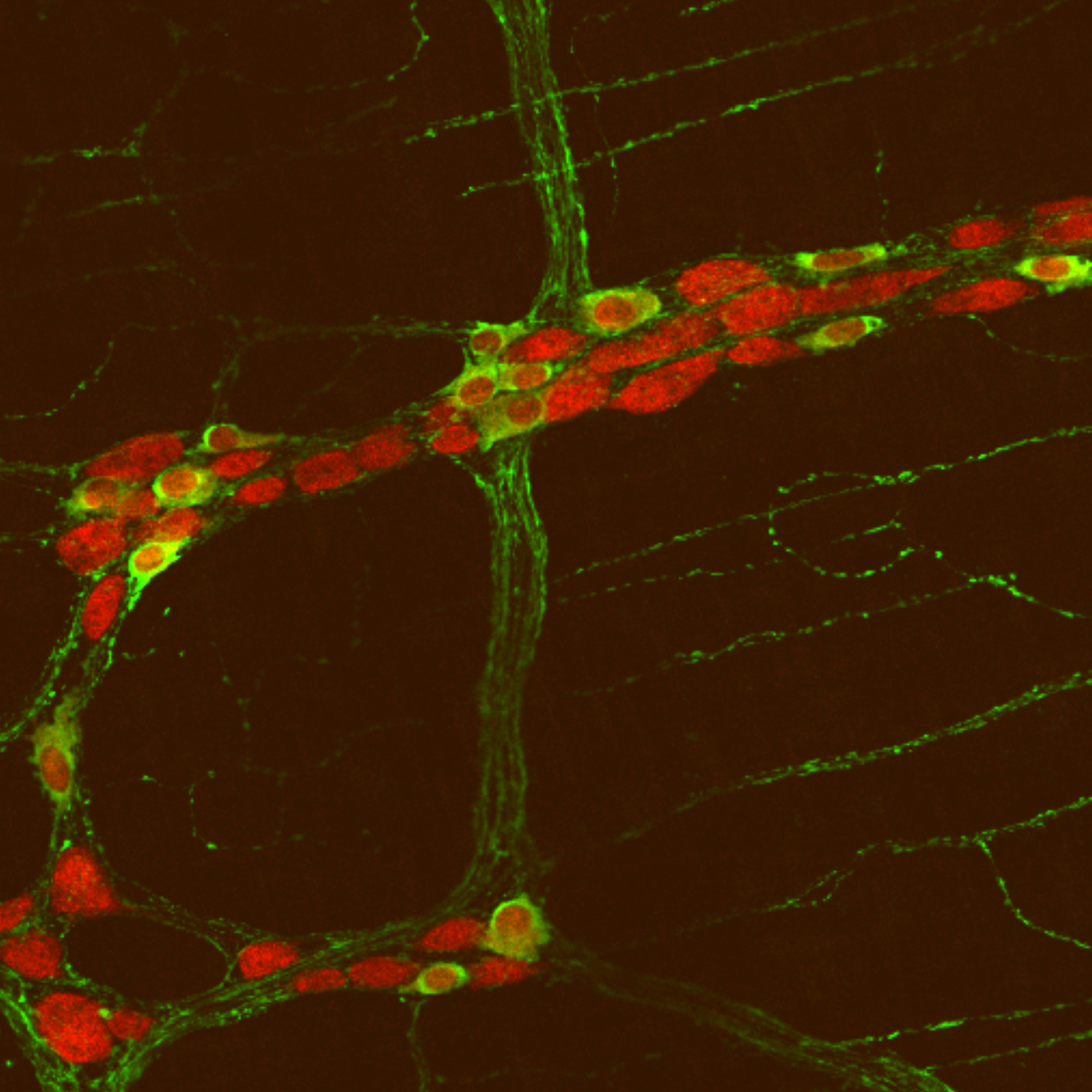
An image showing neurons in the gut of a mouse with the autism-related gene mutation. The study found mice with the mutation had more neurons in the small intestine.
Up to 90% of people with autism suffer from gut problems, but nobody has known why. New research reveals the same gene mutations – found both in the brain and the gut – could be the cause.
The discovery confirms a gut-brain nervous system link in autism, opening a new direction in the search for potential treatments that could ease behavioural issues associated with autism by targeting the gut.
Chief Investigator Associate Professor Elisa Hill-Yardin, RMIT University, said scientists trying to understand autism have long been looking in the brain, but the links with the gut nervous system have only been recently ex...
The future implications of our findings are vast,” says Paolo Sassone-Corsi, senior author of one of the two studies on circadian clocks published today in the journal Cell. He directs UCI’s Center for Epigenetics and Metabolism and is a Donald Bren Professor of Biological Chemistry. Penny Lee / UCI School of Medicine
Can your liver sense when you’re staring at a television screen or cellphone late at night? Apparently so, and when such activity is detected, the organ can throw your circadian rhythms out of whack, leaving you more susceptible to health problems.
That’s one of the takeaways from two new studies by University of California, Irvine scientists working in collaboration with the Institute for Research in Biomedicine in Barcelona, Spain.
A depiction of interactions between human and gut microbial features during inflammatory bowel disease.
A new study led by researchers from Harvard T.H. Chan School of Public Health and the Broad Institute of MIT and Harvard is the first to have observed the complex set of chemical and molecular events that disrupt the microbiome and trigger immune responses during flare-ups of inflammatory bowel diseases (IBD), including Crohn’s disease and ulcerative colitis.
While previous studies have cataloged microbial changes during IBD, the researchers in this study developed a unique biotechnology toolbox to understand why microbiomes change during IBD and how this provokes an unhealthy inflammatory reaction...






Recent Comments