Category Physics

Quantum ‘alchemy’ made feasible with excitons

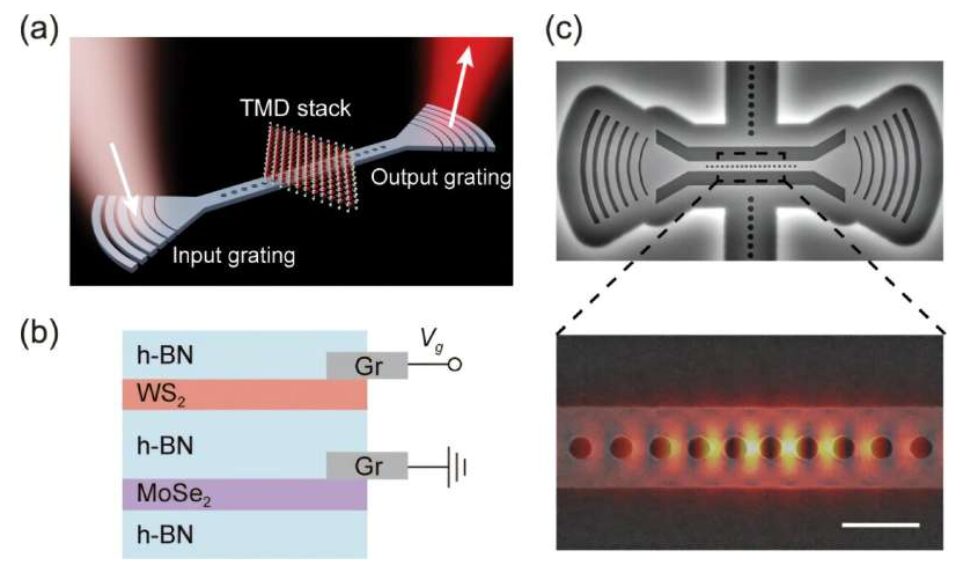
What if you could create new materials just by shining a light at them? To most, this sounds like science fiction or alchemy, but to physicists investigating the burgeoning field of Floquet engineering, this is the goal. With a periodic drive, like light, scientists can “dress up” the electronic structure of any material, altering its fundamental properties—such as turning a simple semiconductor into a superconductor.

While the theory of Floquet physics has been investigated since a bold proposal by Oka and Aoki in 2009, only a handful of experiments within the past decade have managed to demonstrate Floquet effects...

Read More

Soft robotic hand ‘sees’ around corners to achieve human-like touch

A soft robotic hand designed to achieve human-like touch
Illustration comparing the FlexiRay sensor with human hand perception modalities and its application scenarios. It introduces the design inspiration, working principle, and layered structure. Credit: Nature Communications (2025). DOI: 10.1038/s41467-025-67148-y.

To reliably complete household chores, assemble products and tackle other manual tasks, robots should be able to adapt their manipulation strategies based on the objects they are working with, similarly to how humans leverage information they gain via the sense of touch. While humans attain tactile information via nerves in their skin and muscles, robots rely on sensors, devices that sense their surroundings and pick up specific physical signals.

Most robotic hands and grippers developed so far rely on visual-tactile senso...

Read More

New memristor training method slashes AI energy use by six orders of magnitude

New memristor training method slashes AI energy use by six orders of magnitude
The implementation of SRNet ×2 on memristor hardware. Credit: Nature Communications (2025). DOI: 10.1038/s41467-025-66240-7

In a Nature Communications study, researchers from China have developed an error-aware probabilistic update (EaPU) method that aligns memristor hardware’s noisy updates with neural network training, slashing energy use by nearly six orders of magnitude versus GPUs while boosting accuracy on vision tasks. The study validates EaPU on 180 nm memristor arrays and large-scale simulations.

Analog in-memory computing with memristors promises to overcome digital chips’ energy bottlenecks by performing matrix operations via physical laws. Memristors are devices that combine memory and processing like brain synapses.

Inference on these systems works well, as shown ...

Read More

Soft, 3D transistors could host living cells for bioelectronics

Soft, 3D transistors may upend semiconductor device design, transform bioelectronics
From 2D rigid electronics to 3D soft electronics: Increasing the dimensionality of transistors with 3D hydrogel semiconductors. Credit: Shiming Zhang

New research from the WISE group (Wearable, Intelligent, Soft Electronics) at The University of Hong Kong (HKU-WISE) has addressed a long-standing bioelectronic challenge: the development of soft, 3D transistors.

This work introduces a new approach to semiconductor device design with transformative potential for bioelectronics. It is published in Science.

Led by Professor Shiming Zhang from the Department of Electrical and Electronic Engineering, Faculty of Engineering, the research team included senior researchers who joined HKU-WISE from the University of Cambridge and the University of Chicago, together with HKU Ph.D...

Read More