Category Physics

A Silicon Image Sensor that Computes

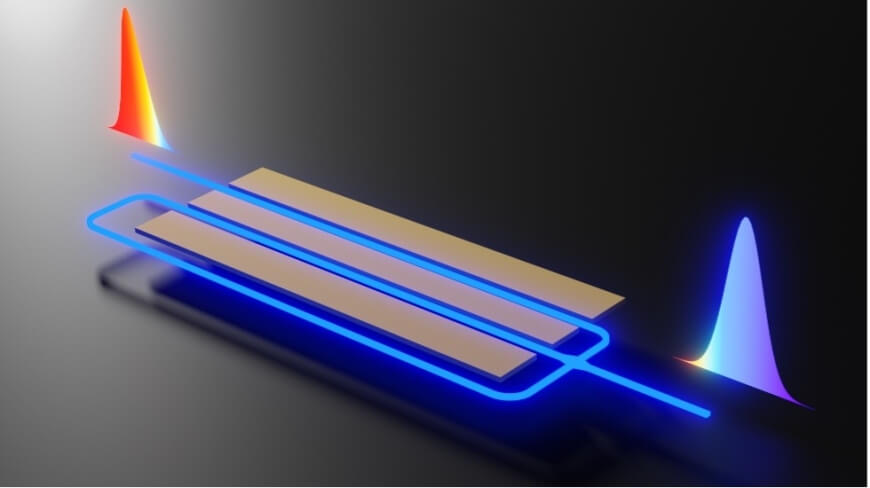
SEAS researchers developed the first in-sensor processor that could be integrated into commercial silicon imaging sensor chips. The array (illustrated here) simplifies image processing for autonomous vehicles and other applications. Credit: Donhee Ham Research Group/Harvard SEAS

As any driver knows, accidents can happen in the blink of an eye—so when it comes to the camera system in autonomous vehicles, processing time is critical. The time that it takes for the system to snap an image and deliver the data to the microprocessor for image processing could mean the difference between avoiding an obstacle or getting into a major accident.

In-sensor image processing, in which important features are extracted from raw data by the image sensor itself instead of the separate microprocess...

Read More

Researchers demonstrate Error Correction in a Silicon Qubit System

Researchers demonstrate error correction in a silicon qubit system
Three-qubit QEC and silicon-based three-qubit device. a. Outline of the three-qubit phase-flip quantum error correcting code. The two-qubit CNOT gates entangle the three qubits, then the Hadamard (H) gates rotate the qubit basis for phase-flip errors. The decoding is the inverse of the encoding. Finally, the correction is performed by a three-qubit Toffoli gate. b. Scanning electron microscope image of the device. Scale bar, 100 nm. The screening gates (brown) are used to restrict the electric field of the plunger (green) and barrier (purple) gates. The three circles (red, green and blue) indicate the position of the triple-quantum-dot array. A further quantum dot shown as the gray circle is used as a charge sensor...
Read More

Researchers Engineer Novel Material capable of ‘Thinking’

man holds rubber block in one hand and squeezed rubber block in other hand
Penn State researchers create mechanical integrated circuit materials from conductive and non-conductive rubber materials that sense and react to tactile input, such as force. Credit: Kelby Hochriether/Penn State. All Rights Reserved.

Collaboration builds on decades-old research to engineer advanced material. Someone taps your shoulder. The organized touch receptors in your skin send a message to your brain, which processes the information and directs you to look left, in the direction of the tap. Now, Penn State and U.S. Air Force researchers have harnessed this processing of mechanical information and integrated it into engineered materials that “think.”

The work, published today (Aug. 24) in Nature, hinges on a novel, reconfigurable alternative to integrated circuits...

Read More

Mathematicians suggest Liquid Crystals could be used to create Building Blocks for a New Kind of Computer

Mathematician pair suggest liquid crystals could be used to create building blocks of a new kind of computer
Nbits pinned to an LC defect line. The local nematic director field n(r), indicated by cylindrical bars, rotates by π along closed curves encircling the defect line (black). The director field is colored by its out-of-plane component, nz(r), while xy-planes are colored by the director’s azimuthal orientation nϕ(r) relative to the x axis. The near-field director profile (red) close to the defect line defines the nbit state. The vertical direction may be interpreted as either a spatial or a time dimension. Credit: Science Advances (2022). DOI: 10.1126/sciadv.abp8371

A pair of researchers at MIT have found evidence suggesting that a new kind of computer could be built based on liquid crystals rather than silicon...

Read More