Category Physics

Building Blocks of the Future for Photovoltaics

Artistic representation showing the twisted layers of tungsten diselenide (top) and molybdenum disulphide (bottom). Following excitation using light, a multitude of optically “dark” excitons form between the layers. These “dark” excitons are electron-hole pairs bound by Coulomb interaction (light and dark spheres connected by field lines), which cannot be directly observed using visible light. One of the most interesting quasiparticles is the “moiré interlayer exciton” – shown in the middle of the image – in which the hole is located in one layer and the electron in the other...
Read More

2D Array of Electron and Nuclear Spin Qubits Opens New Frontier in Quantum Science

Qubits_featured
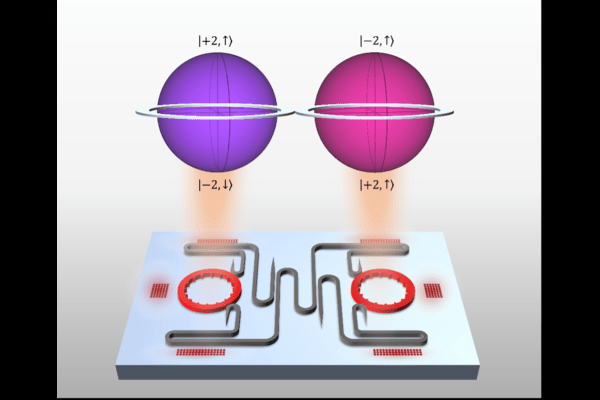
Using photons and electron spin qubits, researchers demonstrated atomic-scale sensing for use in NMR, and by controlling nuclear spin, creating nuclear qubits with longer coherence times than previously used electron spin qubits.

By using photons and electron spin qubits to control nuclear spins in a 2D material, researchers at Purdue University have opened a new frontier in quantum science and technology, enabling applications like atomic-scale nuclear magnetic resonance spectroscopy, and to read and write quantum information with nuclear spins in 2D materials.

As published Monday (Aug...

Read More

Recycling Energy in Everyday Life (piezoelectric fiber)

Recycling Energy in Everyday Life (Piezoelectric Fiber); Finding Solutions in the Shape of Flowers and Stems of Plants! 이미지2
A schematic diagram of the method for determining the relationship between the morphology and piezoelectric performance of fiber components

A research team led by Lim Sang-kyoo, senior researcher of the Division of Energy Technology at DGIST (President Kuk Yang) developed a piezoelectric polymer/ceramic composite fiber with a cross-sectional form that is uniformly controlled to allow the use of energy harvesting technologies that can recycle energy wasted or consumed in everyday life.

Piezoelectric fiber can produce electrical energy through the piezoelectric effect of the material and drive wearable electronic devices through the movement of the wearer...

Read More

Artificial Intelligence Tools Predict DNA’s Regulatory Role and 3D Structure

Predicted 3D structure for a segment of human genomic DNA

Sequence modeling algorithms could eventually lead to new ways to fight diseases caused by genetic mutations. Newly developed artificial intelligence (AI) programs accurately predicted the role of DNA’s regulatory elements and three-dimensional (3D) structure based solely on its raw sequence, according to two recent studies in Nature Genetics. These tools could eventually shed new light on how genetic mutations lead to disease and could lead to new understanding of how genetic sequence influences the spatial organization and function of chromosomal DNA in the nucleus, said study author Jian Zhou, Ph.D., Assistant Professor in the Lyda Hill Department of Bioinformatics at UTSW.

“Taken together, these two programs provide a mor...

Read More