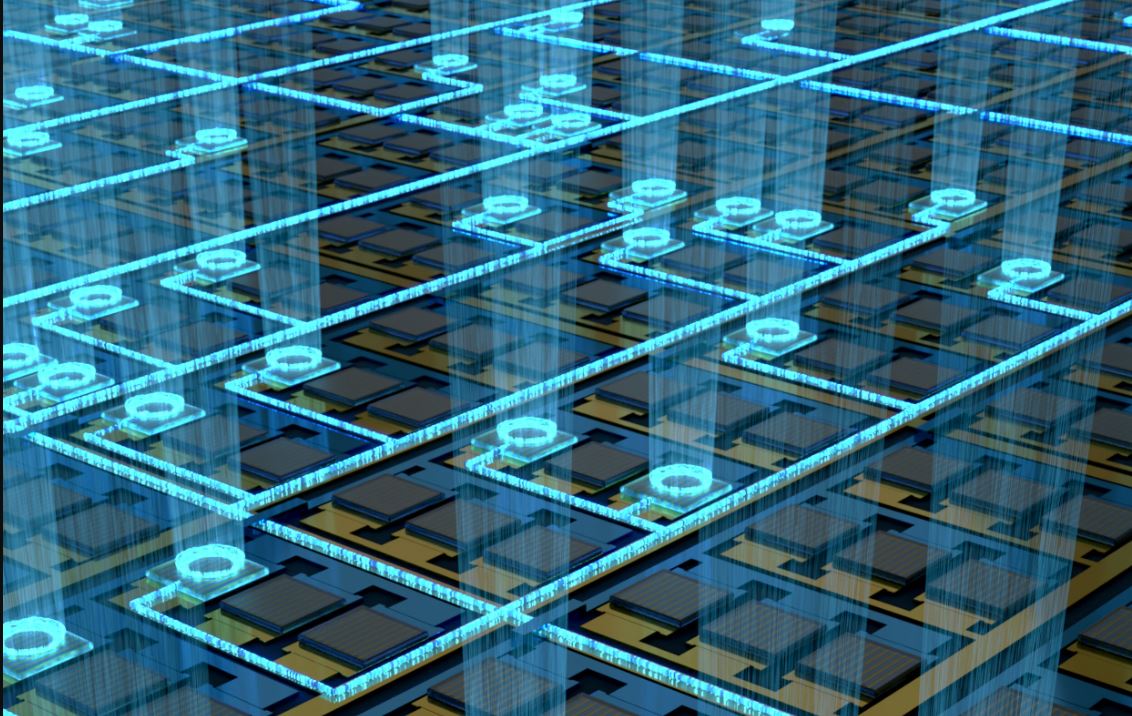
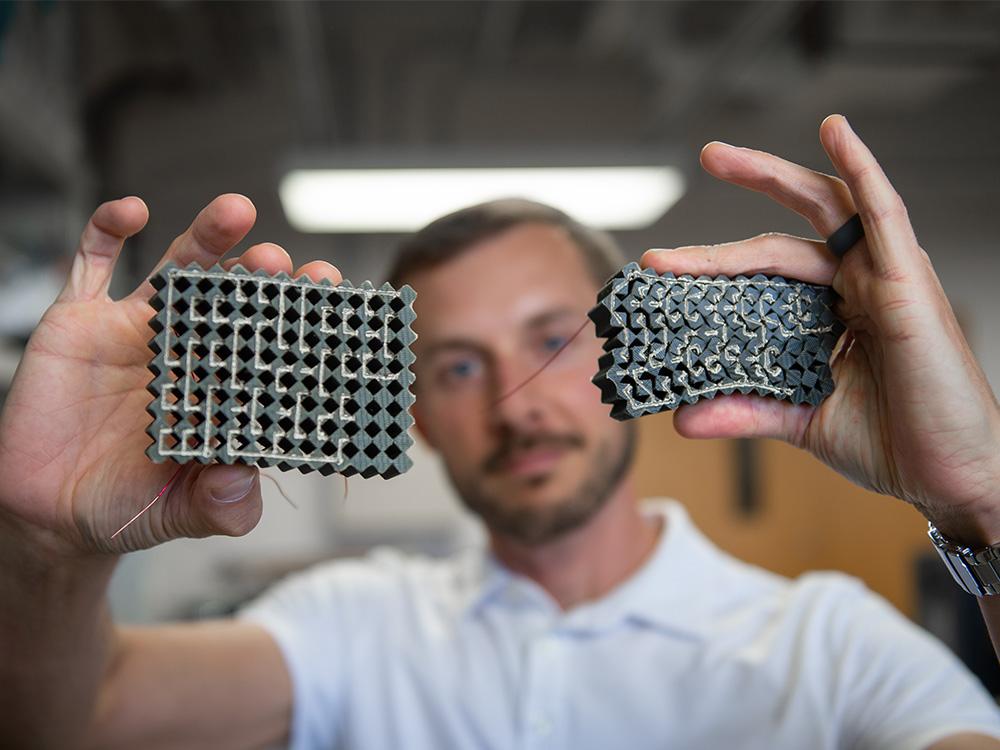
This schematic (left) shows the implementation of our Floquet PTI, the image in the middle shows the actual device, and on the right we show measurements demonstrating the robust propagation of electromagnetic signals across the device. Credit: Nagulu et al.
Floquet topological insulators are materials with topological phases that originate from tailored time-dependent perturbations of their crystal structure. These materials have been proved to feature highly unusual electron conduction properties...
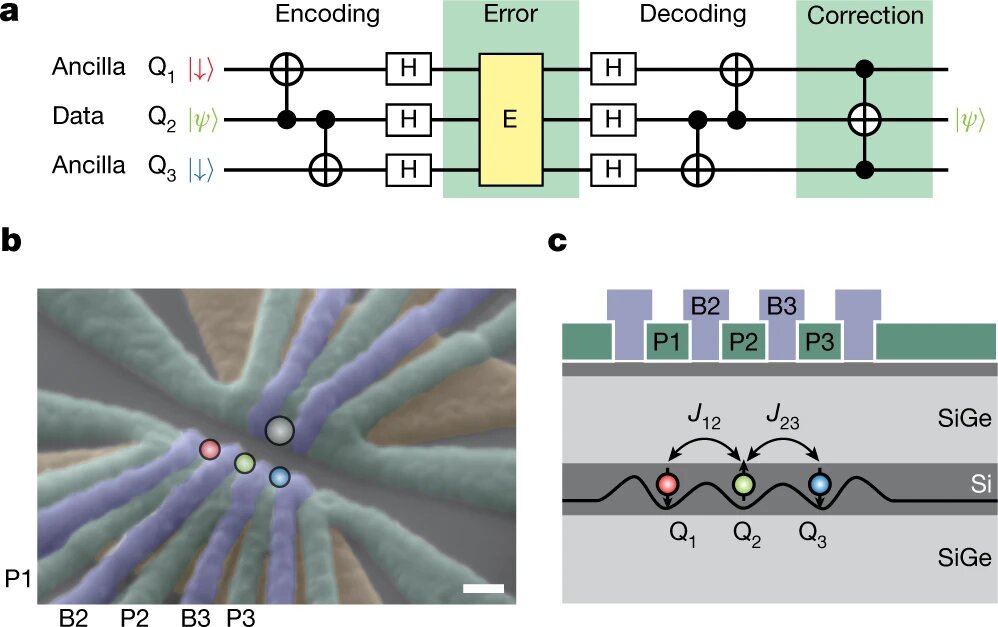
With fault-tolerant implementation the effort and complexity increase, but the resulting quality is better.
Fundamental building blocks for fault-tolerant quantum computing demonstrated. For quantum computers to be useful in practice, errors must be detected and corrected. At the University of Innsbruck, Austria, a team of experimental physicists has now implemented a universal set of computational operations on fault-tolerant quantum bits for the first time, demonstrating how an algorithm can be programmed on a quantum computer so that errors do not spoil the result.
In modern computers errors during processing and storage of information have become a rarity due to high-quality fabrication...
A laser beam (orange) creates excitons (purple) that are trapped inside the semicondcutor material by electric fields. (Image: Puneet Murthy / ETH Zurich)
Researchers at ETH Zurich have succeeded for the first time in trapping excitons—quasiparticles consisting of negatively charged electrons and positively charged holes—in a semiconductor material using controllable electric fields. The new technique is important for creating single photon sources as well as for basic research.
In semiconductor materials, electric current can be conducted both by electrons and by positively charged holes, or missing electrons. Light hitting the material can also excite electrons to a higher energy band, leaving behind a hole in the original band...
Visualization of filamentary seed magnetic fields emerging from large-scale motions of unmagnetized plasma in a first-principles numerical simulation. Credit: Muni Zhou et al
When we look out into space, all of the astrophysical objects that we see are embedded in magnetic fields. This is true not only in the neighborhood of stars and planets, but also in the deep space between galaxies and galactic clusters. These fields are weak—typically much weaker than those of a refrigerator magnet—but they are dynamically significant in the sense that they have profound effects on the dynamics of the universe. Despite decades of intense interest and research, the origin of these cosmic magnetic fields remains one of the most profound mysteries in cosmology.
Recent Comments