Category Physics

Emulating impossible ‘Unipolar’ Laser Pulses paves the way for processing Quantum Information

The semiconductor nanosheets in the water-cooled copper mount turn an infrared laser pulse into an effectively unipolar terahertz pulse. The team says that their terahertz emitter could be made to fit inside a matchbox. Image credit: Christian Meineke, Huber Lab, University of Regensburg

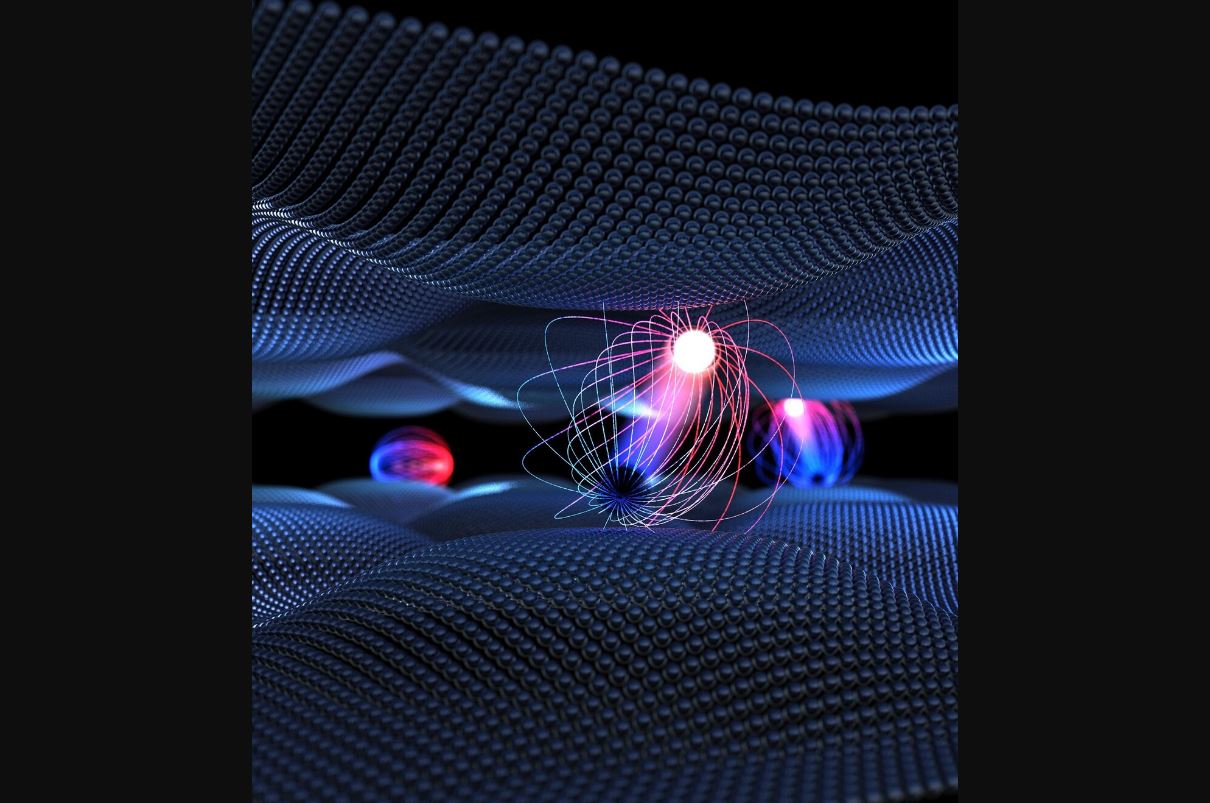
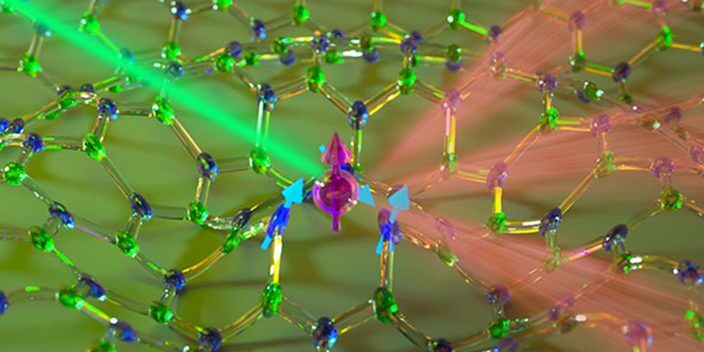
Quantum materials emit light as though it were only a positive pulse, rather than a positive-negative oscillation. A laser pulse that sidesteps the inherent symmetry of light waves could manipulate quantum information, potentially bringing us closer to room temperature quantum computing.

The study, led by researchers at the University of Regensburg and the University of Michigan, could also accelerate conventional computing.

Quantum computing has the potential to accelerate solutions to problems ...

Read More

AI reveals unsuspected Math underlying Search for Exoplanets

chart explaining gravitational microlensing
This infographic explains the light curve astronomers detect when viewing a microlensing event, and the signature of an exoplanet: an additional uptick in brightness when the exoplanet lenses the background star. (Image Credit: NASA / ESA / K. Sahu / STScI)

Artificial intelligence (AI) algorithms trained on real astronomical observations now outperform astronomers in sifting through massive amounts of data to find new exploding stars, identify new types of galaxies and detect the mergers of massive stars, accelerating the rate of new discovery in the world’s oldest science.

But AI, also called machine learning, can reveal something deeper, University of California, Berkeley, astronomers found: Unsuspected connections hidden in the complex mathematics arising from general relativity—...

Read More

Highest Efficiency 1-Sun Solar Cell

A record solar cell is being measured.
The record-setting solar cell shines red under blue luminescence. Photo by Wayne Hicks, NRELz

Researchers at the U.S. Department of Energy’s National Renewable Energy Laboratory (NREL) created a solar cell with a record 39.5% efficiency under 1-sun global illumination. This is the highest efficiency solar cell of any type, measured using standard 1-sun conditions.

“The new cell is more efficient and has a simpler design that may be useful for a variety of new applications, such as highly area-constrained applications or low-radiation space applications,” said Myles Steiner, a senior scientist in NREL’s High-Efficiency Crystalline Photovoltaics (PV) Group and principal investigator on the project...

Read More

Component for Brain-Inspired Computing

Scientists aim to perform machine-​learning tasks more efficiently with processors that emulate the working principles of the human brain. (Visualisations: Adobe Stock)

Researchers from ETH Zurich, the University of Zurich and Empa have developed a new material for an electronic component that can be used in a wider range of applications than its predecessors. Such components will help create electronic circuits that emulate the human brain and that are more efficient at performing machine-​learning tasks.

Compared with computers, the human brain is incredibly energy efficient. Scientists are therefore drawing on how the brain and its interconnected neurons function for inspiration in designing innovative computing technologies...

Read More