Category Physics

New Transistors integrating High-k Perovskite Oxides and 2D Semiconductors

Over the past decades, electronics engineers and material scientists worldwide have been investigating the potential of various materials for fabricating transistors, devices that amplify or switch electrical signals in electronic devices. Two-dimensional (2D) semiconductors have been known to be particularly promising materials for fabricating the new electronic devices.

Despite their advantages, the use of these materials in electronics greatly depends on their integration with high-quality dielectrics, insulating materials or materials that are poor conductors of electrical current. These materials, however, can be difficult to deposit on 2D semiconductor substrates.

Researchers at Nanyang Technological University, Peking University, Tsinghua University, and the Beijing Acade...

Read More

Laser Bursts Drive Extremely Fast Logic Gates

Synchronized laser pulses (red and blue) generate a burst of real and virtual charge carriers in graphene that are absorbed by gold metal to produce a net current. “We clarified the role of virtual and real charge carriers in laser-induced currents, and that opened the way to the creation of ultrafast logic gates,” says Ignacio Franco, associate professor of chemistry and physics at Rochester. (University of Rochester illustration / Michael Osadciw)

Decisive step toward creating ultrafast computers. A long-standing quest for science and technology has been to develop electronics and information processing that operate near the fastest timescales allowed by the laws of nature.

A promising way to achieve this goal involves using laser light to guide the motion of electrons in matt...

Read More

Spintronics: How an Atom-Thin Insulator Helps Transport Spins

Graphical abstract. Credit: Nano Letters (2022). DOI: 10.1021/acs.nanolett.1c04358

An intermediate layer consisting of a few atoms is helping to improve the transport of spin currents from one material to another. Until now, this process involves significant losses. A team from Martin Luther University Halle-Wittenberg (MLU), the Max Planck Institute (MPI) for Microstructure Physics, and the Freie Universität Berlin reports in the scientific journal ACS Nano Letters on how this can be avoided. The researchers thus demonstrate important new insights relevant for many spintronic applications, for example energy-efficient and ultrafast storage technologies of the future.

In modern microelectronics, the charge of electrons is used to carry information in electronic components, mobile p...

Read More

Computational Sleuthing Confirms First 3D Quantum Spin Liquid

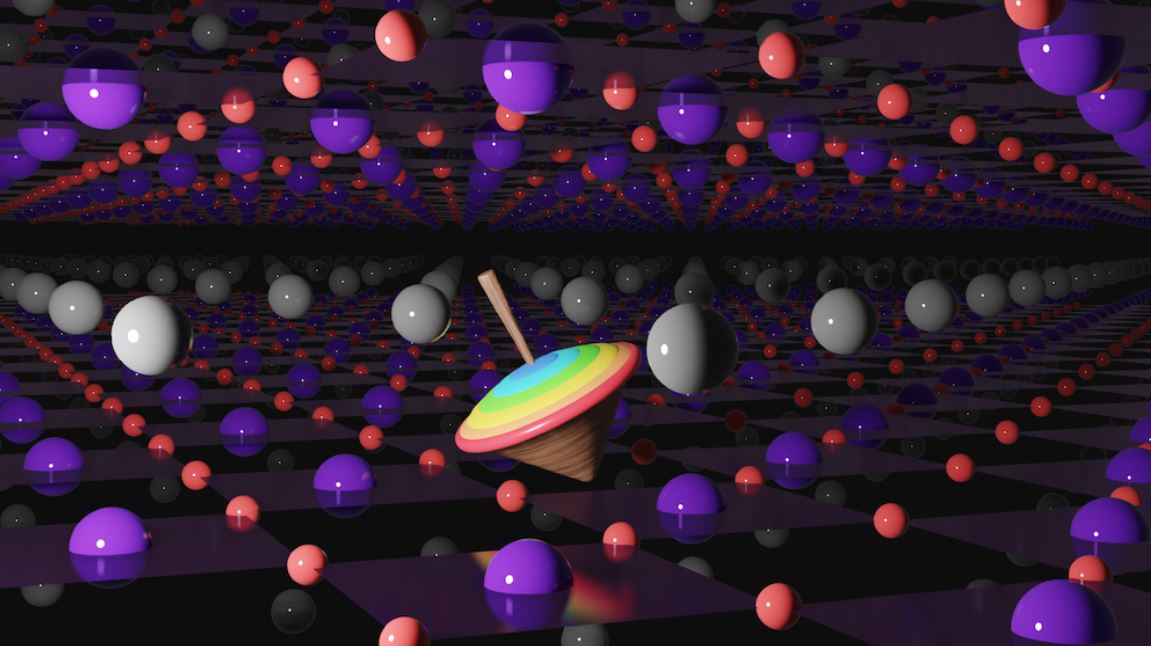
A 3D representation of the spin-excitation continuum — a possible hallmark of a quantum spin liquid — observed in 2019 in a single crystal sample of cerium zirconium pyrochlore. (Image by Tong Chen/Rice University)

Numerical detective work verifies liquidlike magnetic order in prior experiments. Computational detective work by U.S. and German physicists has confirmed cerium zirconium pyrochlore is a 3D quantum spin liquid.

Despite the name, quantum spin liquids are solid materials in which quantum entanglement and the geometric arrangement of atoms frustrate the natural tendency of electrons to magnetically order themselves in relation to one another...

Read More