Category Physics

The future of 5G+ Infrastructure could be built Tile by Tile

Two fabricated proof-of-concept tile arrays are shown alongside two inkjet-printed tile arrays, which the team will present on at the upcoming International Microwave Symposium in June. Credit: Georgia Tech

5G+ (5G/Beyond 5G) is the fastest-growing segment and the only significant opportunity for investment growth in the wireless network infrastructure market, according to the latest forecast by Gartner, Inc. But currently 5G+ technologies rely on large antenna arrays that are typically bulky and come only in very limited sizes, making them difficult to transport and expensive to customize.

Researchers from Georgia Tech’s College of Engineering have developed a novel and flexible solution to address the problem...

Read More

Quantum Physics sets a Speed Limit to Electronics

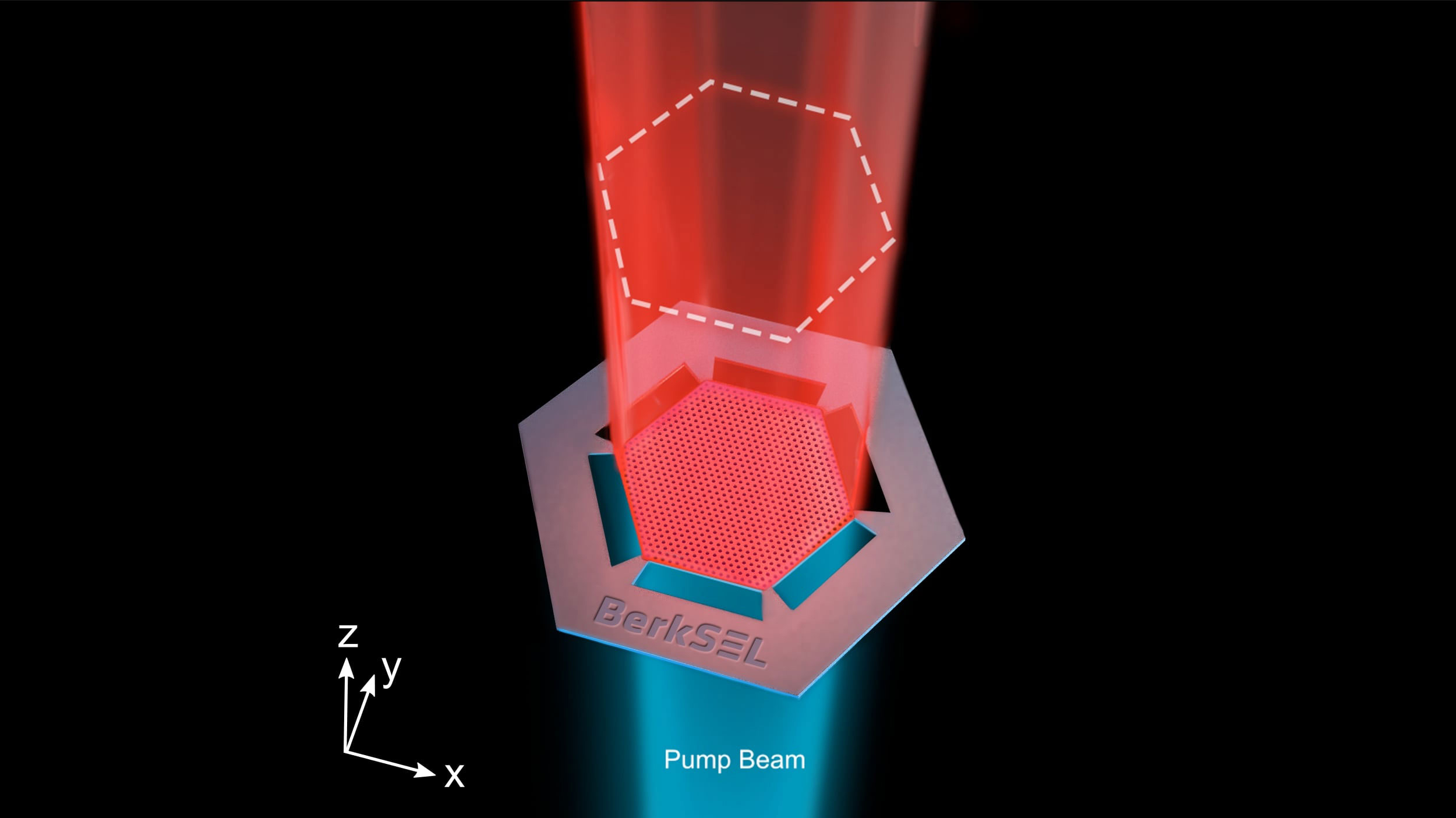
An ultra short laser pulse (blue) creates free charge carriers, another pulse (red) accelerates them in opposite directions.

Semiconductor electronics is getting faster and faster — but at some point, physics no longer permits any increase. The speed can definitely not be increased beyond one petahertz (one million gigahertz), even if the material is excited in an optimal way with laser pulses.

How fast can electronics be? When computer chips work with ever shorter signals and time intervals, at some point they come up against physical limits. The quantum-mechanical processes that enable the generation of electric current in a semiconductor material take a certain amount of time. This puts a limit to the speed of signal generation and signal transmission.

TU Wien (Vienna), TU Gra...

Read More

Physicists Create Extremely Compressible ‘Gas of Light’ – Paving the way to new types of highly sensitive sensors

The centerpiece of the experiment: – the optical microresonator realizes the ‘photon box’.
Photo: Volker Lannert/University of Bonn

Researchers at the University of Bonn have created a gas of light particles that can be extremely compressed. Their results confirm the predictions of central theories of quantum physics. The findings could also point the way to new types of sensors that can measure minute forces. The study is published in the journal Science.

If you plug the outlet of an air pump with your finger, you can still push its piston down. The reason: Gases are fairly easy to compress — unlike liquids, for example. If the pump contained water instead of air, it would be essentially impossible to move the piston, even with the greatest effort.

Gases usually consist of at...

Read More

Quantum Sensors: Measuring even more Precisely

Two teams of physicists have designed the first programmable quantum sensor, and tested it in the laboratory. To do so they applied techniques from quantum information processing to a measurement problem. The innovative method promises quantum sensors whose precision reaches close to the limit set by the laws of nature.

Atomic clocks are the best sensors humankind has ever built. Today, they can be found in national standards institutes or satellites of navigation systems. Scientists all over the world are working to further optimize the precision of these clocks...

Read More