Category Physics

Fully 3D-printed, Flexible OLED Display

The fully 3D-printed flexible organic light-emitting diode (OLED) display prototype is about 1.5 inches on each side and has 64 pixels. Every pixel works and displays light. The 3D-printed display is also flexible, which could make it useful for a wide variety of applications, such as foldable smartphone displays. Credit: McAlpine Group, University of Minnesota

Technology opens door to ubiquitous, more easily fabricated electronic screens. In a groundbreaking new study, researchers at the University of Minnesota Twin Cities used a customized printer to fully 3D print a flexible organic light-emitting diode (OLED) display...

Read More

Physicists Detect a Hybrid Particle Held Together by uniquely Intense ‘Glue’

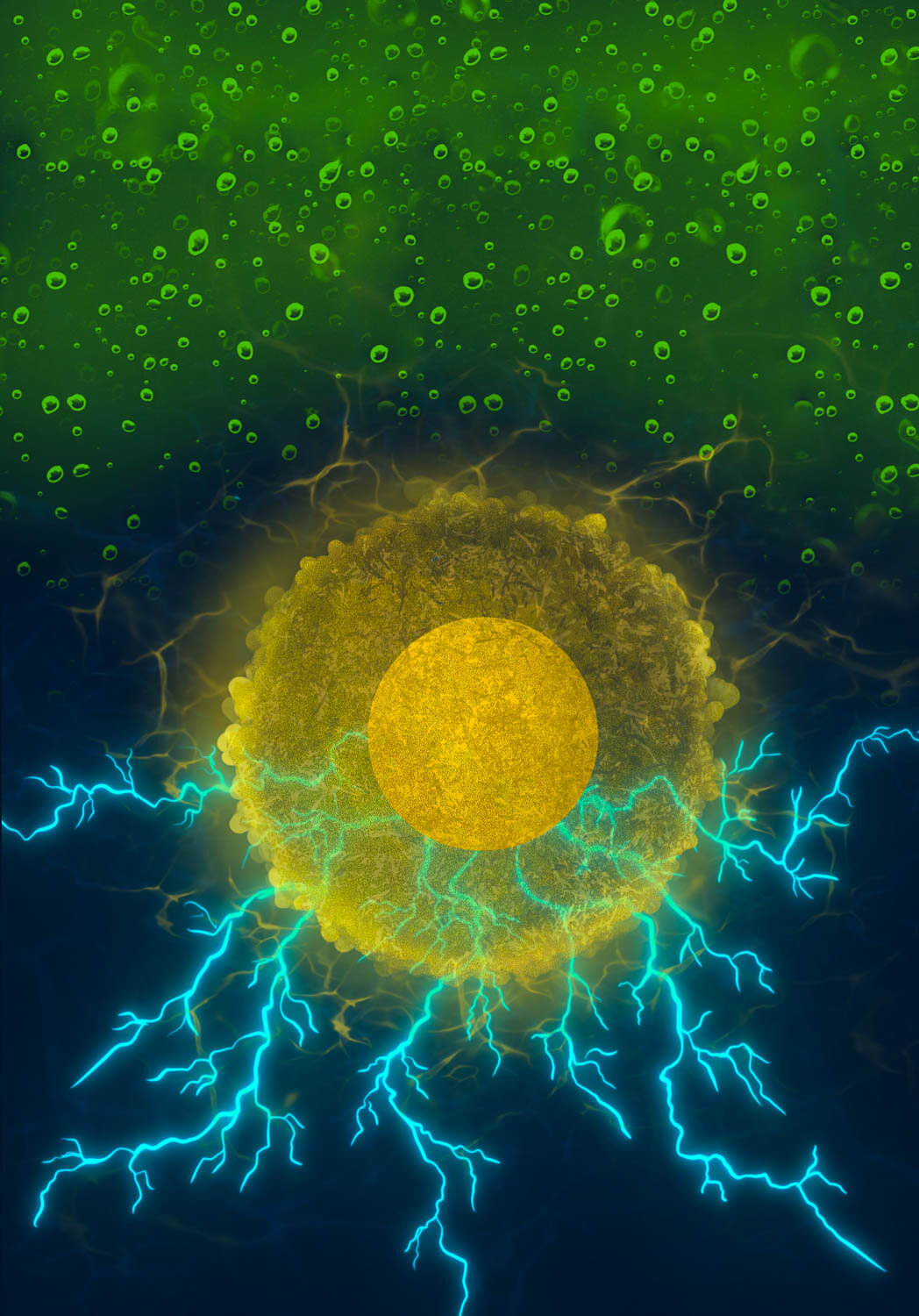
Caption:MIT physicists have detected a hybrid particle in an unusual, two-dimensional magnetic material. The hybrid particle is a mashup of an electron and a phonon.
Credits:Image: Christine Daniloff, MIT

The discovery could offer a route to smaller, faster electronic devices. MIT physicists have detected another kind of hybrid particle in an unusual, two-dimensional magnetic material. They determined that the hybrid particle is a mashup of an electron and a phonon (a quasiparticle that is produced from a material’s vibrating atoms). When they measured the force between the electron and phonon, they found that the glue, or bond, was 10 times stronger than any other electron-phonon hybrid known to date.

The particle’s exceptional bond suggests that its electron and phonon might be tun...

Read More

Novel Memory Technology based on Compound Semiconductors

ULTRARAM device concept. a) Schematic cross-section of a device with corresponding material layers. The floating gate (FG), triple-barrier resonant-tunneling structure (TBRT), and readout channel are highlighted. Arrows indicate the direction of electron flow during program/erase operations. b) Scanning electron micrograph of a fabricated device of 10 Âµm gate length. c,d) Nonequilibrium Green’s functions (NEGF) calculations of density of states alongside conduction band diagrams for no applied bias (i.e., retention) and program-cycle bias respectively. B1, B2, and B3 are the AlSb barrier layers. QW1 and QW2 are the InAs quantum wells in the TBRT. Credit: DOI: 10.1002/aelm.202101103

A pioneering type of patented computer memory known as ULTRARAM has been demonstrated on silicon wafers ...

Read More

Windows that Outsmart the Elements

New research takes energy efficient windows a step further by proposing a new “smart window” design that would harvest the sun’s energy in the winter to warm the house and reflect it in the summer to keep it cool.

Homeowners know that the type of windows in a house contribute greatly to heating and cooling efficiency. And that’s a big deal — maintaining indoor temperatures consumes great amounts of energy and accounts for 20 to 40 percent of the national energy budgets in developed countries. The work was recently published in the journal ACS Photonics and funded as part of the EPSRC Wearable and Flexible Technologies Collaboration.

“The major innovation is that these windows can change according to seasonal needs,” explained Nathan Youngblood, assistant professor of electrical ...

Read More