Category Physics

Engineers make Critical Advance in Quantum Computer Design

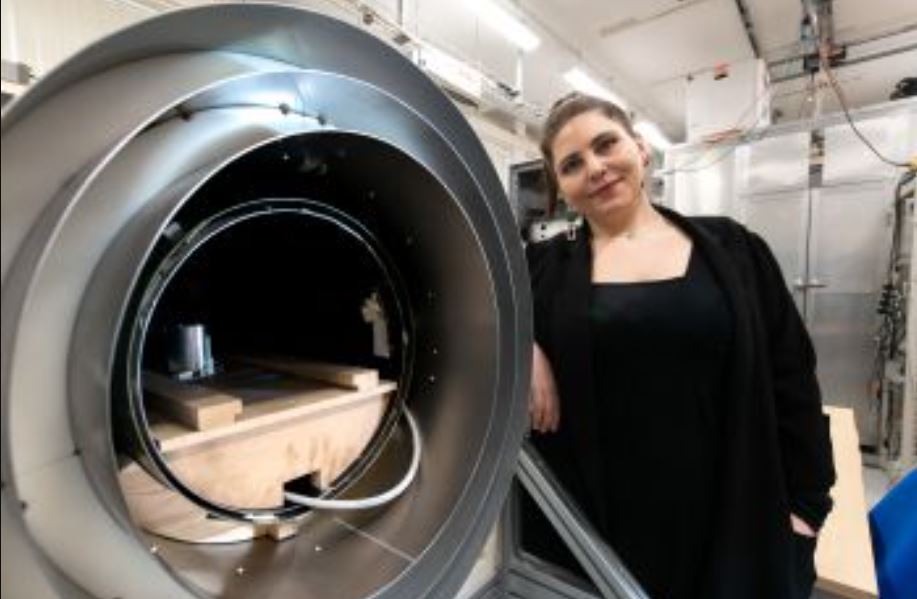
Dr Jarryd Pla and Prof. Andrew Dzurak look from behind a transparent screen showing mathematical workings
Dr Jarryd Pla and Professor Andrew Dzurak have solved the problem of how to reliably control not just a few, but millions of qubits. Photo: UNSW

Quantum engineers from UNSW Sydney have removed a major obstacle that has stood in the way of quantum computers becoming a reality. They discovered a new technique they say will be capable of controlling millions of spin qubits—the basic units of information in a silicon quantum processor.

Until now, quantum computer engineers and scientists have worked with a proof-of-concept model of quantum processors by demonstrating the control of only a handful of qubits.

But with their latest research, published today in Science Advances, the team have found what they consider “the missing jigsaw piece” in the quantum computer architecture that ...

Read More

New Electronic Phenomenon discovered

Physics researchers at the University of North Florida’s Atomic LEGO Lab discovered a new electronic phenomenon they call ” asymmetric ferroelectricity .” The research led by Dr. Maitri Warusawithana, UNF physics assistant professor, in collaboration with researchers at the University of Illinois and the Arizona State University, demonstrated this phenomenon for the first time in engineered two-dimensional crystals.

This discovery of asymmetric ferroelectricity in engineered crystals comes exactly 100 years following the discovery of ferroelectricity in certain naturally occurring crystals...

Read More

System Trains Drones to Fly Around Obstacles at High Speeds

drone graphic
Aerospace engineers at MIT have devised an algorithm that helps drones find the fastest route around obstacles, without crashing.
Credits:Image: MIT News, with background figure courtesy of the researchers

A new algorithm helps drones find the fastest route around obstacles without crashing. The system could enable fast, nimble drones for time-critical operations such as search and rescue.

If you follow autonomous drone racing, you likely remember the crashes as much as the wins. In drone racing, teams compete to see which vehicle is better trained to fly fastest through an obstacle course. But the faster drones fly, the more unstable they become, and at high speeds their aerodynamics can be too complicated to predict...

Read More

Emergent Magnetic Monopoles Controlled at Room Temperature

Researchers at the University of Vienna have designed a new 3D magnetic nanonetwork, where magnetic monopoles emerge due to rising magnetic frustration among the nanoelements, and are stable at room temperature. (© Sabri Koraltan)

Three dimensional (3D) nanonetwork promise a new era in modern solid state physics with numerous applications in photonics, biomedicine, and spintronics. The realization of 3D magnetic nano-architectures could enable ultra-fast and low-energy data storage devices. Due to competing magnetic interactions in these systems magnetic charges or magnetic monopoles can emerge, which can be utilized as mobile, binary information carriers. Researchers have now designed the first 3D artificial spin ice lattice hosting unbound magnetic charges...

Read More