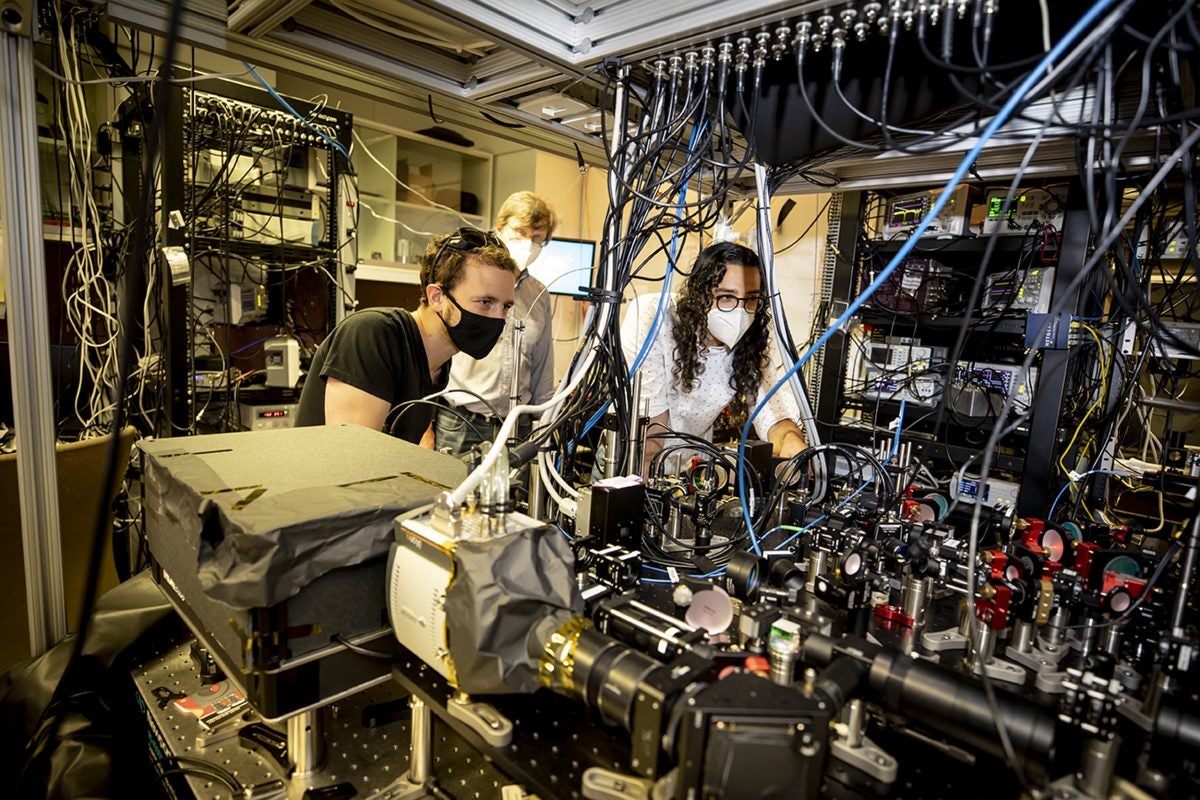
A new path toward sending and receiving information with single photons of light has been discovered by an international team of researchers led by the University of Michigan...
Read More

A new path toward sending and receiving information with single photons of light has been discovered by an international team of researchers led by the University of Michigan...
Read More
Today, we can say without a shadow of doubt that an alternative to fossil fuels is needed. Fossil fuels are not only non-renewable sources of energy but also among the leading causes of global warming and air pollution. Thus, many scientists worldwide have their hopes placed on what they regard as the fuel of tomorrow: hydrogen (H2). Although H2 is a clean fuel with incredibly high energy density, efficiently generating large amounts of it remains a difficult technical challenge.
Water splitting — the breaking of water molecules — is among the most explored methods to produce H2. While there are many ways to go about it, the best-performing water splitting techniques involve electrocatalysts made from expensive metals, such as platinum, ruthenium, and iridium...
Read More
Researchers introduce a novel device concept towards high-efficient and low-voltage vertical organic lighting-emitting transistors. With the new device architecture and fabrication technology, the team paves the way for a broad application of efficient OLED active matrix displays.
In the group of Prof. Karl Leo, physicists, material scientists and engineers are working jointly on the development of novel organic materials and devices for high performance, flexible and possibly even biocompatible electronics and optoelectronics of the future. Increasing the performance of organic devices is one of the key challenges in their research. It was only last year, when the team headed by Dr...
Read More
The total amount of data generated worldwide is expected to reach 175 zettabytes (1 ZB equals 1 billion terabytes) by 2025. If 175 ZB were stored on Blu-ray disks, the stack would be 23 times the distance to the moon. There is an urgent need to develop storage technologies that can accommodate this enormous amount of data.
The demand to store ever-increasing volumes of information has resulted in the widespread implementation of data centers for Big Data. These centers consume massive amounts of energy (about 3% of global electricity supply) and rely on magnetization-based harddisk drives with limited storage capacity (up to 2 TB per disk) and lifespan (three to five years)...
Read More
Recent Comments