Category Physics

Goldilocks and the 3 quantum dots: Just right for peak solar panel performance

An image representing the layered structure of a typical solar photovoltaic device

Maximizing the efficiency of renewable energy technology is dependent on creating nanoparticles with ideal dimensions and density, new simulations have shown. Scientists in Australia have developed a process for calculating the perfect size and density of quantum dots needed to achieve record efficiency in solar panels.

Quantum dots, human-made nanocrystals 100,000 times thinner than a sheet of paper, can be used as light sensitisers, absorbing infrared and visible light and transferring it to other molecules.

This could enable new types of solar panels to capture more of the light spectrum and generate more electrical current, through a process of ‘light fusion’ known as photochemical upconversion.

The researchers, from the ARC Centre of Excellence in Exciton Science, used l...

Read More

Scientists create Entangled Photons 100 times more Efficiently than previously possible

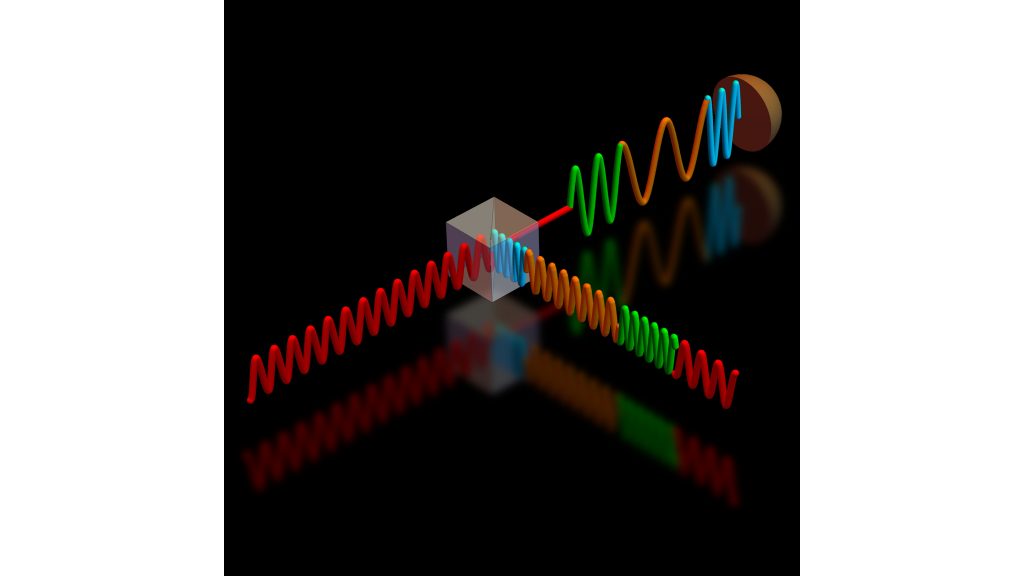
Yuping Huang and colleagues at Stevens Institute of Technology demonstrate a quantum circuit that can readily be integrated with other optical components, paving the way for high-speed, reconfigurable, and multifaceted quantum devices.

Super-fast quantum computers and communication devices could revolutionize countless aspects of our lives — but first, researchers need a fast, efficient source of the entangled pairs of photons such systems use to transmit and manipulate information. Researchers at Stevens Institute of Technology have done just that, not only creating a chip-based photon source 100 times more efficient that previously possible, but bringing massive quantum device integration within reach.

“It’s long been suspected that this was possible in theory, but we’re the first...

Read More

Faraday Fabrics? MXene-coated fabric could contain Electronic Interference in Wearable Devices

Adding a coating of MXene to cotton or linen fabrics gives them the ability to block electromagnetic interference, according to new research out of Drexel’s College of Engineering.

Researchers at Drexel University’s College of Engineering have reported that fabric coated with a conductive, two-dimensional material called MXene, is highly effective at blocking electromagnetic waves and potentially harmful radiation. The discovery is a key development for efforts to weave technological capabilities into clothing and accessories.

Materials that block electromagnetic waves had a commercial moment a handful of years ago when fears that high-tech thieves could scan or copy credit cards, passports or hack into laptops and contactless car keys had people putting them in special wallets, bag...

Read More

New Blended Solar Cells yield High Power Conversion Efficiencies

Schematic illustration of the distribution of the materials in the semiconductor layer for the OPV cell.
ITIC is selectively located at the interface of PTzBT and PCBM domains, which leads to an efficient charge carrier (photocurrent) generation.

Researchers at Hiroshima University in Japan have blended together various polymer and molecular semiconductors as photo-absorbers to create a solar cell with increased power efficiencies and electricity generation. These types of solar cells, known as organic photovoltaics (OPV), are devices that generate electricity when light is incident upon their photo-absorbers. The efficiency of a solar cell is determined by comparing how much electricity is generated to how much light is incident upon the cell...

Read More