Category Physics

Fossil fuel-free jet propulsion with air plasmas

A schematic diagram of a prototype microwave air plasma thruster and the images of the bright plasma jet at different microwave powers. This device consists of a microwave power supply, an air compressor, a compressed microwave waveguide and a flame ignitor. CREDIT: Jau Tang and Jun Li

Humans depend on fossil fuels as their primary energy source, especially in transportation. However, fossil fuels are both unsustainable and unsafe, serving as the largest source of greenhouse gas emissions and leading to adverse respiratory effects and devastation due to global warming.

A team of researchers at the Institute of Technological Sciences at Wuhan University has demonstrated a prototype device that uses microwave air plasmas for jet propulsion...

Read More

Groundbreaking new Rocket-propulsion System

Rocket soaring in space
UCF-developed technology will boost rocket performance.

A University of Central Florida researcher and his team have developed an advanced new rocket-propulsion system once thought to be impossible.

The system, known as a rotating detonation rocket engine, will allow upper stage rockets for space missions to become lighter, travel farther, and burn more cleanly.

The result were published this month in the journal Combustion and Flame. “The study presents, for the first time, experimental evidence of a safe and functioning hydrogen and oxygen propellant detonation in a rotating detonation rocket engine,” said Kareem Ahmed, an assistant professor in UCF’s Department of Mechanical and Aerospace Engineering who led the research.

The rotating detonations are continuous, Mach 5 expl...

Read More

Water-Splitting Module a Source of Perpetual Energy

A schematic and electron microscope cross-section show the structure of an integrated, solar-powered catalyst to split water into hydrogen fuel and oxygen. The module developed at Rice University can be immersed into water directly to produce fuel when exposed to sunlight. Illustration by Jia Liang

‘Artificial leaf’ concept inspires research into solar-powered fuel production. Rice University researchers have created an efficient, low-cost device that splits water to produce hydrogen fuel.

The platform developed by the Brown School of Engineering lab of Rice materials scientist Jun Lou integrates catalytic electrodes and perovskite solar cells that, when triggered by sunlight, produce electricity...

Read More

A 3D Memristor-based Circuit for Brain-inspired Computing

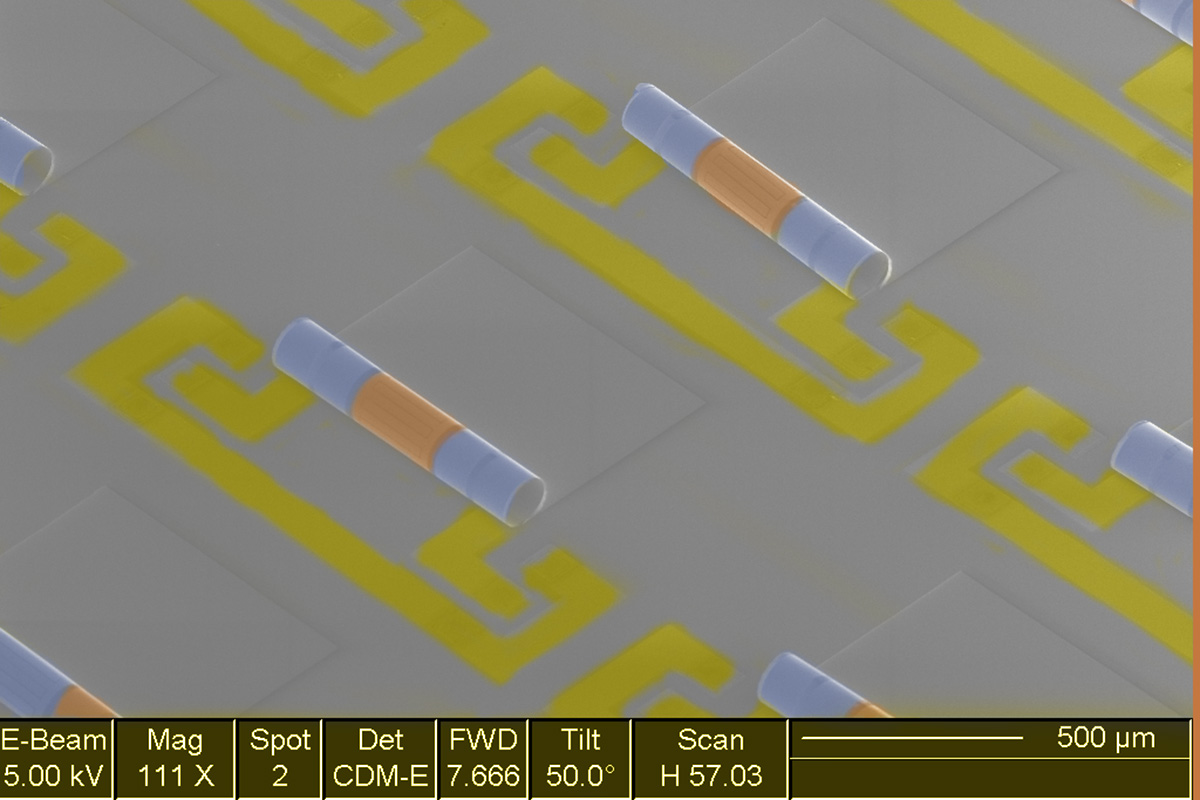
An image of the 3D circuit created by the researchers, captured using a scanning electron microscope (SEM). Credit: Lin et al.

Researchers at the University of Massachusetts and the Air Force Research Laboratory Information Directorate have recently created a 3D computing circuit that could be used to map and implement complex machine learning algorithms, such convolutional neural networks (CNNs). This 3D circuit, presented in a paper published in Nature Electronics, comprises eight layers of memristors; electrical components that regulate the electrical current flowing in a circuit and directly implement neural network weights in hardware.

“Previously, we developed a very reliable memristive device that meets most requirements of in-memory computing for artificial neural networks, ...

Read More