Category Physics

Small, Precise and Affordable Gyroscope for Navigating without GPS

The new resonator and electrodes, on a quarter for scale. The resonator is almost perfectly symmetrical, made of nearly-pure glass. This enables it to vibrate for long periods, similar to the ringing of a wine glass. Credit: Najafi Group, University of Michigan

A small, inexpensive and highly accurate gyroscope, developed at the University of Michigan, could help drones and autonomous cars stay on track without a GPS signal.

“Our gyroscope is 10,000 times more accurate but only 10 times more expensive than gyroscopes used in your typical cell phones. This gyroscope is 1,000 times less expensive than much larger gyroscopes with similar performance,” said Khalil Najafi, the Schlumberger Professor of Engineering at U-M and a professor of electrical engineering and computer science.

Read More

A Key Development in the drive for Energy-Efficient Electronics

Driving forward energy-efficient electronics
Sample of the advanced material undergoing analysis by muon spectroscopy. A muon is a sub-atomic particle. 

Scientists have made a breakthrough in the development of a new generation of electronics that will require less power and generate less heat.

It involves exploiting the complex quantum properties of electrons – in this case, the spin state of electrons.

In a world first, the researchers – led by a team of physicists from the University of Leeds – have announced in the journal Science Advances that they have created a ‘spin capacitor’ that is able to generate and hold the spin state of electrons for a number of hours.

Previous attempts have only ever held the spin state for a fraction of a second. In electronics, a capacitor holds energy in the form of electric charge...

Read More

An Organic Solar Cell with 25% Efficiency

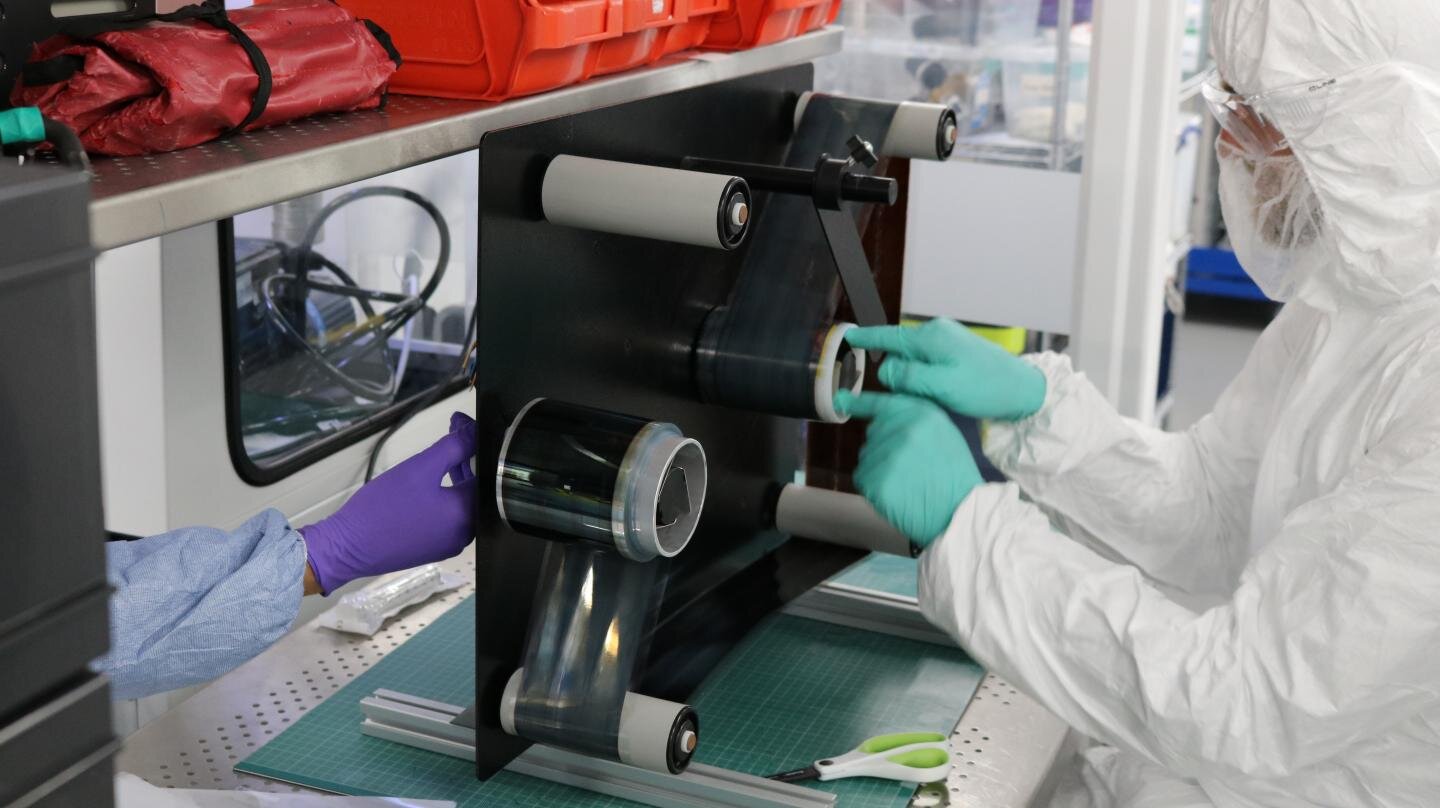
The ‘best conversion performance in the world in a dark room’ is how the developers of a new organic PV device have described it. Such cells could be used as a wireless source of energy for IoT applications or in gadgets such as temperature-humidity and motion sensors.

Eight months ago, a state-funded French research institute and Japanese textiles company Toyobo announced they would join forces to develop superior organic solar cells for indoor applications. The partnership, the French organization said at the time, was aimed at developing thin, flexible solar cells which could function where conventional, inorganic solar cells could not.

The new energy technologies and nanomaterials (Liten) division of the French Alternative Energies and Atomic Energy Commission and To...

Read More

Precision Mirrors poised to Improve Sensitivity of Gravitational Wave Detectors

The illustration shows the cross-section of a thermal bimorph mirror and its constituents. Controlling the temperature of the mirror changes the curvature of the reflected wavefront. Overlaid on the cross-section is the simulated radial stress, showing a concentration of stress at the boundary of the two layers, where the adhesive holds the structure together.
Credit: Huy Tuong Cao, University of Adelaide

Improved deformable mirrors could help scientists detect new sources of gravitational waves from deep in space. Researchers have developed a new type of deformable mirror that could increase the sensitivity of ground-based gravitational wave detectors such as the Advanced Laser Interferometer Gravitational-Wave Observatory (LIGO)...

Read More