
Category Physics

New Technology Speeds up Organic Data Transfer

Credit: CC0 Public Domain

Researchers are pushing the boundaries of data speed with a brand new type of organic LED. An international research team, involving Newcastle University experts, developed a visible light communication (VLC) setup capable of a data rate of 2.2 Mb/s by employing a new type of organic light-emitting diodes (OLEDs).

To reach this speed, the scientists created new far-red/near-infrared, solution-processed OLEDs. And by extending the spectral range to 700-1000 nm, they successfully expanded the bandwidth and achieved the fastest-ever data speed for solution-based OLEDs.

Described in the journal Light Science & Applications, the new OLEDs create opportunities for new internet-of-things (IoT) connectivity, as well as wearable and implantable biosensors technol...

Read More
Tech to help Autonomous Vehicles better Scan for nearby Fast-Moving Objects

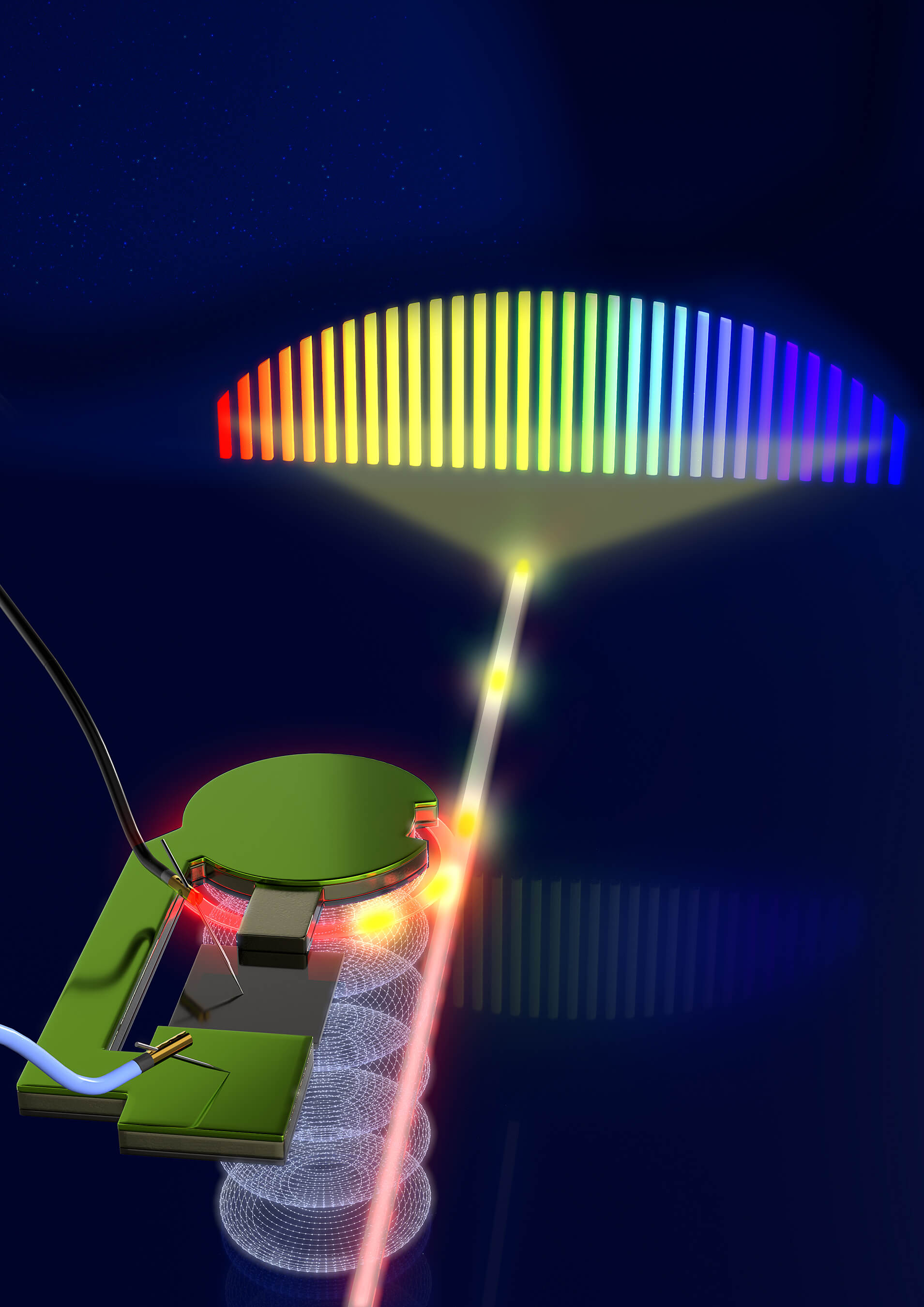
New technology uses acoustics to better control a pulse of laser light split into a frequency comb, potentially helping lidar to achieve detection of nearby high-speed objects. (WoogieWorks graphic/Alex Mehler)

Mechanical control and modulation of light on a silicon chip could enhance lidar. Researchers have built a way that lidar could achieve higher-resolution detection of nearby fast-moving objects through mechanical control and modulation of light on a silicon chip.

A self-driving car has a hard time recognizing the difference between a toddler and a brown bag that suddenly appears into view because of limitations in how it senses objects using lidar.

The autonomous vehicle industry is exploring “frequency modulated continuous wave” (FMCW) lidar to solve this problem...

Read More

T-ray Camera Speed Boosted a Hundred Times over

Optical set up for single pixel transmission imaging of object R.

Scientists are a step closer to developing a fast and cost effective camera that utilises terahertz radiation, potentially opening the opportunity for them to be used in non-invasive security and medical screening.

A research team led by Professor Emma Pickwell-Macpherson from the University of Warwick Department of Physics and involving Rayko Ivanov Stantchev and scientists from the Department of Electronic Engineering at The Chinese University of Hong Kong has reached a crucial milestone towards developing single-pixel terahertz imaging technology for use in biomedical and industrial applications.

Their single-pixel terahertz camera reached 100 times faster acquisition than the previous state-of-the-art without a...

Read More

5G Wireless Networks have few health impacts, Oregon State study using Zebrafish Model finds

Findings from an Oregon State University study into the effects of radiofrequency radiation generated by the wireless technology that will soon be the standard for cell phones suggest few health impacts.

Fifth generation or 5G wireless technology, which began being deployed worldwide in 2019, provides faster connectivity and more bandwidth, meaning higher download speeds.

But because 5G technology is so new, little is known about the potential health effects from its radiofrequency radiation, which is higher than the current industry standard 4G. The Oregon State study begins to change that.

“Based on our study, we don’t think 5G radiation is that harmful,” said Subham Dasgupta, a postdoctoral fellow working in the lab of Robyn Tanguay at Oregon State...

Read More