Category Physics

Device Splits and Recombines Superconducting Electron Pairs

image of  Josephson junction
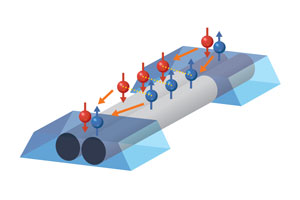
A Josephson junction can split and recombine Cooper pairs of electrons as they travel through two nanowires.

A device that can separate and recombine pairs of electrons may offer a way to study an unusual form of superconductivity, according to RIKEN physicists. This superconducting state would involve exotic particles, Majorana fermions that could prove useful in developing quantum computers.

In conventional superconductors, electrical current flows with no resistance due to electrons teaming up to make ‘Cooper pairs’. A superconductor touching a normal conductor can sometimes induce superconductivity in that conductor through Cooper pairs from the superconductor penetrating the normal conductor.

Now, Sadashige Matsuo of the RIKEN Center for Emergent Matter Science and collea...

Read More
Proton Therapy Lowers Risk of Side Effects in Cancer compared to Traditional Radiation

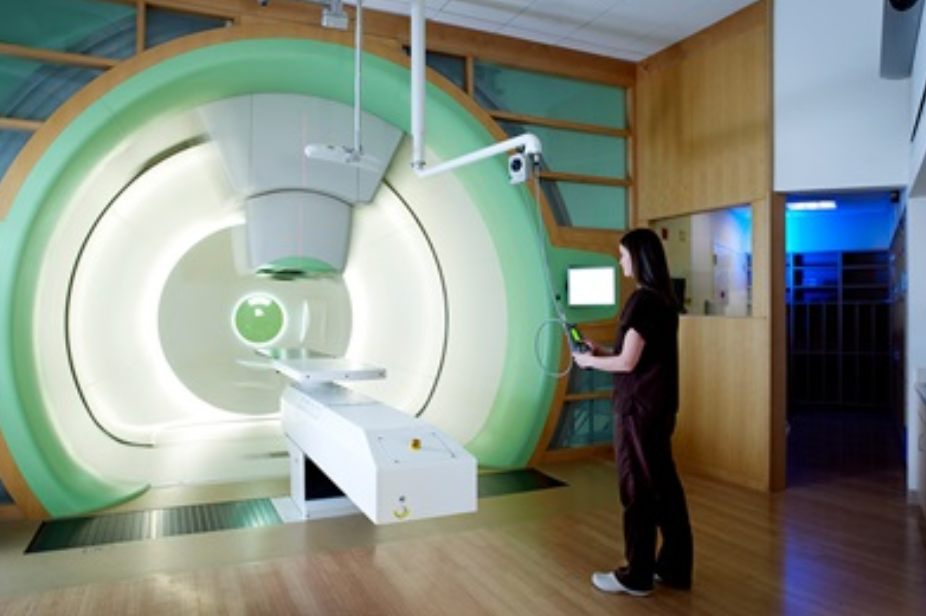
Penn researchers have demonstrated that proton therapy reduces the likelihood of adverse affects among cancer patients also being treated with chemotherapy. The study compared proton therapy patients to those receiving traditional photon radiation. SOURCE/PERELMAN SCHOOL OF MEDICINE

Study found protons led to two-thirds reduction in unplanned hospitalizations. Proton therapy leads to significantly lower risk of side effects severe enough to lead to unplanned hospitalizations for cancer patients when compared with traditional radiation, while cure rates between the two groups are almost identical...

Read More

New Nano-barrier for Composites could Strengthen Spacecraft Payloads

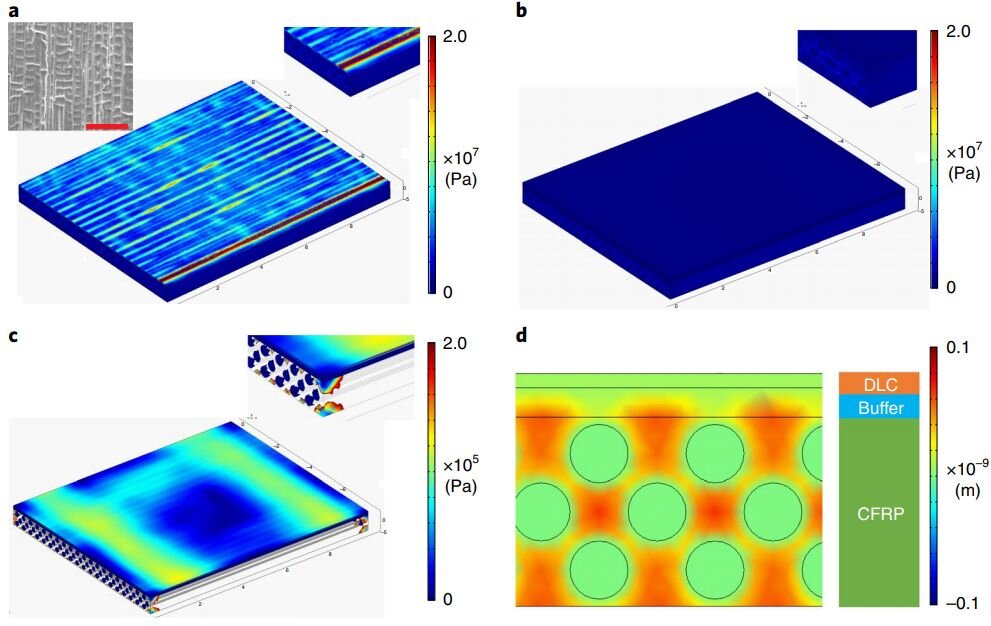
Stress modelling within CFRP and coated components. Credit: Nature Materials (2019). DOI: 10.1038/s41563-019-0565-3

The University of Surrey has developed a robust multi-layed nano-barrier for ultra-lightweight and stable carbon fibre reinforced polymers (CFRPs) that could be used to build high precision instrument structures for future space missions.

CFRP is used in current space missions, but its applications are limited because the material absorbs moisture. This is often released as gas during a mission, causing the material to expand and affect the stability and integrity of the structure. Engineers try to minimise this problem with CFRP by performing long, expensive procedures such as drying, recalibrations and bake-out- all of which may not completely resolve the issue.

...Read More

First Chip-to-Chip Quantum Teleportation harnessing Silicon Photonic Chip Fabrication

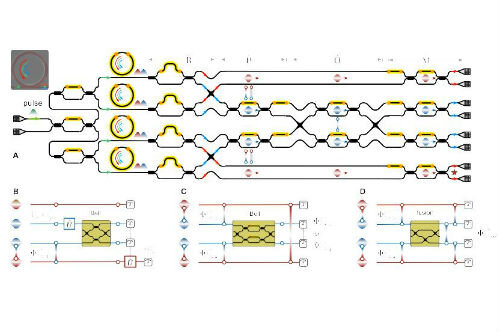
A. Chip Schematic. Black lines represent single mode waveguides for the single photons, red and blue pulses represent the photon energy in each path. Yellow bars represent external phase control. B. Teleportation setup. C. Entanglement swapping setup. D. 4-photon GHZ state preparation. Credit: University of Bristol

The development of technologies which can process information based on the laws of quantum physics are predicted to have profound impacts on modern society. For example, quantum computers may hold the key to solving problems that are too complex for today’s most powerful supercomputers, and a quantum internet could ultimately protect the worlds information from malicious attacks...

Read More