

Over the past decade, deep learning has transformed how artificial intelligence (AI) agents perceive and act in digital environments, allowing them to master board games, control simulated robots and reliably tackle various other tasks...
Read More

October 26, 2025,
 Technology/Electronics, Physics
Over the past decade, deep learning has transformed how artificial intelligence (AI) agents perceive and act in digital environments, allowing them to master board games, control simulated robots and reliably tackle various other tasks...
Read More
October 24, 2025,
Physics
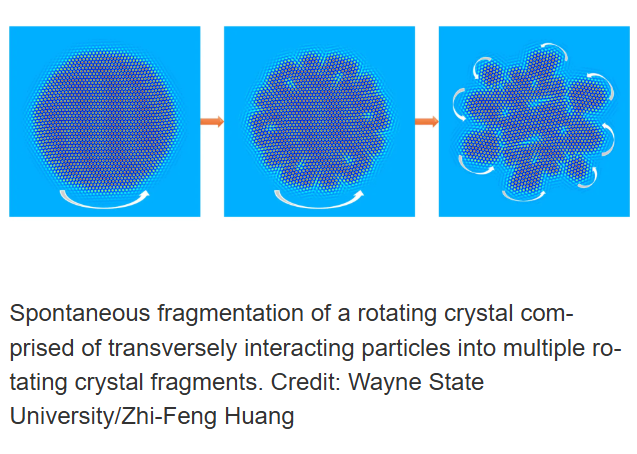
Spinning crystals that twist, shatter, and rebuild themselves may hold the key to next-generation materials.. Physicists have uncovered the fascinating world of “rotating crystals” — solids made of spinning particles that behave in strange, almost living ways. These odd materials can twist instead of stretch, shatter into fragments, and even reassemble themselves.
It may sound unbelievable, but crystals made of rotating particles are real. A group of physicists from Aachen, Düsseldorf, Mainz, and Wayne State University (Detroit, USA) has explored these unusual materials and their remarkable behavior. These crystals can easily split into separate fragments, form unusual grain boundaries, and display controllable structural defects...
Read More
October 23, 2025,
Physics, Technology/Electronics

A research team, led by Professor Heein Yoon in the Department of Electrical Engineering at UNIST has unveiled an ultra-small hybrid low-dropout regulator (LDO) that promises to advance power management in advanced semiconductor devices. This innovative chip not only stabilizes voltage more effectively, but also filters out noise—all while taking up less space—opening new doors for high-performance system-on-chips (SoCs) used in AI, 6G communications, and beyond.
The new LDO combines analog and digital circuit strengths in a hybrid design, ensuring stable power delivery even during sudden changes in current demand—like when launching a game on your smartphone—and effectively blocking unwanted noise from the power supply.
What sets this developmen...
Read More
October 20, 2025,
Physics, Technology/Electronics

King Abdullah University of Science and Technology (KAUST; Saudi Arabia) researchers have set a record in microchip design, achieving the first six-stack hybrid CMOS (complementary metal-oxide semiconductor) for large-area electronics. With no other reported hybrid CMOS exceeding two stacks, the feat marks a new benchmark in integration density and efficiency, opening possibilities in electronic miniaturization and performance.
A paper detailing the team’s research appears in Nature Electronics.
Among microchip technologies, CMOS microchips are found in nearly all electronics, from phones and televisions to satellites and medical devices. Compared with conventional silicon chips, hybrid CMOS microchips hold greater promise for large-area electronics...
Read More
Recent Comments