Category Physics

Dialing in the temperature needed for precise nuclear timekeeping

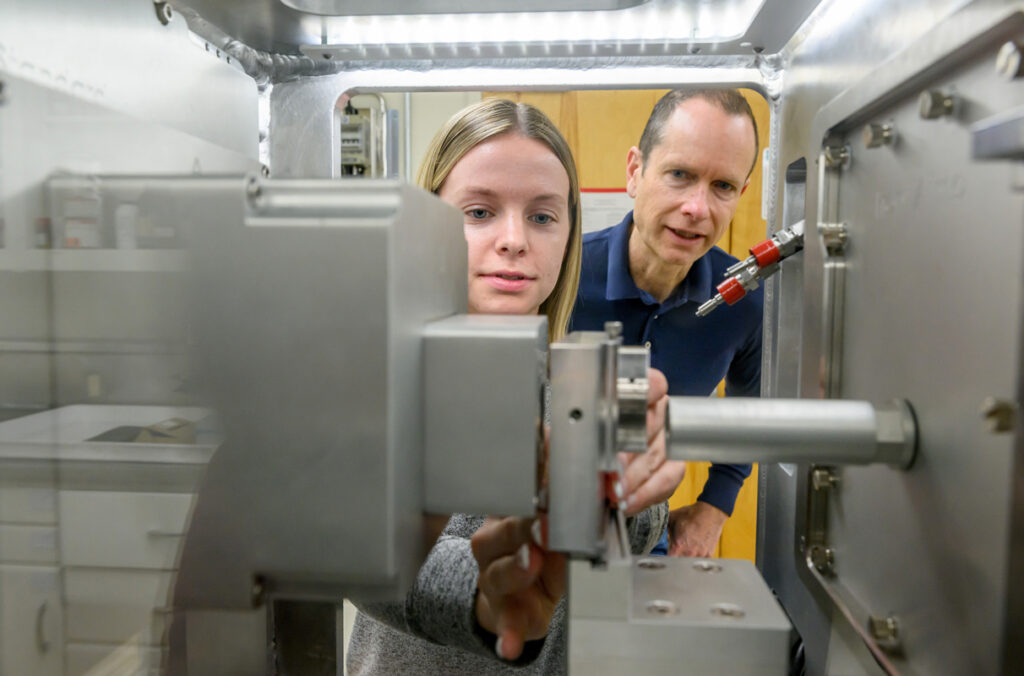
For decades, atomic clocks have been the pinnacle of precision timekeeping, enabling GPS navigation, cutting-edge physics research, and tests of fundamental theories. But researchers at JILA, led by JILA and NIST Fellow and University of Colorado Boulder physics professor Jun Ye, in collaboration with the Technical University of Vienna, are pushing beyond atomic transitions to something potentially even more stable: a nuclear clock.

This clock could revolutionize timekeeping by using a uniquely low-energy transition within the nucleus of a thorium-229 atom. This transition is less sensitive to environmental disturbances than modern atomic clocks and has been proposed for tests of fundamental physics beyond the Standard Model.

This idea isn’t new in Ye’s laboratory...

Read More

New AI model can estimate a person’s true biological age from five drops of blood

Top Left: A small blood sample is analyzed to measure 22 key steroids, and the data is fed into an AI system to calculate biological age. Top Right: The AI-predicted biological age (BA) shows a general correlation with chronological age (CA), but individual differences widen over time. Bottom: Using the metaphor of a “river widening as it flows downstream,” the illustration visualizes how biological age evolves with the passage of time. Credit: Zi Wang

We all know someone who seems to defy aging—people who look younger than their peers despite being the same age. What’s their secret? Scientists at Osaka University (Japan) may have found a way to quantify this difference...

Read More

Holograms with a twist: Entangling light and information

Quantum holograms using polarized light and metasurfaces enable precise control over entangled holographic information, advancing practical applications in quantum communication and anticounterfeiting technologies

Quantum entanglement is a fundamental phenomenon in nature and one of the most intriguing aspects of quantum mechanics. It describes a correlation between two particles, such that measuring the properties of one instantly reveals those of the other, no matter how far apart they are. This unique property has been harnessed in applications such as quantum computing and quantum communication.

A common method for generating entanglement is through a nonlinear crystal, which produces photon pairs with entangled polarizations via spontaneous parametric down-conversion (SPDC)...

Read More

Ultra-broadband photonic chip boosts optical signals to reshape high-speed data transmission

Ultra-broadband photonic chip boosts optical signals
A focus-stacked macro photograph of a fabricated gallium phosphide photonic chip featuring multiple spiral waveguides and other test structures. The chip width is just 0.55 cm across. Due to the high Kerr nonlinearity of gallium phosphide, its high refractive index, and its negligible two-photon absorption, extremely efficient optical parametric amplification and frequency conversion over S, C, and L optical communication bands are achieved using this chip. Credit: Nikolai Kuznetsov (EPFL).

Modern communication networks rely on optical signals to transfer vast amounts of data. But just like a weak radio signal, these optical signals need to be amplified to travel long distances without losing information.

The most common amplifiers, erbium-doped fiber amplifiers (EDFAs), have served...

Read More