Category Technology/Electronics

Scientists Trap Light inside a Magnet

Vinod_Florian magneto-optical research
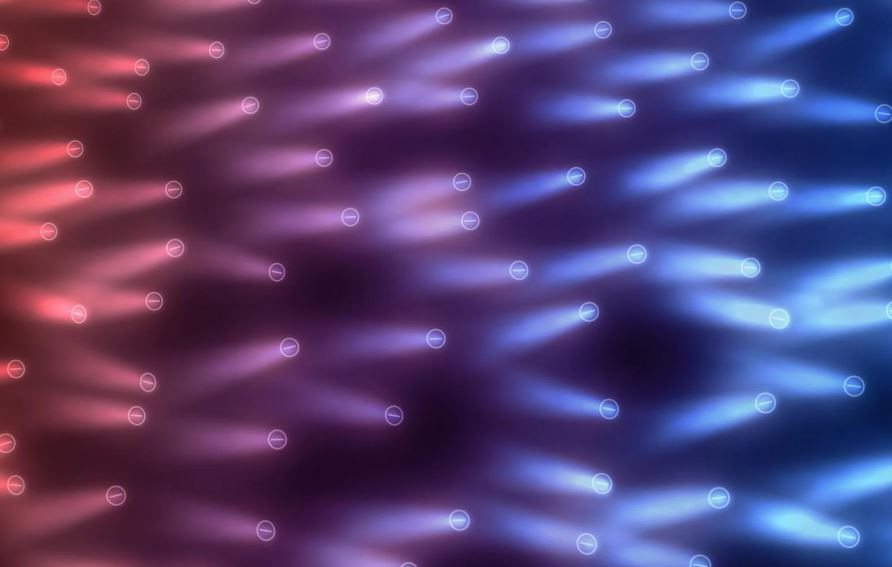
Light trapped inside a magnetic crystal can strongly enhance its magneto-optical interactions. Image created by Rezlind Bushati.

A new study led by Vinod M. Menon and his group at the City College of New York shows that trapping light inside magnetic materials may dramatically enhance their intrinsic properties. Strong optical responses of magnets are important for the development of magnetic lasers and magneto-optical memory devices, as well as for emerging quantum transduction applications.

In their new article in Nature, Menon and his team report the properties of a layered magnet that hosts strongly bound excitons — quasiparticles with particularly strong optical interactions. Because of that, the material is capable of trapping light — all by itself...

Read More

Researchers fabricate Phase-Heterojunction All-Inorganic Perovskite Solar Cells with an Efficiency Above 21.5%

Phase-heterojunction all-inorganic perovskite solar cells with an efficiency above 21.5%
Schematic representation of fabrication of phase-heterojunction perovskite solar cells. Credit: Mali et al.

Solar technologies have become increasingly advanced over the years, with the discovery of new photovoltaic materials and designs. While solar cells based on a mixture of organic and inorganic halide perovskite materials have been the topic of numerous research studies and achieved promising performances, these cells are often difficult to fabricate on a large-scale.

Researchers at Chonnam University in South Korea recently introduced an alternative solar cell design fully based on inorganic perovskites. Their solar cells, introduced in Nature Energy, could be easier to fabricate on a large-scale, while nonetheless achieving promising power conversion efficiencies (PCEs).

“...

Read More

Scientists Discover Novel Way of Reading Data in Antiferromagnets, Unlocking their use as Computer Memory

A microscopic image of the tiny device containing antiferromagnetic manganese bismuth telluride (green) that the Nanyang Technological University, Singapore researchers did their experiments on. The lines (light yellow) radiating from the centre are electrodes from which current was passed through the manganese bismuth telluride. (Image: NTU Singapore)

Scientists led by Nanyang Technological University, Singapore (NTU Singapore) investigators have made a significant advance in developing alternative materials for the high-speed memory chips that let computers access information quickly and that bypass the limitations of existing materials.

They have discovered a way that allows them to make sense of previously hard-to-read data stored in these alternative materials, known as antifer...

Read More

Arrays of Quantum Rods could Enhance TVs or Virtual Reality devices

A blue squiggle-like DNA graphic points down in the center emitting light downwards. Two red DNA graphics are pointed up beside it. A structured array composed of triangular rods lie flat on dark gray surface, while the top rows of the arrays contain pieces resembling red pills.

MIT engineers developed a new way to create these arrays, by scaffolding quantum rods onto patterned DNA. Using scaffolds of folded DNA, engineers assembled arrays of quantum rods with desirable photonic properties that could enable them to be used as highly efficient micro-LEDs for televisions or virtual reality devices.

Flat screen TVs that incorporate quantum dots are now commercially available, but it has been more difficult to create arrays of their elongated cousins, quantum rods, for commercial devices. Quantum rods can control both the polarization and color of light, to generate 3D images for virtual reality devices.

Using scaffolds made of folded DNA, MIT engineers have come up with a new way to precisely assemble arrays of quantum rods...

Read More