
Category Technology/Electronics

Strengthening Electron-triggered Light Emission

Decorative image resembling triangular prism and colorful lights.
Caption: Researchers have found a way to create much stronger interactions between photons and electrons, in the process producing a hundredfold increase in the emission of light from a phenomenon called Smith-Purcell radiation.
Credits:Courtesy of the researchers

A new method can produce a hundredfold increase in light emissions from a type of electron-photon coupling, which is key to electron microscopes and other technologies.

Researchers have found a way to create much stronger interactions between photons and electrons, in the process producing a hundredfold increase in the emission of light from a phenomenon called Smith-Purcell radiation. The finding has potential implications for both commercial applications and fundamental scientific research.

The way electrons interact w...

Read More
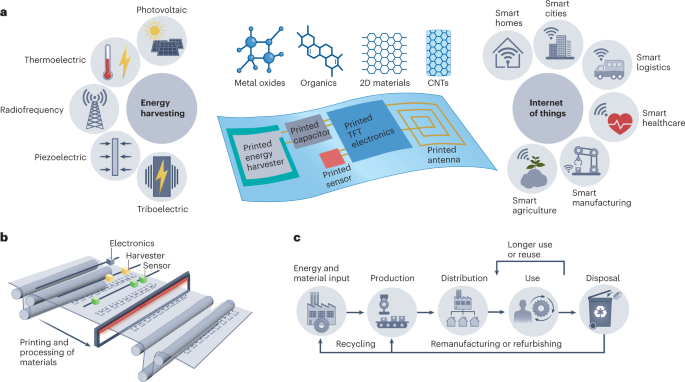

Self-powered, Printable Smart Sensors created from Emerging Semiconductors could mean Cheaper, Greener Internet of Things

Wirelessly powered large-area electronics for the Internet of Things |  Nature Electronics
 LAE sensor nodes for sustainable IoT

Creating smart sensors to embed in our everyday objects and environments for the Internet of Things (IoT) would vastly improve daily life — but requires trillions of such small devices. Simon Fraser University professor Vincenzo Pecunia believes that emerging alternative semiconductors that are printable, low-cost and eco-friendly could lead the way to a cheaper and more sustainable IoT.

Leading a multinational team of top experts in various areas of printable electronics, Pecunia has identified key priorities and promising avenues for printable electronics to enable self-powered, eco-friendly smart sensors. His forward-looking insights are outlined in his paper published on Dec. 28 in Nature Electronics.

“Equipping everyday objects and envir...

Read More

A Greener Internet of Things with No Wires attached

A greener internet of things with no wires attached
Wirelessly powered electronics developed by KAUST researchers could help to make internet of things technology more environmentally friendly. Credit: © 2022 KAUST; Heno Hwang

Emerging forms of thin-film device technologies that rely on alternative semiconductor materials, such as printable organics, nanocarbon allotropes and metal oxides, could contribute to a more economically and environmentally sustainable IoT, a KAUST-led international team suggests.

Their paper is published in the journal Nature Electronics.

The IoT is set to have a major impact on daily life and many industries...

Read More

Nanoimprinting Technique for Humidity-Responsive Holographic Images

A magical display that projects holographic images that change when in contact with water has been developed. This new technology increases the possibility of commercialization as it can infinitely imprint holographic images.

A POSTECH research team led by Professor Junsuk Rho (Department of Mechanical Engineering and Department of Chemical Engineering) and Ph.D. candidates Byoungsu Ko, Younghwan Yang, Jaekyung Kim, and Dr. Trevon Badloe has developed a technology for a humidity-responsive display that changes in brightness and color depending on the degree of humidity.

The team first successfully realized holographic images with tunable brightness using polyvinyl alcohol (PVA)...

Read More