Category Technology/Electronics

Green Information Technologies: Superconductivity meets Spintronics

Credit: CC0 Public Domain

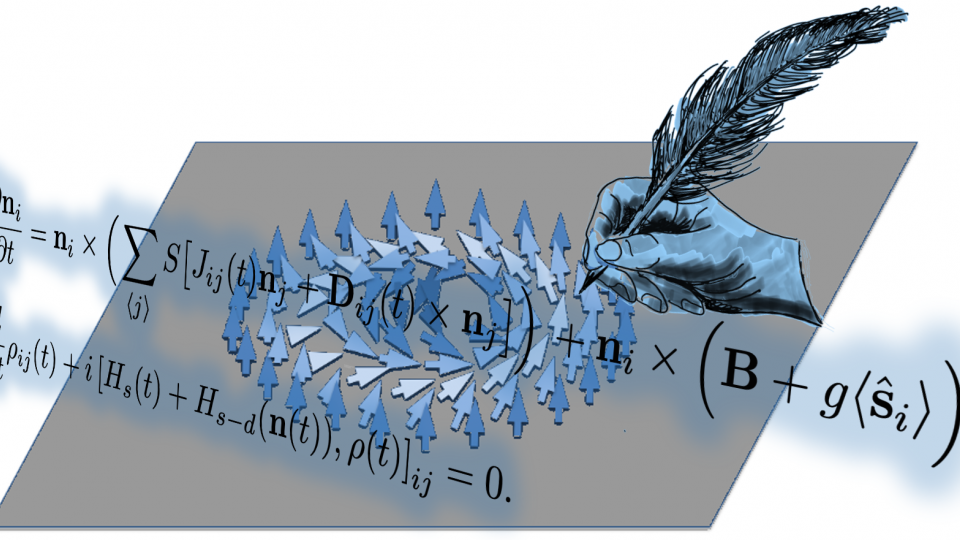
When two superconducting regions are separated by a strip of non-superconducting material, a special quantum effect can occur, coupling both regions: The Josephson effect. If the spacer material is a half-metal ferromagnet novel implications for spintronic applications arise. An international team has now for the first time designed a material system that exhibits an unusually long-range Josephson effect: Here, regions of superconducting YBa2Cu3O7 are separated by a region of half-metallic, ferromagnetic manganite (La2/3Sr1/3MnO3) one micron wide.

With the help of magneto-transport measurements, the researchers were able to demonstrate the presence of a supercurrent circulating through the manganite — this supercurrent is arising from the superconducting co...

Read More

3D Laser Nanoprinters become Compact

Electron microscopic reconstruction of a 3D nanostructure printed with the 2-step absorption process (left) and light microscopy (right). (Photo: Professor Rasmus Schröder, University of Heidelberg, Vincent Hahn, KIT)

Lasers in conventional laser printers for paper printouts are very small. 3D laser printers for 3-dimensional microstructures and nanostructures, by contrast, have required big and expensive laser systems so far. Researchers of Karlsruhe Institute of Technology (KIT) and the Heidelberg University now use another process for this purpose. Two-step absorption works with inexpensive and small, blue laser diodes. As a result, much smaller printers can be used. Work is reported in Nature Photonics.

Presently, laser printing is the method of choice for additive manufacture ...

Read More

Researchers propose a Simpler Design for Quantum Computers

An animation of the photonic quantum computer proposed by the researchers. On the left is the storage ring, which holds several counter-propagating photons. On the right is the scattering unit, which is used to manipulate the photonic qubits. The spheres at the top, called “Bloch spheres,” depict the mathematical state of the atom and one of the photons. Because the atom and the photon are entangled, manipulating the atom also affects the state of the photon. (Image credit: Ben Bartlett)

Today’s quantum computers are complicated to build, difficult to scale up, and require temperatures colder than interstellar space to operate. These challenges have led researchers to explore the possibility of building quantum computers that work using photons—particles of light...

Read More

New Device Modulates light a Light Without Dimming it—with the Smallest Footprint and Lowest Power Consumption

A visible-spectrum phase modulator (the ring at the center of a radius of 10 microns) is tinier than a butterfly wing scale. Photo credit: Heqing Huang and Cheng-Chia Tsai/Columbia Engineering

Engineers have invented a breakthrough visible-spectrum, compact, power-efficient, low-loss phase modulator – a breakthrough in integrated photonics; the device will improve LIDAR for remote sensing, AR/VR goggles, quantum information processing chips, implantable optogenetic probes, and more.

Over the past several decades, researchers have moved from using electric currents to manipulating light waves in the near-infrared range for telecommunications applications such as high-speed 5G networks, biosensors on a chip, and driverless cars...

Read More